• Fri frakt över 249 kr
  • •
  • Snabba leveranser
  • •
  • Billiga böcker
Kundservice

Du är på sajten för privatpersoner.

Företag, bibliotek eller offentlig verksamhet?

Du handlar på classic.bokus.com, där alla dina funktioner finns intakta.
Till classic.bokus.com
Bokus logotyp. Gå till startsidan.
  • Erbjudanden
  • Student
  • Topplistor
  • Barn & ungdom
  • Bokus Play
  • E-böcker
  • Ljudböcker
  • Pocketböcker
  • Spel & pussel

Upp till 25% på utvalda nyheter →

Sidfot

Mina sidor

    Hjälp

    • Kundservice
    • Vanliga frågor och svar
    • Frakt och leverans
    • Retur vid ångerrätt
    • Reklamera vara
    • Betalning
    • Köpvillkor
    • Allmänna villkor
    • Information om webbplatsens tillgänglighet

    Om Bokus

    • Om oss
    • Pressrum
    • För studenter
    • För företag
    • För bibliotek och offentlig verksamhet
    • För leverantörer
    • Hållbarhet

    Populärt

    • Aktuella erbjudanden
    • Presentkort
    • Studentlitteratur
    • Nya böcker
    • Topplistor
    • Signerade böcker
    • Engelska böcker

    Inspiration

    • Boktips
    • BookTok
    • Populära bokserier
    • Barnbokskaraktärer
    • Populära författare
    Logotyp för Bokus
    Följ oss på Facebook (extern länk)Följ oss på Instagram (extern länk)Följ oss på YouTube (extern länk)Följ oss på TikTok (extern länk)
    bokus @ CookiesAnpassa cookiesIntegritetspolicyKöpvillkor
    Till Citymail hemsida (extern länk)Till Budbee hemsida (extern länk)Till Postnord hemsida (extern länk)Till Schenker hemsida (extern länk)Till Early Bird hemsida (extern länk)Till Walleys hemsida (extern länk)
    1. Juridik
    2. Särskilda rättsområden
    3. Bolags-, handels- och konkurrensrätt
    4. Handelsrätt

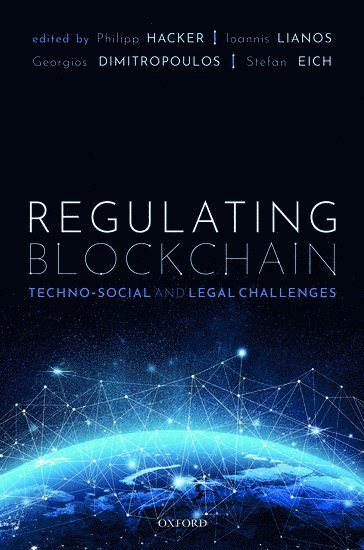
    Regulating Blockchain

    Techno-Social and Legal Challenges

    AvLianos Et Al,Philipp Hacker

    Inbunden, Engelska, 2019

    1 760 kr

    Beställningsvara. Skickas inom 5-8 vardagar. Fri frakt över 249 kr.

    Beskrivning

    Less than a decade after the Financial Crisis, we are witnessing the fast emergence of a new financial order driven by three different, yet interconnected, dynamics: first, the rapid application of technology - such as big data, machine learning, and distributed computing - to banking, lending, and investing, in particular with the emergence of virtual currencies and digital finance; second, a disintermediation fuelled by the rise of peer-to-peer lending platforms and crowd investment which challenge the traditional banking model and may, over time, lead to a transformation of the way both retail and corporate customers bank; and, third, a tendency of de-bureaucratisation under which new platforms and technologies challenge established organisational patterns that regulate finance and manage the money supply.These changes are to a significant degree driven by the development of blockchain technology. The aim of this book is to understand the technological and business potential of the blockchain technology and to reflect on its legal challenges. The book mainly focuses on the challenges blockchain technology has so far faced in its first application in the areas of virtual money and finance, as well as those that it will inevitably face (and is partially already facing, as the SEC Investigative Report of June 2017 and an ongoing SEC securities fraud investigation show) as its domain of application expands in other fields of economic activity such as smart contracts and initial coin offerings. The book provides an unparalleled critical analysis of the disruptive potential of this technology for the economy and the legal system and contributes to current thinking on the role of law in harvesting and shaping innovation.

    Produktinformation

    • Utgivningsdatum:2019-08-29
    • Mått:175 x 251 x 32 mm
    • Vikt:968 g
    • Format:Inbunden
    • Språk:Engelska
    • Antal sidor:460
    • Förlag:OUP OXFORD
    • ISBN:9780198842187

    Utforska kategorier

    • Handelsrätt inom Juridik
    • Finansrätt inom Juridik
    • IT-rätt och kommunikationsrätt inom Juridik

    Mer om författaren

    Philipp Hacker, LL.M. (Yale), is a postdoctoral fellow at the law department of Humboldt University of Berlin, an A.SK Fellow at WZB Berlin Social Sciences Center and a Research Fellow at the Centre for Blockchain Technologies and at the Centre for Law, Economics and Society, both at UCL.Ioannis Lianos holds the chair of global competition law and policy at UCL Laws. He is also Director of the Centre for Law, Economics and Society and Executive Director of the Jevons Institute of Competition Law and Economics. He was awarded a Gutenberg Research chair at the Ecole Nationale d'Administration (ENA), the elite public administration school of the French republic in November 2011 and was appointed in 2015 chief researcher at the Skolkovo Institute for Law and Development, the leading innovation law centre at the Russian Federation. He is also a visiting professor at the University of Chile in Santiago, the Centre for Industrial Property Studies (CEIPI) at the University of Strasbourg and has been an Alexander von Humboldt fellow at the WZB and Humboldt University, Berlin, as well as an Emile Noel fellow at NYU Law School and a visiting fellow at the University of California, Berkeley.Georgios Dimitropoulos is an Assistant Professor of Law at HBKU College of Law & Public Policy. Georgios studied Law at the University of Athens, and holds an LLM from Yale Law School, and a PhD summa cum laude from the University of Heidelberg.Stefan Eich is the Perkins-Cotsen Postdoctoral Fellow in the Princeton Society of Fellows and a Lecturer in Politics at Princeton University. Stefan's research interests are in political theory and the history of political thought.

    Recensioner i media

    The book provides an excellent survey of the legal implications of blockchain, and of the legal challenges FinTech entrepreneurs are facing when they want to develop blockchain applications. It shows that blockchain clearly is not the answer to everything, but that it can make a difference in many aspects of FinTech and beyond.

    Innehållsförteckning

    • Philipp Hacker, Ioannis Lianos, Georgios Dimitropoulos and Stefan Eich: Regulating Blockchain: Techno-Social and Legal Challenges - An Introduction Part I: Technological and Business Challenges of Blockchain Technology 1: Paolo Tasca and Riccardo Piselli: The Blockchain Paradox 2: Aaron Wright and Jonathan Rohr: Blockchains, Private Ordering and The Future of Governance 3: Angela Walch: In Code(rs) We Trust: Software Developers as Fiduciaries in Public Blockchains Part II: Blockchain and the Future of Money 4: Stefan Eich: Old Utopias, New Tax Havens: The Politics of Bitcoin in Historical Perspective 5: Claus D. Zimmermann: Monetary Policy in the Digital Age 6: Georgios Dimitropoulos: Global Currencies and Domestic Regulation: Embedding through Enabling? 7: Philipp Hacker: Corporate Governance for Complex Cryptocurrencies? A Framework for Stability and Decision Making in Blockchain-Based Organizations Part III: Blockchain and the Future of Banking, Finance, Insurance and Securities Regulation 8: Rohan Grey: Banking in a Digital Fiat Currency Regime 9: Jonathan Greenacre: Regulating the Shadow Payment System: Bitcoin, Mobile Money and Beyond 10: Michael Abramowicz: Blockchain-Based Insurance 11: Alexandros Seretakis: Blockchain, Securities Markets and Central Banking 12: Philipp Hacker and Chris Thomale: The Crypto-Security: Initial Coin Offerings and EU Securities Regulation 13: Houman Shadab: Regulation of Blockchain Token Sales in the United States Part IV: Beyond Finance: Blockchain as a legal and regulatory challenge 14: Agnieszka Janczuk-Gorywoda: Blockchain and Payment Systems: A Tale about Re-Intermediation 15: Florian Möslein: Conflicts of Laws and Codes: Defining the Boundaries of Digital Jurisdictions 16: Pietro Ortolani: The Judicialisation of Blockchain 17: Roger Brownsword: Smart Contracts: Coding the Transaction, Decoding the Legal Debates Part V: Connecting the Dots: Competitive Advantage and Regulation in the Era of Blockchain 18: Ioannis Lianos: Blockchain Competition. Gaining Competitive Advantage in the Digital Economy: Competition Law Implications