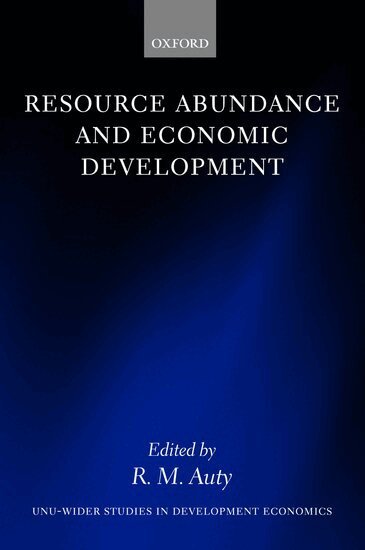
Häftad, Engelska, 2004
Resource Abundance and Economic Development
Av R. M. Auty
1943 kr
Skickas inom 5-8 vardagar
Beskrivning
Since the 1960s the per capita incomes of the resource-poor countries have grown significantly faster than those of the resource-abundant countries. In fact, in recent years economic growth has been inversely proportional to the share of natural resource rents in GDP, so that the small mineral-driven economies have performed least well and the oil-driven economies worst of all. Yet the mineral-driven resource-rich economies have high growth potential because the mineral exports boost their capacity to invest and to import."Resource Abundance and Economic Development" explains the disappointing performance of resource-abundant countries by extending the growth accounting framework to include natural and social capital. The resulting synthesis identifies two contrasting development trajectories: the competitive industrialization of the resource-poor countries and the staple trap of many resource-abundant countries. The resource-poor countries are less prone to policy failure than the resource-abundant countries because social pressures force the political state to align its interests with the majority poor and follow relatively prudent policies. Resource-abundant countries are more likely to engender political states in which vested interests vie to capture resource surpluses (rents) at the expense of policy coherence. A longer dependence on primary product exports also delays industrialization, heightens income inequality, and retards skill accumulation. Fears of 'Dutch disease' encourage efforts to force industrialization through trade policy to protect infant industry. The resulting slow-maturing manufacturing sector demands transfers from the primary sector that outstrip the natural resource rents and sap the competitiveness of the economy. The chapters in this collection draw upon historical analysis and models to show that a growth collapse is not the inevitable outcome of resource abundance and that policy counts. Malaysia, a rare example of successful resource-abundant development, is contrasted with Ghana, Bolivia, Saudi Arabia, Mexico, and Argentina, which all experienced a growth collapse. The book also explores policies for reviving collapsed economies with reference to Costa Rica, South Africa, Russia and Central Asia. It demonstrates the importance of initial conditions to successful economic reform.
Produktinformation
- Utgivningsdatum: 2004-10-07
- Mått: 156 x 235 x 20 mm
- Vikt: 549 g
- Format: Häftad
- Språk: Engelska
- Antal sidor: 360
- Förlag: OUP OXFORD
- Serie: WIDER Studies in Development Economics
- ISBN: 9780199275786
Utforska kategorier
Betyg & recensioner
0 recensioner
Inga recensioner tillgängliga.