• Fri frakt över 249 kr
  • •
  • Snabba leveranser
  • •
  • Billiga böcker
Kundservice

Du är på sajten för privatpersoner.

Företag, bibliotek eller offentlig verksamhet?

Du handlar på classic.bokus.com, där alla dina funktioner finns intakta.
Till classic.bokus.com
Bokus logotyp. Gå till startsidan.
  • Erbjudanden
  • Nyheter
  • Student
  • Topplistor
  • Barn & ungdom
  • Bokus Play
  • E-böcker
  • Pocketböcker
  • Spel & pussel

10% rabatt på allt med kod NYSTART10 →

Sidfot

Mina sidor

    Hjälp

    • Kundservice
    • Vanliga frågor och svar
    • Frakt och leverans
    • Retur vid ångerrätt
    • Reklamera vara
    • Betalning
    • Köpvillkor
    • Allmänna villkor
    • Information om webbplatsens tillgänglighet

    Om Bokus

    • Om oss
    • Pressrum
    • För studenter
    • För företag
    • För bibliotek och offentlig verksamhet
    • För leverantörer
    • Hållbarhet

    Populärt

    • Aktuella erbjudanden
    • Presentkort
    • Studentlitteratur
    • Nya böcker
    • Topplistor
    • Signerade böcker
    • Engelska böcker

    Inspiration

    • Boktips
    • BookTok
    • Populära bokserier
    • Barnbokskaraktärer
    • Populära författare
    Logotyp för Bokus
    Följ oss på Facebook (extern länk)Följ oss på Instagram (extern länk)Följ oss på YouTube (extern länk)Följ oss på TikTok (extern länk)
    bokus @ CookiesAnpassa cookiesIntegritetspolicyKöpvillkor
    Till Citymail hemsida (extern länk)Till Budbee hemsida (extern länk)Till Postnord hemsida (extern länk)Till Schenker hemsida (extern länk)Till Early Bird hemsida (extern länk)Till Walleys hemsida (extern länk)
    1. Psykologi och pedagogik
    2. Psykologi
    3. Socialpsykologi och gruppsykologi

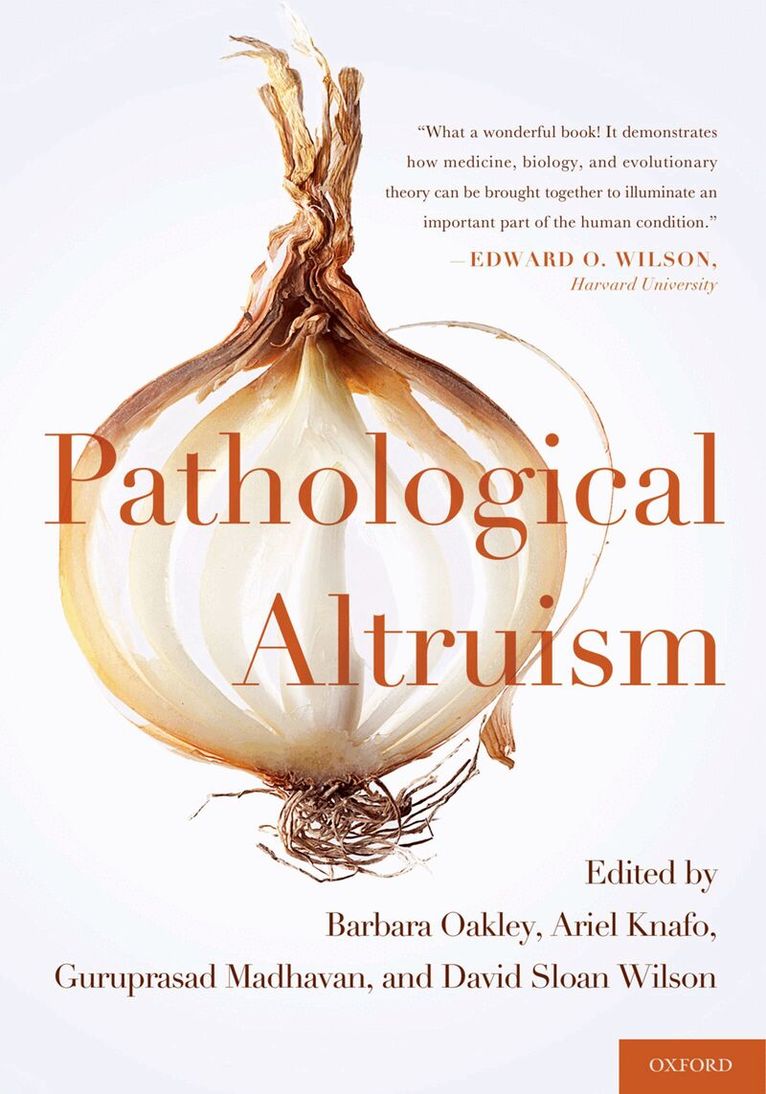
    Pathological Altruism

    AvBarbara Oakley,Ariel Knafo

    Inbunden, Engelska, 2012

    1 697 kr

    Beställningsvara. Skickas inom 5-8 vardagar. Fri frakt över 249 kr.

    Beskrivning

    The benefits of altruism and empathy are obvious. These qualities are so highly regarded and embedded in both secular and religious societies that it seems almost heretical to suggest they can cause harm. Like most good things, however, altruism can be distorted or taken to an unhealthy extreme. Pathological Altruism presents a number of new, thought-provoking theses that explore a range of hurtful effects of altruism and empathy. Pathologies of empathy, for example, may trigger depression as well as the burnout seen in healthcare professionals. The selflessness of patients with eating abnormalities forms an important aspect of those disorders. Hyperempathy - an excess of concern for what others think and how they feel - helps explain popular but poorly defined concepts such as codependency. In fact, pathological altruism, in the form of an unhealthy focus on others to the detriment of one's own needs, may underpin some personality disorders.Pathologies of altruism and empathy not only underlie health issues, but also a disparate slew of humankind's most troubled features, including genocide, suicide bombing, self-righteous political partisanship, and ineffective philanthropic and social programs that ultimately worsen the situations they are meant to aid. Pathological Altruism is a groundbreaking new book - the first to explore the negative aspects of altruism and empathy, seemingly uniformly positive traits. The contributing authors provide a scientific, social, and cultural foundation for the subject of pathological altruism, creating a new field of inquiry. Each author's approach points to one disturbing truth: what we value so much, the altruistic "good" side of human nature, can also have a dark side that we ignore at our peril.

    Produktinformation

    • Utgivningsdatum:2012-01-05
    • Mått:175 x 257 x 27 mm
    • Vikt:980 g
    • Format:Inbunden
    • Språk:Engelska
    • Antal sidor:496
    • Förlag:OUP USA
    • ISBN:9780199738571

    Utforska kategorier

    • Socialpsykologi och gruppsykologi inom Psykologi och pedagogik
    • Psykiatri inom Medicin

    Mer om författaren

    Barbara Oakley is an associate professor of engineering at Oakland University in Michigan. Her work focuses on the complex relationship between social behavior and neuroscience. Her books include Cold-Blooded Kindness (Prometheus Books, 2011) and Evil Genes (Prometheus Books, 2007).Ariel Knafo is a senior lecturer in psychology at the Hebrew University of Jerusalem. His research deals with the genetic and environmental contributions to empathy and altruism and how children's genetics affect their behavior and the way parents react to them.Guruprasad Madhavan, a bioengineer, is a program officer in policy and global affairs at the National Academy of Sciences, National Academy of Engineering, Institute of Medicine, and the National Research Council - collectively called the National Academies - in Washington, DC. He is senior co-editor of Career Development in Bioengineering and Biotechnology (Springer, 2008).David Sloan Wilson is SUNY Distinguished Professor of Biology and Anthropology at Binghamton University. His books include The Neighborhood Project (Little, Brown, 2011), Evolution for Everyone (Delacorte, 2007), Darwin's Cathedral (Chicago, 2002), and Unto Others (Harvard,1998).

    Recensioner i media

    Scholarly yet surprisingly sprightly volume

    Innehållsförteckning

    • Part I: The Psychology of Altruism ; Chapter 1: Pathological Altruism - An Introduction ; Barbara Oakley, Ariel Knafo, and Michael McGrath ; Chapter 2: Empathy-Based Pathogenic Guilt, Pathological Altruism, and Psychopathology ; Lynn E. O'Connor, Jack W. Berry, Thomas Lewis, David J. Stiver ; Chapter 3: A Contextual Behavioural Approach to Pathological Altruism ; Roger Vilardaga and Steven C. Hayes ; Chapter 4: Codependency and Pathological Altruism ; Michael McGrath ; Part II: Psychiatric Implications of Pathological Altruism ; Chapter 5: Self-Addiction and Self-Righteousness ; By David Brin ; Chapter 6: Pathological Altruism and Personality Disorder ; Thomas A. Widiger and Jennifer Ruth Presnall ; Chapter 7: The relevance of pathological altruism to eating disorders ; Rachel Bachner-Melman ; Chapter 8: Animal Hoarding: How the Semblance of a Benevolent Mission Becomes Actualized as Egoism and Cruelty ; Jane N. Nathanson and Gary J. Patronek ; Chapter 9: Everyone's friend? The case of Williams syndrome ; Deborah M Riby, Vicki Bruce, & Ali Jawaid ; Part III. Societal implications of pathological altruism ; Chapter 10: Pathological Certitude ; Robert Burton ; Chapter 11: Altruism and Suffering in the Context of Cancer: Implications of a Relational Paradigm ; Madeline Li, Gary Rodin ; Chapter 12: Considering Pathological Altruism in the Law from Therapeutic Jurisprudence and Neuroscience Perspectives ; Michael L. Perlin ; Chapter 13: Pathological Altruism: Victims and Motivational Types ; Brent E. Turvey ; Chapter 14: Does No Good Deed Go Unpunished? The Victimology of Altruism ; Robert J. Homant and Daniel B. Kennedy ; Chapter 15: Suicide Attack Martyrdoms: Temperament and Mindset of Altruistic Warriors ; Adolf Tobena ; Chapter 16: Genocide: From pathological altruism to pathological obedience ; Augustine Brannigan ; Chapter 17: Too Much of a Good Thing? Foreign Aid and Pathological Altruism ; Guruprasad Madhavan and Barbara Oakley ; Chapter 18: Was Gandhi A "Pathological Altruist"? ; Arun Gandhi ; Chapter 19: A Contrarian Perspective on Altruism: The Dangers of First Contact ; David Brin ; Chapter 20: Is Pathological Altruism Altruism? ; Bernard Berofsky ; Chapter 21: Altruism, Pathology, and Culture ; John W. Traphagan ; Part IV. Cultural and evolutionary dimensions of pathological altruism ; Chapter 22: Culture-gene coevolution of empathy and altruism ; Joan Y. Chiao, Katherine D. Blizinsky, Vani A. Mathur, Bobby K. Cheon ; Chapter 23: The Messianic Effect of Pathological Altruism ; Jorge M. Pacheco and Francisco C. Santos ; Chapter 24: Battered Women, Happy Genes: There Is No Such Thing as Altruism, Pathological or Otherwise ; Satoshi Kanazawa ; Part V. The development and underlying brain processes of pathological altruism ; Chapter 25: Empathy, Guilt, and Depression: When Caring for Others Becomes Costly to Children ; Carolyn Zahn-Waxler & Carol Van Hulle ; Chapter 26: Autism, Empathizing-Systemizing (E-S) Theory, and Pathological Altruism ; Simon Baron-Cohen ; Chapter 27: Seduction Super-Responders and Hyper-Trusters: The Biology of Affiliative Behavior ; Karol M. Pessin ; Chapter 28: Empathic Distress Fatigue Rather than Compassion Fatigue? - Integrating Findings from Empathy Research in Psychology and Social Neuroscience ; Olga Klimecki and Tania Singer ; Part VI. Synthesis of views on pathological altruism ; Chapter 29: Hell's angels-a runaway model of pathological altruism ; Marc D. Hauser ; Chapter 30: Altruism gone mad ; Joachim I. Krueger ; Chapter 31: Pathology, Evolution, and Altruism ; David Sloan Wilson