• Fri frakt över 249 kr
  • •
  • Snabba leveranser
  • •
  • Billiga böcker
Kundservice

Du är på sajten för privatpersoner.

Företag, bibliotek eller offentlig verksamhet?

Du handlar på classic.bokus.com, där alla dina funktioner finns intakta.
Till classic.bokus.com
Bokus logotyp. Gå till startsidan.
  • Erbjudanden
  • Nyheter
  • Student
  • Topplistor
  • Barn & ungdom
  • Bokus Play
  • E-böcker
  • Pocketböcker
  • Spel & pussel

10% rabatt på allt med kod NYSTART10 →

Sidfot

Mina sidor

    Hjälp

    • Kundservice
    • Vanliga frågor och svar
    • Frakt och leverans
    • Retur vid ångerrätt
    • Reklamera vara
    • Betalning
    • Köpvillkor
    • Allmänna villkor
    • Information om webbplatsens tillgänglighet

    Om Bokus

    • Om oss
    • Pressrum
    • För studenter
    • För företag
    • För bibliotek och offentlig verksamhet
    • För leverantörer
    • Hållbarhet

    Populärt

    • Aktuella erbjudanden
    • Presentkort
    • Studentlitteratur
    • Nya böcker
    • Topplistor
    • Signerade böcker
    • Engelska böcker

    Inspiration

    • Boktips
    • BookTok
    • Populära bokserier
    • Barnbokskaraktärer
    • Populära författare
    Logotyp för Bokus
    Följ oss på Facebook (extern länk)Följ oss på Instagram (extern länk)Följ oss på YouTube (extern länk)Följ oss på TikTok (extern länk)
    bokus @ CookiesAnpassa cookiesIntegritetspolicyKöpvillkor
    Till Citymail hemsida (extern länk)Till Budbee hemsida (extern länk)Till Postnord hemsida (extern länk)Till Schenker hemsida (extern länk)Till Early Bird hemsida (extern länk)Till Walleys hemsida (extern länk)
    1. Filosofi och religion
    2. Filosofi

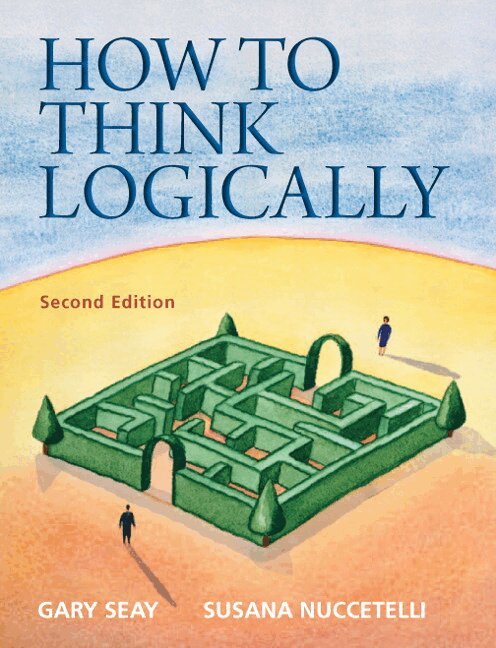
    How to Think Logically

    AvGary Seay,Susana Nuccetelli

    Häftad, Engelska, 2012

    1 452 kr

    Beställningsvara. Skickas inom 3-6 vardagar. Fri frakt över 249 kr.

    Beskrivning

    ALERT: Before you purchase, check with your instructor or review your course syllabus to ensure that you select the correct ISBN. Several versions of Pearson's MyLab & Mastering products exist for each title, including customized versions for individual schools, and registrations are not transferable. In addition, you may need a CourseID, provided by your instructor, to register for and use Pearson's MyLab & Mastering products.

    Packages

    Access codes for Pearson's MyLab & Mastering products may not be included when purchasing or renting from companies other than Pearson; check with the seller before completing your purchase.

    Used or rental books

    If you rent or purchase a used book with an access code, the access code may have been redeemed previously and you may have to purchase a new access code.

    Access codes

    Access codes that are purchased from sellers other than Pearson carry a higher risk of being either the wrong ISBN or a previously redeemed code. Check with the seller prior to purchase.

    --

    Concise Principles of Reasoning

    Concise, yet covering all the basics of a 15-week course in informal logic or critical reasoning, this text engages students with a lively format and clear writing style. The small scale of the book keeps the cost low, a vital consideration in today’s economy, yet without compromising on logical rigor.

    The author’s presentation strikes a careful balance: it offers clear, jargon-free writing while preserving rigor. Brimming with numerous pedagogical features, this accessible text assists students with analysis, reconstruction, and evaluation of arguments and helps them become independent, analytical thinkers. Introductory students are exposed to the basic principles of reasoning while also having their appetites whetted for future courses in philosophy.

    Teaching and Learning Experience

    Improve Critical Thinking - Abundant pedagogical aids -- including exercises and study questions within each chapter -- encourage students to examine their assumptions, discern hidden values, evaluate evidence, assess their conclusions, and more!

    Engage Students - Chapter and section outlines, summaries, illustrative examples, special-emphasis boxes and key terms present new ideas in manageable-sized units of information so students can digest each concept before moving on to the next one, and ensure students key-in on crucial points to remember.

    Support Instructors -Teaching your course just got easier! You can create a Customized Text or use our Instructor’s Manual, or PowerPoint Presentation Slides. Plus, this concise textbook contains only as much material as you can cover in a course, creating an affordable alternative you can assign with confidence to a cost-conscious student population. Additionally, each chapter in How to Think Logically is designed as a self-contained unit so that you can choose the combination and order of chapters according to the needs of your courses; making the text a flexible base for courses in logic, critical thinking, and rhetoric.

    Produktinformation

    • Utgivningsdatum:2012-03-02
    • Mått:177 x 231 x 14 mm
    • Vikt:520 g
    • Format:Häftad
    • Språk:Engelska
    • Antal sidor:416
    • Upplaga:2
    • Förlag:Pearson Education
    • ISBN:9780205154982

    Utforska kategorier

    • Filosofi inom Filosofi och religion

    Mer om författaren

    In This Section:I. Author BioII. Author LetterI. Author BioGary Seay has taught formal and informal logic since 1979 at the City University of New York, where he is presently professor of philosophy at Medgar Evers College. His articles on moral philosophy and bioethics have appeared in The American Philosophical Quarterly, The Journal of Value Inquiry, The Journal of Medicine and Philosophy, and The Cambridge Quarterly of Healthcare Ethics, among other journals. With Susana Nuccetelli, he is editor of Themes from G. E. Moore: New Essays in Epistemology and Ethics (Oxford University Press, 2007), Philosophy of Language: The Central Topics (Rowman & Littlefield, 2007), and Latin American Philosophy: An Introduction With Readings (Prentice Hall, 2004). Gary Seay may be contacted at garys@mec.cuny.edu. For more information about his work, visit http://www.mec.cuny.edu/academic_affairs/libarts_ed_school/phil_rel_dept/seay_bio.asp.Susana Nuccetelliis professor of philosophy at St. Cloud State University in Minnesota. Her essays in epistemology and philosophy of language have appeared in Analysis, The American Philosophical Quarterly, Metaphilosophy, The Philosophical Forum, Inquiry, and The Southern Journal of Philosophy, among other journals. She is editor of New Essays in Semantic Externalism and Self-Knowledge (MIT Press, 2003) and author of Latin American Thought: Philosophical Problems and Arguments (Westview Press, 2002). She is co-editor of The Blackwell Companion to Latin American Philosophy (Blackwell, 2009) and, with Gary Seay, Ethical Naturalism: Current Debates (Cambridge University Press, forthcoming, 2011). Susana Nuccetelli may be contacted at snuccetelli@stcloudstate.edu. For more information about her work, visit http://web.stcloudstate.edu/sinuccetelli/.II. Author LetterDear Colleague,Now in a new Second Edition, How to Think Logically is a concise and user-friendly textbook for freshman-level logic and critical thinking courses. Focused throughout on arguments and how we may evaluate them, the book is intended to show students how to distinguish between arguments that ought to persuade us and those that should not. It presents students with criteria for assessing both deductive and inductive reasoning, and it does so in a clear writing style much praised by our students. "This book is well written and structured," students have told us again and again over the ten semesters since it first appeared. "It’s easy to understand."We believe that critical thinking skills are more vital than ever as a component of a liberal education. In a world where college graduates face increasingly fierce competition for jobs, those who are careful reasoners, lucid writers, and clear-headed thinkers are simply better equipped to succeed in any area of specialization. Learning these skills, however, should not be a dry, dull process, but an exercise leavened with humor and down-to-earth examples that students can understand.How to Think Logicallyaccomplishes these goals with materials designed specifically for readers who have never encountered philosophy before, and for whom analytical thinking may at first be an unfamiliar exercise. In our courses at the City University of New York, at St. Cloud State University in Minnesota, and at the University of Texas Pan American, we have used this book with students from a great number of different nationalities, ethnicities, and economic backgrounds. Invariably, we find that students respond well to its simple format, lively examples, and plain language.In addition, this textbook comprises only enough material for a standard fifteen-week course (with flexibility to allow instructors options for different approaches); thus students are not paying for material they don’t use. This helps us keep costs down, a welcome feature at a time when students are struggling with soaring tuition and fees!But at no point does How to Think Logically compromise on logical rigor. The book charts a mainstream course through discussions of natural language, meaning, truth, belief, and definition. It discusses twenty of the most common informal fallacies, explaining what is wrong with each type and how to avoid it. It also includes an expanded treatment of deductive reasoning, both in modern, propositional logic (including the rudiments of symbolic notation and natural deduction) and traditional, syllogistic logic. We believe that this is the book instructors have been looking for. It presents a broad and immensely readable approach to introductory-level logic, yet it does so concisely and at moderate cost.We are interested in hearing from instructors who adopt our book, since we do value their suggestions for improving it. We want to know what works best in the classroom. So please do email us if you have suggestions or criticisms at garys@mec.cuny.edu and sinuccetelli@stcloudstate.edu. We look forward to learning about your experiences with How to Think Logically.Sincerely,Gary Seay and Susana NuccetelliCity University of New York and St. Cloud State University

    Recensioner i media

    "The Chapter Summay(ies) were helpful, as were the definitons. I stress mastering the definitions to the key words because these provide the materials for performing logical operations in an intentional way." -- Andrew Waskey, Dalton State College

    Innehållsförteckning

    • IN THIS SECTION:1.) BRIEF2.) COMPREHENSIVE BRIEF TABLE OF CONTENTSPART I: THE BUILDING BLOCKS OF REASONINGChapter One What Is Logical Thinking? And Why Should We Care?Chapter Two Thinking Logically and Speaking One’s MindChapter Three The Virtues of BeliefPART II: REASON AND ARGUMENTChapter Four Tips for Argument AnalysisChapter Five Evaluating Deductive ArgumentsChapter Six Analyzing Inductive ArgumentsPART III: INFORMAL FALLACIESChapter Seven Some Ways an Argument Can FailChapter Eight Avoiding Ungrounded AssumptionsChapter Nine From Unclear Language to Unclear ReasoningChapter Ten Avoiding Irrelevant PremisesPART IV: MORE ON DEDUCTIVE REASONINGChapter Eleven Compound PropositionsChapter Twelve Checking the Validity of Propositional ArgumentsChapter Thirteen Categorical Propositions and Immediate InferencesChapter Fourteen Categorical SyllogismsAppendix: Summary of Informal FallaciesAnswers to Selected ExercisesGlossary/Index COMPREHENSIVE TABLE OF CONTENTSPART I: THE BUILDING BLOCKS OF REASONINGChapter One What Is Logical Thinking? And Why Should We Care?1.1 The Study of Reasoning1.2 Logic and Reasoning1.3 What Arguments Are1.4 Reconstructing Arguments1.5 Arguments and Non-arguments1.6 Chapter Summary1.7 Key WordsChapter Two Thinking Logically and Speaking One’s Mind2.1 Rational Acceptability2.2 Beyond Rational Acceptability2.3 From Mind to Language2.4 Indirect Use and Figurative Language2.5 Definition: An Antidote to Unclear Language2.6 Chapter Summary2.7 Key WordsChapter Three The Virtues of Belief3.1 Belief, Disbelief, and Non-Belief3.2 Beliefs’ Virtues and Vices3.3 Accuracy and Truth3.4 Reasonableness3.5 Consistency3.6 Conservatism and Revisability3.7 Rationality vs. Irrationality3.8 Chapter Summary3.9 Key WordsPART II: REASON AND ARGUMENTChapter Four Tips for Argument Analysis4.1 A Principled Way of Reconstructing Arguments4.2 Missing Premises4.3 Extended Arguments4.4 Types of Reason4.5 Norms and Argument4.6 Chapter Summary4.7 Key WordsChapter Five Evaluating Deductive Arguments5.1 Validity5.2 Soundness5.3 Cogency5.4 Chapter Summary5.5 Key WordsChapter Six Analyzing Inductive Arguments6.1 Reconstructing Inductive Arguments6.2 Some Types of Inductive Argument6.3 Evaluating Inductive Arguments6.4 Chapter Summary6.5 Key WordsPART III: INFORMAL FALLACIESChapter Seven Some Ways an Argument Can Fail7.1 What Is a Fallacy?7.2 Classification of Informal Fallacies7.3 When Inductive Arguments Go Wrong7.4 Chapter Summary7.5 Key WordsChapter Eight Avoiding Ungrounded Assumptions8.1 Fallacies of Presumption8.2 Begging the Question8.3 Begging-the-Question-Against8.4 Complex Question8.5 False Alternatives8.6 Accident8.7 Chapter Summary8.8 Key WordsChapter Nine From Unclear Language to Unclear Reasoning9.1 Unclear Language and Argument Failure9.2 Semantic Unclarity9.3 Vagueness9.4 Ambiguity9.5 Confused Predication9.6 Chapter Summary9.7 Key WordsChapter Ten Avoiding Irrelevant Premises10.1 Fallacies of Relevance10.2 Appeal to Pity10.3 Appeal to Force10.4 Appeal to Emotion10.5 Ad Hominem10.6 Beside the Point10.7 Straw Man10.8 Is the Appeal to Emotion Always Fallacious?10.9 Chapter Summary10.10 Key WordsPART IV: MORE ON DEDUCTIVE REASONINGChapter Eleven Compound Propositions11.1 Argument as a Relation Between Propositions11.2 Simple and Compound Propositions11.3 Symbolizing Compound Propositions11.4 Defining Connectives with Truth Tables11.5 Truth Tables for Compound Propositions11.6 Chapter Summary11.7 Key WordsChapter Twelve Checking the Validity of Propositional Arguments12.1 Checking Validity with Truth Tables12.2 Some Standard Argument Forms12.3 Formal Fallacies12.4 A Simplified Approach to Proofs of Validity12.5 Chapter Summary12.6 Key WordsChapter Thirteen Categorical Propositions and Immediate Inferences13.1 What Is a Categorical Proposition?13.2 Venn Diagrams for Categorical Propositions13.3 The Square of Opposition13.4 Other Immediate Inferences13.5 Chapter Summary13.6 Key WordsChapter Fourteen Categorical Syllogisms14.1 What Is a Categorical Syllogism?14.2 Syllogistic Argument Forms14.3 Testing for Validity with Venn Diagrams14.4 Distribution of Terms14.5 Rules of Validity and Syllogistic Fallacies14.6 Chapter Summary14.7 Key WordsAppendix: Summary of Informal FallaciesAnswers to Selected ExercisesGlossary/Index