• Fri frakt över 249 kr
  • •
  • Snabba leveranser
  • •
  • Billiga böcker
Kundservice

Du är på sajten för privatpersoner.

Företag, bibliotek eller offentlig verksamhet?

Du handlar på classic.bokus.com, där alla dina funktioner finns intakta.
Till classic.bokus.com
Bokus logotyp. Gå till startsidan.
  • Erbjudanden
  • Nyheter
  • Student
  • Topplistor
  • Barn & ungdom
  • Bokus Play
  • E-böcker
  • Pocketböcker
  • Spel & pussel

10% rabatt på allt med kod: NYSTART10 →

Sidfot

Mina sidor

    Hjälp

    • Kundservice
    • Vanliga frågor och svar
    • Frakt och leverans
    • Retur vid ångerrätt
    • Reklamera vara
    • Betalning
    • Köpvillkor
    • Allmänna villkor
    • Information om webbplatsens tillgänglighet

    Om Bokus

    • Om oss
    • Pressrum
    • För studenter
    • För företag
    • För bibliotek och offentlig verksamhet
    • För leverantörer
    • Hållbarhet

    Populärt

    • Aktuella erbjudanden
    • Presentkort
    • Studentlitteratur
    • Nya böcker
    • Topplistor
    • Signerade böcker
    • Engelska böcker

    Inspiration

    • Boktips
    • BookTok
    • Populära bokserier
    • Barnbokskaraktärer
    • Populära författare
    Logotyp för Bokus
    Följ oss på Facebook (extern länk)Följ oss på Instagram (extern länk)Följ oss på YouTube (extern länk)Följ oss på TikTok (extern länk)
    bokus @ CookiesAnpassa cookiesIntegritetspolicyKöpvillkor
    Till Citymail hemsida (extern länk)Till Budbee hemsida (extern länk)Till Postnord hemsida (extern länk)Till Schenker hemsida (extern länk)Till Early Bird hemsida (extern länk)Till Walleys hemsida (extern länk)

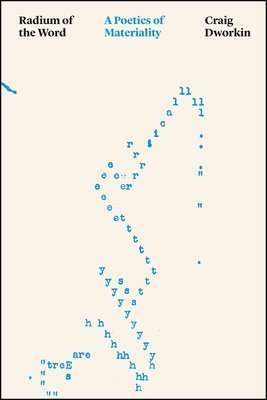
    Radium of the Word

    A Poetics of Materiality

    AvCraig Dworkin

    Häftad, Engelska, 2020

    Del i serien Thinking Literature

    308 kr

    Beställningsvara. Skickas inom 5-8 vardagar. Fri frakt över 249 kr.

    Fler format och utgåvor

    Inbunden

    1 087 kr

    E-bok

    603 kr

    Beskrivning

    With fresh insight and contemporary relevance, Radium of the Word argues that a study of the form of language yields meanings otherwise inaccessible through ordinary reading strategies. Attending to the forms of words rather than to their denotations, Craig Dworkin traces hidden networks across the surface of texts, examining how typography, and even individual letters and marks of punctuation, can reveal patterns that are significant without being symbolic—fully meaningful without communicating any preordained message.Radium of the Word takes its title from Mina Loy’s poem for Gertrude Stein, which hails her as the Madame “Curie / of the laboratory / of vocabulary.” In this spirit, Dworkin considers prose as a dynamic literary form, characterized by experimentation. Dworkin draws on examples from writers as diverse as Lyn Hejinian, William Faulkner, and Joseph Roth. He takes up the status of the proper name in Modernism, with examples from Stein, Loy, and Guillaume Apollinaire, and he offers in-depth analyses of individual authors from the counter-canon of the avant-garde, including P. Inman, Russell Atkins, N. H. Pritchard, and Andy Warhol. The result is an inspiring intervention in contemporary poetics.

    Produktinformation

    • Utgivningsdatum:2020-11-18
    • Mått:152 x 229 x 28 mm
    • Vikt:313 g
    • Format:Häftad
    • Språk:Engelska
    • Serie:Thinking Literature
    • Antal sidor:264
    • Förlag:The University of Chicago Press
    • ISBN:9780226743561

    Mer om författaren

    Craig Dworkin is professor of English at the University of Utah. He is the author of Reading the Illegible, No Medium, and Dictionary Poetics, as well as ten books of poetry, most recently, The Pine-Woods Notebook.

    Recensioner i media

    “We count on Dworkin to say the smartest things about contemporary poetics, so the smartness of Radium of the Word comes as no surprise. What does come as a surprise is the book's first sentence: ‘This book proposes a methodology.’ And it does not disappoint. Dworkin is reinventing the practice of reading by unscrewing the locks on its doors. Not close, not distant, not surface, not formal, not historical, not reparative, not paranoid reading. This book bypasses adjectives and heads straight for the nouns: the death penalty, paper cuts, opera queens, gossip, songs, riots, print, quotation marks, homelessness, names, the typeset line, spaces, prose. Oh, and poetry. This is a difficult book that everybody should read.”

    Innehållsförteckning

    • List of FiguresIntroductionOne    The Prosaic ImaginationTwo    The Onomastic ImaginationThree    The Logic of the Work (on P. Inman)Four    The Logic of Print (on Russell Atkins)Five    The Logic of Spacing (on N. H. Pritchard)Six    The Logic of Registration (on Andy Warhol)AcknowledgmentsNotesIndex