• Fri frakt över 249 kr
  • •
  • Snabba leveranser
  • •
  • Billiga böcker
Kundservice

Du är på sajten för privatpersoner.

Företag, bibliotek eller offentlig verksamhet?

Du handlar på classic.bokus.com, där alla dina funktioner finns intakta.
Till classic.bokus.com
Bokus logotyp. Gå till startsidan.
  • Erbjudanden
  • Nyheter
  • Student
  • Topplistor
  • Barn & ungdom
  • Bokus Play
  • E-böcker
  • Pocketböcker
  • Spel & pussel

10% rabatt på allt med kod NYSTART10 →

Sidfot

Mina sidor

    Hjälp

    • Kundservice
    • Vanliga frågor och svar
    • Frakt och leverans
    • Retur vid ångerrätt
    • Reklamera vara
    • Betalning
    • Köpvillkor
    • Allmänna villkor
    • Information om webbplatsens tillgänglighet

    Om Bokus

    • Om oss
    • Pressrum
    • För studenter
    • För företag
    • För bibliotek och offentlig verksamhet
    • För leverantörer
    • Hållbarhet

    Populärt

    • Aktuella erbjudanden
    • Presentkort
    • Studentlitteratur
    • Nya böcker
    • Topplistor
    • Signerade böcker
    • Engelska böcker

    Inspiration

    • Boktips
    • BookTok
    • Populära bokserier
    • Barnbokskaraktärer
    • Populära författare
    Logotyp för Bokus
    Följ oss på Facebook (extern länk)Följ oss på Instagram (extern länk)Följ oss på YouTube (extern länk)Följ oss på TikTok (extern länk)
    bokus @ CookiesAnpassa cookiesIntegritetspolicyKöpvillkor
    Till Citymail hemsida (extern länk)Till Budbee hemsida (extern länk)Till Postnord hemsida (extern länk)Till Schenker hemsida (extern länk)Till Early Bird hemsida (extern länk)Till Walleys hemsida (extern länk)
    1. Ekonomi och Ledarskap
    2. Nationalekonomi

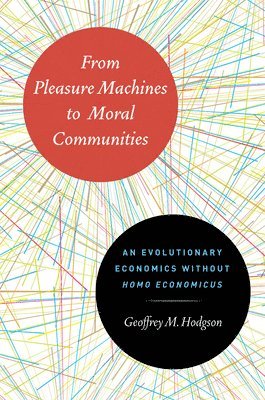
    From Pleasure Machines to Moral Communities

    An Evolutionary Economics without Homo economicus

    AvGeoffrey M. Hodgson

    Inbunden, Engelska, 2012

    463 kr

    Beställningsvara. Skickas inom 5-8 vardagar. Fri frakt över 249 kr.

    Beskrivning

    Are humans at their core seekers of their own pleasure or cooperative members of society? Paradoxically, they are both. Pleasure seeking can take place only within the context of what works within a defined community, and central to any community are the evolved codes and principles guiding appropriate behavior or morality. The complex interaction of morality and self-interest is at the heart of Geoffrey M. Hodgson's approach to evolutionary economics, which is designed to bring about a better understanding of human behavior. In "From Pleasure Machines to Moral Communities", Hodgson casts a critical eye on neoclassical individualism, its foundations and flaws, and turns to recent insights from research on the evolutionary bases of human behavior. He focuses his attention on the evolution of morality, its meaning, why it came about, and how it influences human attitudes and behavior. This more nuanced understanding sets the stage for a fascinating investigation of its implications for a range of pressing issues drawn from diverse environments, including the business world and crucial policy realms like health care and ecology.This book provides a valuable complement to Hodgson's earlier work with Thorbjorn Knudsen on evolutionary economics in Darwin's Conjecture, extending the evolutionary outlook to include moral and policy-related issues.

    Produktinformation

    • Utgivningsdatum:2012-11-02
    • Mått:16 x 24 x 2 mm
    • Vikt:567 g
    • Format:Inbunden
    • Språk:Engelska
    • Antal sidor:328
    • Förlag:The University of Chicago Press
    • ISBN:9780226922713

    Utforska kategorier

    • Nationalekonomi inom Ekonomi och Ledarskap
    • Samhälle och kultur inom Samhälle och politik

    Mer om författaren

    Geoffrey M. Hodgson is research professor at the University of Hertfordshire Business School, England, and the author or coauthor of over a dozen books, including The Evolution of Institutional Economics and Darwin's Conjecture.

    Recensioner i media

    "In his bold and thought-provoking new book, Geoffrey M. Hodgson exposes the deficiencies in 'methodological individualism' and shows how the neoclassical model of human nature is a crude caricature when it comes to dealing with the emergent dynamics of collective phenomena. In doing so, he provides much-needed clarification for an often muddy economic debate." (Peter Corning, Institute for the Study of Complex Systems and the author of The Fair Society)"