• Fri frakt över 249 kr
  • •
  • Snabba leveranser
  • •
  • Billiga böcker
Kundservice

Du är på sajten för privatpersoner.

Företag, bibliotek eller offentlig verksamhet?

Du handlar på classic.bokus.com, där alla dina funktioner finns intakta.
Till classic.bokus.com
Bokus logotyp. Gå till startsidan.
  • Erbjudanden
  • Nyheter
  • Student
  • Topplistor
  • Barn & ungdom
  • Bokus Play
  • E-böcker
  • Pocketböcker
  • Spel & pussel

10% rabatt på allt med kod: NYSTART10 →

Sidfot

Mina sidor

    Hjälp

    • Kundservice
    • Vanliga frågor och svar
    • Frakt och leverans
    • Retur vid ångerrätt
    • Reklamera vara
    • Betalning
    • Köpvillkor
    • Allmänna villkor
    • Information om webbplatsens tillgänglighet

    Om Bokus

    • Om oss
    • Pressrum
    • För studenter
    • För företag
    • För bibliotek och offentlig verksamhet
    • För leverantörer
    • Hållbarhet

    Populärt

    • Aktuella erbjudanden
    • Presentkort
    • Studentlitteratur
    • Nya böcker
    • Topplistor
    • Signerade böcker
    • Engelska böcker

    Inspiration

    • Boktips
    • BookTok
    • Populära bokserier
    • Barnbokskaraktärer
    • Populära författare
    Logotyp för Bokus
    Följ oss på Facebook (extern länk)Följ oss på Instagram (extern länk)Följ oss på YouTube (extern länk)Följ oss på TikTok (extern länk)
    bokus @ CookiesAnpassa cookiesIntegritetspolicyKöpvillkor
    Till Citymail hemsida (extern länk)Till Budbee hemsida (extern länk)Till Postnord hemsida (extern länk)Till Schenker hemsida (extern länk)Till Early Bird hemsida (extern länk)Till Walleys hemsida (extern länk)
    1. Skönlitteratur
    2. Litteraturvetenskap
    3. Litteraturvetenskap

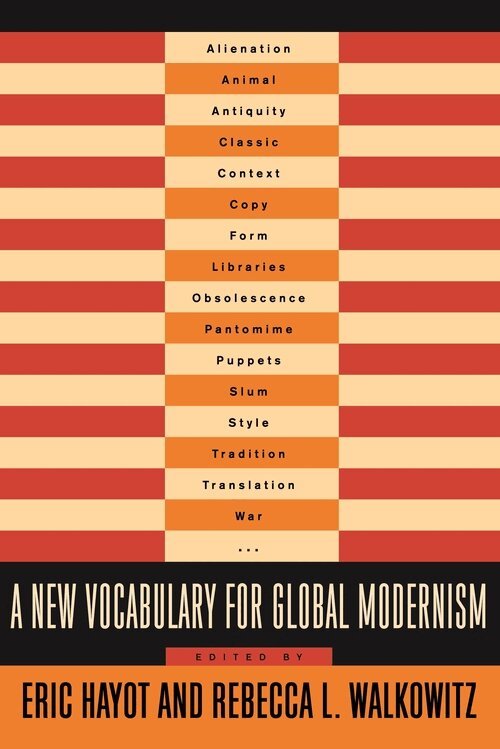
    New Vocabulary for Global Modernism

    AvEric Hayot,Rebecca Walkowitz

    Inbunden, Engelska, 2016

    Del i serien Modernist Latitudes

    1 322 kr

    Beställningsvara. Skickas inom 5-8 vardagar. Fri frakt över 249 kr.

    Beskrivning

    Bringing together leading critics and literary scholars, A New Vocabulary for Global Modernism argues for new ways of understanding the nature and development of twentieth-century literature and culture. Scholars have largely understood modernism as an American and European phenomenon. Those parameters have expanded in recent decades, but the incorporation of multiple origins and influences has often been tied to older conceptual frameworks that make it difficult to think of modernism globally. Providing alternative approaches, A New Vocabulary for Global Modernism introduces pathways through global archives and new frameworks that offer a richer, more representative set of concepts for the analysis of literary and cultural works. In separate essays each inspired by a critical term, this collection explores what happens to the foundational concepts of modernism and the methods we bring to modernist studies when we approach the field as a global phenomenon. Their work transforms the intellectual paradigms we have long associated with modernism, such as tradition, antiquity, style, and translation.New paradigms, such as context, slum, copy, pantomime, and puppets emerge as the archive extends beyond its European center. In bringing together and reexamining the familiar as well as the emergent, the contributors to this volume offer an invaluable and original approach to studying the intersection of world literature and modernist studies.

    Produktinformation

    • Utgivningsdatum:2016-11-29
    • Mått:152 x 229 x undefined mm
    • Format:Inbunden
    • Språk:Engelska
    • Serie:Modernist Latitudes
    • Antal sidor:320
    • Förlag:Columbia University Press
    • ISBN:9780231165204

    Utforska kategorier

    • Litteraturvetenskap inom Skönlitteratur
    • Litteraturteori inom Skönlitteratur

    Mer om författaren

    Eric Hayot is professor of comparative literature and Asian studies at the Pennsylvania State University. He is the author of The Elements of Academic Style (Columbia, 2014), On Literary Worlds (2012), and The Hypothetical Mandarin (2009). Rebecca L. Walkowitz is professor of English and affiliate faculty in the comparative literature program at Rutgers University. Her books are Born Translated: The Contemporary Novel in an Age of World Literature (2015) and Cosmopolitan Style: Modernism Beyond the Nation (2006), both published by Columbia University Press.

    Recensioner i media

    A New Vocabulary for Global Modernism is an exciting roadmap for 21st-century ways of reading the aesthetics of a world always already globalized. Its creative mixture of old and new modernist vocabularies-e.g., form; slum; alienation; puppets; war; libraries--suggests innovative ways of reading the global in the local, the cross-cuts of multidirectional mobilities, the perpetually indigenizing processes of all modernisms. Resisting diffusionist, regional, or additive approaches, the book shifts the paradigm for reading globally. A must read in the field! -- Susan Stanford Friedman, author of Planetary Modernisms: Provocations on Modernity Across Time This brilliant collection of essays responds to perhaps the most urgent need in the scholarship on modernism-a guide and a set of terms that take us beyond the high modernist norm and induct readers into a world in which modern art and literature operated in a truly global public sphere. Written with clarity and intelligence, the book makes modernism appear new, again. -- Simon Gikandi, Robert Schirmer Professor of English, Princeton University The global turn in modernist studies constitutes not so much an expansion as an explosion. With received coordinates - geographic, temporal, national - obsolete, the field is unmappable. But if everything is modernism, nothing is. Enter A New Vocabulary for Global Modernism to articulate nodal points in a global network of modernism, making possible acts of provisional yet critical definition that serve not as gatekeepers but portals to a newer modernist studies. -- Mark A. Wollaeger, Vanderbilt University

    Innehållsförteckning

    • Acknowledgments 1. Introduction, by Eric Hayot and Rebecca L. Walkowitz 2. Alienation, by Christopher Reed 3. Animal, by Efthymia Rentzou 4. Antiquity, by David Damrosch 5. Classic, by Tsitsi Jaji 6. Context, by Christopher Bush 7. Copy, by Jacob Edmond 8. Form, by Jahan Ramazani 9. Libraries, by B. Venkat Mani 10. Obsolescence, by Mark Goble 11. Pantomime, by Monica L. Miller 12. Puppets, by Martin Puchner 13. Slum, by David Pike 14. Style, by Judith Brown 15. Tradition, by Rachel Adams 16. Translation, by Gayle Rogers 17. War, by Mariano Siskind Appendix: More Vocabulary Contributors Index