• Fri frakt över 249 kr
  • •
  • Snabba leveranser
  • •
  • Billiga böcker
Kundservice

Du är på sajten för privatpersoner.

Företag, bibliotek eller offentlig verksamhet?

Du handlar på classic.bokus.com, där alla dina funktioner finns intakta.
Till classic.bokus.com
Bokus logotyp. Gå till startsidan.
  • Erbjudanden
  • Nyheter
  • Student
  • Topplistor
  • Barn & ungdom
  • Bokus Play
  • E-böcker
  • Pocketböcker
  • Spel & pussel

10% rabatt på allt med kod NYSTART10 →

Sidfot

Mina sidor

    Hjälp

    • Kundservice
    • Vanliga frågor och svar
    • Frakt och leverans
    • Retur vid ångerrätt
    • Reklamera vara
    • Betalning
    • Köpvillkor
    • Allmänna villkor
    • Information om webbplatsens tillgänglighet

    Om Bokus

    • Om oss
    • Pressrum
    • För studenter
    • För företag
    • För bibliotek och offentlig verksamhet
    • För leverantörer
    • Hållbarhet

    Populärt

    • Aktuella erbjudanden
    • Presentkort
    • Studentlitteratur
    • Nya böcker
    • Topplistor
    • Signerade böcker
    • Engelska böcker

    Inspiration

    • Boktips
    • BookTok
    • Populära bokserier
    • Barnbokskaraktärer
    • Populära författare
    Logotyp för Bokus
    Följ oss på Facebook (extern länk)Följ oss på Instagram (extern länk)Följ oss på YouTube (extern länk)Följ oss på TikTok (extern länk)
    bokus @ CookiesAnpassa cookiesIntegritetspolicyKöpvillkor
    Till Citymail hemsida (extern länk)Till Budbee hemsida (extern länk)Till Postnord hemsida (extern länk)Till Schenker hemsida (extern länk)Till Early Bird hemsida (extern länk)Till Walleys hemsida (extern länk)
    1. Filosofi och religion
    2. Filosofi

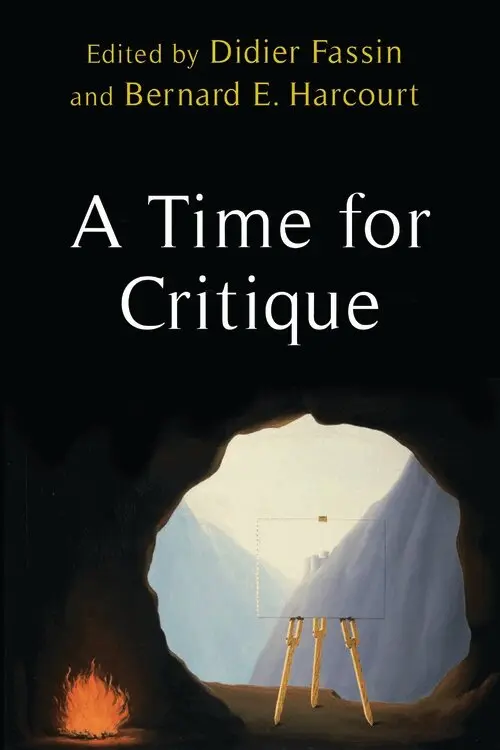
    Time for Critique

    AvBernard E. Harcourt,Didier Fassin

    Häftad, Engelska, 2019

    Del 58 i serien New Directions in Critical Theory

    292 kr

    Beställningsvara. Skickas inom 5-8 vardagar. Fri frakt över 249 kr.

    Beskrivning

    In a world of political upheaval, rising inequality, catastrophic climate change, and widespread doubt of even the most authoritative sources of information, is there a place for critique? This book calls for a systematic reappraisal of critical thinking—its assumptions, its practices, its genealogy, its predicament—following the principle that critique can only start with self-critique.In A Time for Critique, Didier Fassin, Bernard E. Harcourt, and a group of eminent political theorists, anthropologists, sociologists, philosophers, and literary and legal scholars reflect on the multiplying contexts and forms of critical discourse and on the social actors and social movements engaged in them. How can one maintain sufficient distance from the eventful present without doing it an injustice? How can one address contemporary issues without repudiating the intellectual legacies of the past? How can one avoid the disconnection between theory and action? How can critique be both public and collective? These provocative questions are addressed by revisiting the works of Foucault and Arendt, Said and Césaire, Benjamin and Du Bois, but they are also given substance through on-the-ground case studies that treat subaltern criticism in Palestine, emancipatory mobilizations in Syria, the antitorture campaigns of Sri Lankan activists, and the abolitionism of the African American critical resistance and undercommons movements in the United States. Examining lucidly the present challenges of critique, A Time for Critique shows how its theoretical reassessment and its emerging forms can illuminate the imaginative modalities to rejuvenate critical praxis.


    Produktinformation

    • Utgivningsdatum:2019-09-10
    • Mått:155 x 231 x 20 mm
    • Vikt:454 g
    • Format:Häftad
    • Språk:Engelska
    • Serie:New Directions in Critical Theory
    • Antal sidor:320
    • Förlag:Columbia University Press
    • ISBN:9780231191272

    Utforska kategorier

    • Filosofi inom Filosofi och religion

    Mer om författaren

    Didier Fassin is the James Wolfensohn Professor at the Institute for Advanced Study and a director of studies at the École des Hautes Études en Sciences Sociales. The author of several books, including most recently Life: A Critical User’s Manual, he was the first social scientist to receive the Nomis Distinguished Scholar Award.Bernard E. Harcourt is the Isidor and Seville Sulzbacher Professor of Law and professor of political science at Columbia University and a director of studies at the École des Hautes Études en Sciences Sociales. Founding director of the Columbia Center for Contemporary Critical Thought at Columbia University, he is the author of several books, including most recently The Counterrevolution: How Our Government Went to War Against Its Own Citizens.

    Recensioner i media

    What is a timely book? Perhaps one that, in the middle of urgency, is untimely enough to bridge the gaps between a rich tradition and a problematic future, identifying multiple forms of resistance and innovation within multiple life worlds which are also places of reflection. I found all that, and more, in Fassin and Harcourt's fascinating inquiry on the question of critique and its relation to practice. And I trust that readers will think as much.

    Innehållsförteckning

    • AcknowledgmentsIntroduction, by Didier Fassin and Bernard E. HarcourtPart I: Critique as Practice1. How Is Critique?, by Didier Fassin2. Critique as a Political Practice of Freedom, by Linda M. G. Zerilli3. Critique Without a Politics of Hope?, by Ayşe Parla4. The Usefulness of Uncertain Critique, by Peter Redfield5. Human Rights Consciousness and Critique, by Karen Engle6. Critique as Subduction, by Massimiliano Tomba7. What’s Left of the Real?, by Vanja HamzićPart II: Critique in Practice8. Subaltern Critique and the History of Palestine, by Lori Allen9. Critical Theory in a Minor Key to Take Stock of the Syrian Revolution, by Fadi A. Bardawil10. Pragmatic Critique of Torture in Sri Lanka, by Nick Cheesman11. Dispossession, Reimagined from the 1690s, by David Kazanjian12. Crisis, Critique, and Abolition, by Andrew Dilts13. Law, Critique, and the Undercommons, by Allegra M. McLeod14. Critical Praxis for the Twenty- First Century, by Bernard E. HarcourtList of ContributorsIndex