• Fri frakt över 249 kr
  • •
  • Snabba leveranser
  • •
  • Billiga böcker
Kundservice

Du är på sajten för privatpersoner.

Företag, bibliotek eller offentlig verksamhet?

Du handlar på classic.bokus.com, där alla dina funktioner finns intakta.
Till classic.bokus.com
Bokus logotyp. Gå till startsidan.
  • Erbjudanden
  • Student
  • Topplistor
  • Barn & ungdom
  • Bokus Play
  • E-böcker
  • Ljudböcker
  • Pocketböcker
  • Spel & pussel

10% rabatt på allt med kod NYSTART10 →

Sidfot

Mina sidor

    Hjälp

    • Kundservice
    • Vanliga frågor och svar
    • Frakt och leverans
    • Retur vid ångerrätt
    • Reklamera vara
    • Betalning
    • Köpvillkor
    • Allmänna villkor
    • Information om webbplatsens tillgänglighet

    Om Bokus

    • Om oss
    • Pressrum
    • För studenter
    • För företag
    • För bibliotek och offentlig verksamhet
    • För leverantörer
    • Hållbarhet

    Populärt

    • Aktuella erbjudanden
    • Presentkort
    • Studentlitteratur
    • Nya böcker
    • Topplistor
    • Signerade böcker
    • Engelska böcker

    Inspiration

    • Boktips
    • BookTok
    • Populära bokserier
    • Barnbokskaraktärer
    • Populära författare
    Logotyp för Bokus
    Följ oss på Facebook (extern länk)Följ oss på Instagram (extern länk)Följ oss på YouTube (extern länk)Följ oss på TikTok (extern länk)
    bokus @ CookiesAnpassa cookiesIntegritetspolicyKöpvillkor
    Till Citymail hemsida (extern länk)Till Budbee hemsida (extern länk)Till Postnord hemsida (extern länk)Till Schenker hemsida (extern länk)Till Early Bird hemsida (extern länk)Till Walleys hemsida (extern länk)
    1. Kultur
    2. Arkitektur

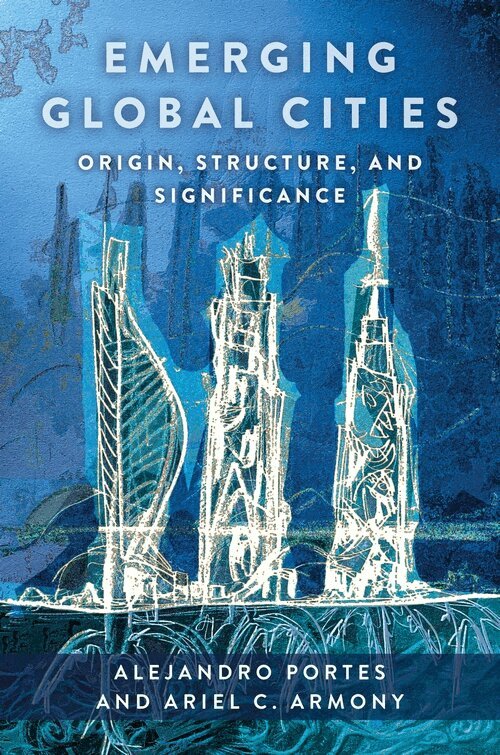
    Emerging Global Cities

    Origin, Structure, and Significance

    AvAlejandro Portes,Ariel C. Armony

    Häftad, Engelska, 2022

    301 kr

    Beställningsvara. Skickas inom 5-8 vardagar. Fri frakt över 249 kr.

    Fler format och utgåvor

    Inbunden

    1 182 kr

    Beskrivning

    Certain cities—most famously New York, London, and Tokyo—have been identified as “global cities,” whose function in the world economy transcends national borders. Without the same fanfare, formerly peripheral and secondary cities have been growing in importance, emerging as global cities in their own right. The striking similarity of the skylines of Dubai, Miami, and Singapore is no coincidence: despite following different historical paths, all three have achieved newfound prominence through parallel trends.In this groundbreaking book, Alejandro Portes and Ariel C. Armony demonstrate how the rapid and unexpected rise of these three cities recasts global urban studies. They identify the constellation of factors that allow certain urban places to become “emerging global cities”—centers of commerce, finance, art, and culture for entire regions. The book traces the transformations of Dubai, Miami, and Singapore, identifying key features common to these emerging global cities. It contrasts them with “global hopefuls,” cities that, at one point or another, aspired to become global, and analyzes how Hong Kong is threatened with the loss of this status. Portes and Armony highlight the importance of climate change to the prospects of emerging global cities, showing how the same economic system that propelled their rise now imperils their future. Emerging Global Cities provides a powerful new framework for understanding the role of peripheral cities in the world economy and how they compete for and sometimes achieve global standing.

    Produktinformation

    • Utgivningsdatum:2022-12-27
    • Mått:156 x 235 x 31 mm
    • Vikt:572 g
    • Format:Häftad
    • Språk:Engelska
    • Antal sidor:368
    • Förlag:Columbia University Press
    • ISBN:9780231205177

    Utforska kategorier

    • Arkitektur inom Kultur

    Mer om författaren

    Alejandro Portes is professor of law and distinguished scholar of arts and sciences at the University of Miami. He is the Howard Harrison and Gabrielle S. Beck Professor of Sociology (emeritus) and the founding director of the Center for Migration and Development at Princeton University. Portes is also a member of the National Academy of Sciences and the former president of the American Sociological Association. His books include City on the Edge: The Transformation of Miami (1993) and Immigrant America: A Portrait (fourth edition, 2014).Ariel C. Armony is vice chancellor for global affairs and director of the University Center for International Studies at the University of Pittsburgh, where he is also a professor in the Graduate School of Public and International Affairs. He was a fellow at the Woodrow Wilson International Center for Scholars, a Fulbright scholar at Nankai University, and a resident fellow at the Rockefeller Foundation Bellagio Center. His publications include The Dubious Link: Civic Engagement and Democratization (2004) and, with Portes, The Global Edge: Miami in the Twenty-First Century (2018).

    Recensioner i media

    Emerging Global Cities sets a new standard for the comparative study of cities. Combining historical analysis, political economy, demography, and institutional analysis with a deep understanding of the global division of economic labor, the authors produce a set of gripping profiles of the successful, the also-rans, and the precarious, and place them all in a compelling theoretical framework.

    Innehållsförteckning

    • AcknowledgmentsIntroductionPart I1. The Role of Cities in the Capitalist Economy: An Overview2. Dubai: From Marginal Gulf Town to Regional Hub, by Rana Tomaira3. Miami: From Winter Resort to Hemispheric Capital, with the collaboration of Brandon P. Martinez4. Singapore: From Fishing Village to World-Class Metropolis, with the collaboration of Larry LiuPart II5. Global Hopefuls: An Overview6. New Orleans: A Century of Decline, with the collaboration of Larry Liu7. São Paulo: Brazil’s Always-Aspiring City, with the collaboration of Rosa Hassan De Ferrari and Anthony Ocepek8. Lagos: Africa’s New Dubai?, with the collaboration of Rosa Hassan De Ferrari and Anthony OcepekPart III9. Hong Kong: A Threatened Global City, by Larry LiuConclusion: Theoretical Implications, Climate Change, and Future ChallengesNotesReferencesIndex