• Fri frakt över 249 kr
  • •
  • Snabba leveranser
  • •
  • Billiga böcker
Kundservice

Du är på sajten för privatpersoner.

Företag, bibliotek eller offentlig verksamhet?

Du handlar på classic.bokus.com, där alla dina funktioner finns intakta.
Till classic.bokus.com
Bokus logotyp. Gå till startsidan.
  • Erbjudanden
  • Nyheter
  • Student
  • Topplistor
  • Barn & ungdom
  • Bokus Play
  • E-böcker
  • Pocketböcker
  • Spel & pussel

10% studentrabatt med kod TERM26

Sidfot

Mina sidor

    Hjälp

    • Kundservice
    • Vanliga frågor och svar
    • Frakt och leverans
    • Retur vid ångerrätt
    • Reklamera vara
    • Betalning
    • Köpvillkor
    • Allmänna villkor
    • Information om webbplatsens tillgänglighet

    Om Bokus

    • Om oss
    • Pressrum
    • För studenter
    • För företag
    • För bibliotek och offentlig verksamhet
    • För leverantörer
    • Hållbarhet

    Populärt

    • Aktuella erbjudanden
    • Presentkort
    • Studentlitteratur
    • Nya böcker
    • Topplistor
    • Signerade böcker
    • Engelska böcker

    Inspiration

    • Boktips
    • BookTok
    • Populära bokserier
    • Barnbokskaraktärer
    • Populära författare
    Logotyp för Bokus
    Följ oss på Facebook (extern länk)Följ oss på Instagram (extern länk)Följ oss på YouTube (extern länk)Följ oss på TikTok (extern länk)
    bokus @ CookiesAnpassa cookiesIntegritetspolicyKöpvillkor
    Till Citymail hemsida (extern länk)Till Budbee hemsida (extern länk)Till Postnord hemsida (extern länk)Till Schenker hemsida (extern länk)Till Early Bird hemsida (extern länk)Till Walleys hemsida (extern länk)
    1. Skönlitteratur
    2. Poesi

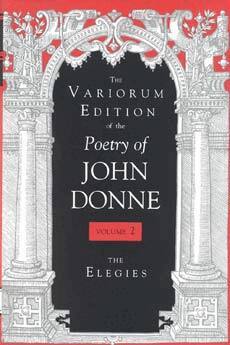
    Variorum Edition of the Poetry of John Donne, Volume 2

    The Elegies

    AvJohn Donne,Gary A. Stringer

    Inbunden, Engelska, 2000

    Del i serien Variorum Edition of the Poetry of John Donne

    1 030 kr

    Beställningsvara. Skickas inom 10-15 vardagar. Fri frakt över 249 kr.

    Beskrivning

    From reviews of previous volumes:"This variorum edition will be the basis of all future Donne scholarship." —Chronique"Academic libraries and specialists in Renaissance and 17th-century studies should feel compelled to own each and every volume of this series." —Seventeenth Century News"An occasion for celebration. Among the most ambitious and valuable collaborative scholarly enterprises at the end of the twentieth century. Superb." —Early Modern LiteraryStudiesThis latest addition to the Donne variorum, the third to appear in a projected eight-volume series, presents a newly edited critical text of Donne's elegies and a comprehensive variorum commentary. As with previous volumes, Volume 2 is based on a study of all known manuscript sources and significant printed editions of Donne's poetry and on an examination of the criticism and scholarship of the past four centuries.

    Produktinformation

    • Utgivningsdatum:2000-10-22
    • Mått:156 x 235 x 69 mm
    • Vikt:1 819 g
    • Format:Inbunden
    • Språk:Engelska
    • Serie:Variorum Edition of the Poetry of John Donne
    • Antal sidor:1 152
    • Förlag:Indiana University Press
    • ISBN:9780253333766

    Utforska kategorier

    • Poesi inom Skönlitteratur
    • Litteraturvetenskap inom Skönlitteratur

    Mer om författaren

    Gary A. Stringer is Professor of English at Texas A&M University.Ted-Larry Pebworth is Emeritus Professor of English at the University of Michigan-Dearborn. Ernest W. Sullivan, II, is Edward S. Diggs Professor of English at Virginia Tech University. John R. Roberts is Emeritus Professor of English at the University of Missouri-Columbia. Diana Trevino Benet is Professor of English at the University of North Texas. Theodore J. Sherman is Assistant Professor of English at Middle Tennessee State University.Dennis Flynn is Professor of English at Bentley College.Paul A Parrish is Professor of English at Texas A&M University.

    Recensioner i media

    "In the end, the Elegies are experiments in rhetoric, and whilst, for Donne as for Shakespeare, that does not automatically entail insincerity, it refuses to make sincerity the touchstone of excellence. We are seldom reminded as forcefully as by these poems that in the Latin poetry which underlies them the idea of rhetorical figuration is itself imaged as the application of cosmetics. March 2001"—New Criterion"An occasion for celebration. Among the most ambitious and valuable collaborative scholarly enterprises at the end of the twentieth century. Superb."—Early Modern Literary Studies"Academic libraries and specialists in Renaissance and 17th–century studies should feel compelled to own each and every volume of this series."—Seventeeth Century News"Like its predecessors, . . . [this] volume of the Donne Variorum enterprise to appear is a triumph in every way."—John Donne Journal". . . This edition immediately displaces all its predecessors, and will be indispensable for scholars and libraries."—TLS"In this third volume in a projected eight-volume series, Stringer presents the most authoritative texts and fullest editorial history of the elegies, including textual apparatus from all known manuscripts and editions from the 17th century onward, and also a comprehensive summary of scholarly and critical commentary on the elegies (also from Donne's era onward). The remarkable insights in the textual/editorial component include identification of the most authoritative manuscript for the elegies (housed in the New York Public Library) and a persuasive speculation that the first 12 elegies in this manuscript reflect Donne's intended sequence. Critical insights reveal the early trend not to treat the elegies as a separate group but to integrate them into a discussion of Donne's amatory verse; the value of using the elegies as context for Donne's later amatory verse, notably Songs and Sonnets; moralistic and biographical readings, which sometimes characterize Donne as a libertine and denounce him for licentiousness; Donne as the first poet to write love elegies in English; the coteries for which the elegies were written and the scribal culture that copied and recopied them for presentation to such audiences of intellectuals. The volume contains five indexes and the most comprehensive bibliography on the elegies now available. Indispensable for large collections supporting 17th–century literature.February 2001"—A. C. Labriola, Duquesne University

    Innehållsförteckning

    • AcknowledgmentsShort Forms of Reference for Donne's WorksAbbreviations Used in the CommentarySigla for Textual SourcesManuscripts Listed by Traditional ClassificationSymbols and Abbreviations Used in the Textual ApparatusGeneral IntroductionIntroduction to Volume 2Texts and ApparatusesTHE ELEGIESElegy 1 The Bracelet.[Not that in color it was like thy haire]Elegy 2 The Comparison.[As the sweet sweate of roses in a still,]Elegy 3. The Perfume.[Once and but once found in thy companee]Elegy 4. Jealousy.[Found woman which wouldst haue thy husband dy]Elegy 5. Oh let not me serve so.[Oh let not me serve so, as those men serve]Elegy 6. Natures Lay Ideott.[Natures Lay Ideott, I tought thee to Love]Elegy 7. Love's War.[Till I haue peace with thee, warr other Men;]Elegy 8. To his Mistress going to bed.[Come Madame, come; All rest my powers defy;]Elegy 9. Change.[Allthough thy hand, and fayth and good works too]Elegy 10. The Anagram.[Marry and love thy Flauai for Shee]Elegy 11. On his Mistris.[By our first strange and fatal interview]Elegy 12. His Picture.[Here take my picture, though I bid farewell]Elegy 13. The Autumnall.[No springe, nor summer beautie, hath such grace]Elegy 14. Loues Progresse.[Whoe ever luves, if hee doe not propose]Elegy 15. His Parting from Her.[Since shee must goe, and I must mourne, some night]Elegy 16. The Expostulation.[To make the doubt cleare, that noe woman's true]Elegy 17. Variety.[The heuens rejoyce in motion, why should I]Sappho to Philnis.[As the sweet sweate of roses in a still,]Analysis of Early Printed CopiesDUBIATextual IntroductionElegy. Iulia.[Hearke newes, o Enuy, Thou shalt heare desiry'd]A Tale of a Citizen and his Wife.[I sing no harme, goodsooth, to any wight]APPENDIXIntroductionDe Verstellingh[Hebt Flavia vry lief, en trouwtse toe: haer wesen]Aen sign Lief.[Doe mijn Ziel saliger gescheedt stack in mijn'leden,]CommentaryGeneral Commentary on the ElegiesDates and CircumstancesGeneral CommentaryClassical Borrowings and Literary InfluencesVersificationElegy as GenreElegy 1. The Bracelet.Elegy 2. The Comparison.Elegy 3. The Perfume.Elegy 4. Jealousy.Elegy 5. Oh let me not serve so.Elegy 6. Natures Lay Ideott.Elegy 7. Love's War.Elegy 8. To his Mistress going to bed.Elegy 9. Change.Elegy 10. The Anagram.Elegy 11. On his Mistris.Elegy 12. His Picture.Elegy 13. The Autumnall.Elegy 14. Loues Progresse.Elegy 15. His Parting From Her.Elegy 16. The Expostulation.Elegy 17. Variety.Sappho to Philaenis.DUBIAElegy. Iulia.CommentaryNotes and GlossesA Tale of a Citizen and his WifeCommentaryNotes and GlossesWorks CitedIndexes