• Fri frakt över 249 kr
  • •
  • Snabba leveranser
  • •
  • Billiga böcker
Kundservice

Du är på sajten för privatpersoner.

Företag, bibliotek eller offentlig verksamhet?

Du handlar på classic.bokus.com, där alla dina funktioner finns intakta.
Till classic.bokus.com
Bokus logotyp. Gå till startsidan.
  • Erbjudanden
  • Nyheter
  • Student
  • Topplistor
  • Barn & ungdom
  • Bokus Play
  • E-böcker
  • Pocketböcker
  • Spel & pussel

Må bättre, för mindre! Upp till 50% rabatt på hälsoböcker

Sidfot

Mina sidor

    Hjälp

    • Kundservice
    • Vanliga frågor och svar
    • Frakt och leverans
    • Retur vid ångerrätt
    • Reklamera vara
    • Betalning
    • Köpvillkor
    • Allmänna villkor
    • Information om webbplatsens tillgänglighet

    Om Bokus

    • Om oss
    • Pressrum
    • För studenter
    • För företag
    • För bibliotek och offentlig verksamhet
    • För leverantörer
    • Hållbarhet

    Populärt

    • Aktuella erbjudanden
    • Presentkort
    • Studentlitteratur
    • Nya böcker
    • Topplistor
    • Signerade böcker
    • Engelska böcker

    Inspiration

    • Boktips
    • BookTok
    • Populära bokserier
    • Barnbokskaraktärer
    • Populära författare
    Logotyp för Bokus
    Följ oss på Facebook (extern länk)Följ oss på Instagram (extern länk)Följ oss på YouTube (extern länk)Följ oss på TikTok (extern länk)
    bokus @ CookiesAnpassa cookiesIntegritetspolicyKöpvillkor
    Till Citymail hemsida (extern länk)Till Budbee hemsida (extern länk)Till Postnord hemsida (extern länk)Till Schenker hemsida (extern länk)Till Early Bird hemsida (extern länk)Till Walleys hemsida (extern länk)
    1. Språk och ordböcker
    2. Språkvetenskap och lingvistik

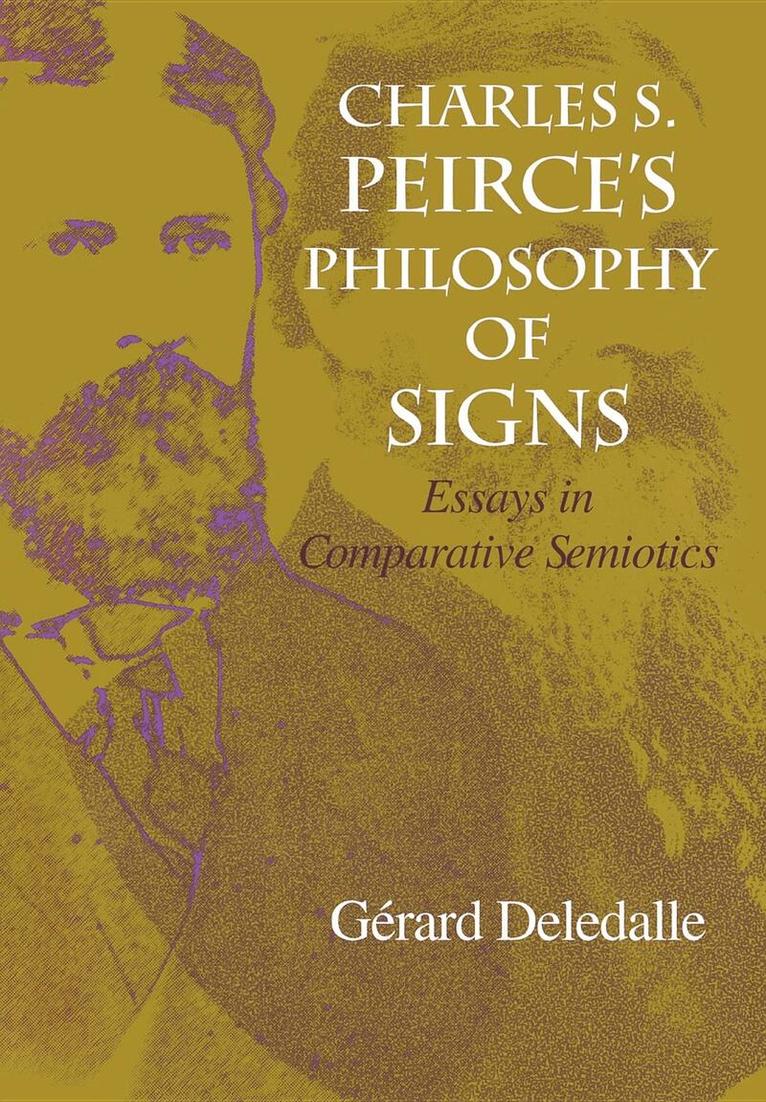
    Charles S. Peirce's Philosophy of Signs

    Essays in Comparative Semiotics

    AvGerard Deledalle

    Inbunden, Engelska, 2001

    Del i serien Advances in Semiotics

    451 kr

    Beställningsvara. Skickas inom 10-15 vardagar. Fri frakt över 249 kr.

    Beskrivning

    [Note: Picture of Peirce available]Charles S. Peirce's Philosophy of SignsEssays in Comparative SemioticsGérard DeledallePeirce's semiotics and metaphysics compared to the thought of other leading philosophers. "This is essential reading for anyone who wants to find common ground between the best of American semiotics and better-known European theories. Deledalle has done more than anyone else to introduce Peirce to European audiences, and now he sends Peirce home with some new flare."—Nathan Houser, Director, Peirce Edition ProjectCharles S. Peirce's Philosophy of Signs examines Peirce's philosophy and semiotic thought from a European perspective, comparing the American's unique views with a wide variety of work by thinkers from the ancients to moderns. Parts I and II deal with the philosophical paradigms which are at the root of Peirce's new theory of signs, pragmatic and social. The main concepts analyzed are those of "sign" and "semiosis" and their respective trichotomies; formally in the case of "sign," in time in the case of semiosis. Part III is devoted to comparing Peirce's theory of semiotics as a form of logic to the work of other philosophers, including Bertrand Russell, Wittgenstein, Frege, Philodemus, Lady Welby, Saussure, Morris, Jakobson, and Marshall McLuhan. Part IV compares Peirce's "scientific metaphysics" with European metaphysics.Gérard Deledalle holds the Doctorate in Philosophy from the Sorbonne. A research scholar at Columbia University and Attaché at the Centre National de la Recherche Scientifique, Paris, he has also been Professor of Philosophy and Head of the Philosophy Department of the universities of Tunis, Perpignan, and Libreville. In 1990 he received the Herbert W. Schneider Award "for distinguished contributions to the understanding and development of American philosophy. In 2001, he was appointed vice-president of the Charles S. Peirce Society.ContentsIntroduction—Peirce Compared: Directions for UsePart I—Semeiotic as PhilosophyPeirce's New Philosophical ParadigmsPeirce's Philosophy of SemeioticPeirce's First Pragmatic Papers (1877-1878)The Postscriptum of 1893Part II—Semeiotic as SemioticsSign: Semiosis and Representamen—Semiosis and TimeSign: The Concept and Its Use—Reading as TranslationPart III—Comparative SemioticsSemiotics and Logic: A Reply to Jerzy PelcSemeiotic and Greek Logic: Peirce and PhilodemusSemeiotic and Significs: Peirce and Lady WelbySemeiotic and Semiology: Peirce and SaussureSemeiotic and Semiotics: Peirce and MorrisSemeiotic and Linguistics: Peirce and JakobsonSemeiotic and Communication: Peirce and McLuhanSemeiotic and Epistemology: Peirce, Frege, and WittgensteinPart IV—Comparative MetaphysicsGnoseology—Perceiving and Knowing: Peirce, Wittgenstein, and GestalttheorieOntology—Transcendentals "of" or "without" Being: Peirce versus Aristotle and Thomas AquinasCosmology—Chaos and Chance within Order and Continuity: Peirce between Plato and DarwinTheology—The Reality of God: Peirce's Triune God and the Church's TrinityConclusion—Peirce: A Lateral View

    Produktinformation

    • Utgivningsdatum:2001-03-22
    • Mått:156 x 235 x 21 mm
    • Vikt:739 g
    • Format:Inbunden
    • Språk:Engelska
    • Serie:Advances in Semiotics
    • Antal sidor:216
    • Förlag:Indiana University Press
    • ISBN:9780253337368

    Utforska kategorier

    • Språkvetenskap och lingvistik inom Språk och ordböcker
    • Filosofi inom Filosofi och religion

    Mer om författaren

    Gérard Deledalle (born 1921)holds the Doctorate in Philosophy from the Sorbonne. He is a Research Scholar at Columbia University, New York, and Attaché at the Centre National de la Recherche Scientifique, Paris, he was also successively Professor of Philosophy and Head of the Philosophy Department of the universities of Tunis (1963-1972), Perpignan (1974-1990), and Libreville (1977-1981). He was appointed Director of the Instut Franco-Japonais in Tokyo from 1972 to 1974. He has been Visiting Professor in Japan (Waseda University), China (Beijing and Wuhan), the United States (Bloomington) and Canada (UQAM). He has written extensively on American philosophy, Charles S. Peirce, and John Dewey, pragmatism, and semiotics. He received in 1990 the Herbert W. Schneider Award "for distinguished contributions to the understanding and development of American philosophy." In 2001, he was appointed vice-president of the Charles S. Peirce Society.

    Recensioner i media

    "This collection of essays, from 50 years of writing about C.S. Peirce by Gerard Deledalle (Columbia Univ.), offers critical investigations of topics in semiotics and helpful philosophical comparisons. Deledalle's efforts to introduce Peirce to a French and European audience are laudable, since Peirce is often difficult to comprehend in English. Also laudable is Deledalle's historic sense of Peirce's semiotic thinking, especially his chapter on the Greek origins of Peirce's terms. Because many of these essays are written as introductions to Peirce's thought, there is some repetition. The text also reflects the limited secondary resources on Peirce available in French. What Deledalle does exceptionally well, though, is bring Peirce's thought into historical and philosophical dialogue with Saussure, Wittgenstein, Frege, Morris, McLuhan, and the trinitarian doctrine of the Eastern and Western church. A very rich read for those who admire and understand Peirce's significance. Suitable for graduate students and researchers."—R. Ward, Georgetown College , 2001nov CHOICE.

    Innehållsförteckning

    • Preliminary Table of Contents:Introduction — Peirce Compared: Directions for UsePart I — Semeiotic as PhilosophyChapter 1. Peirce's New Philosophical ParadigmsChapter 2. Peirce's Philosophy of SemeioticChapter 3. Peirce's First Pragmatic Papers (1877-1878)The Postscriptum of 1893Part II — Semeiotic as SemioticsChapter 4. Sign: Semiosis and Representamen—Semiosis and TimeChapter 5. Sing: The Concept and Its Use—Reading as TranslationPart III — Comparative SemioticsChapter 6. Semiotics and Logic: A Reply to Jerzy PelcChapter 7. Semeiotic and Greek Logic: Peirce and PhilodemusChapter 8. Semeiotic and Significs: Peirce and Lady WelbyChapter 9. Semeiotic and Semiology: Peirce and SaussureChapter 10. Semeiotic and Semiotics: Peirce and MorrisChapter 11. Semeiotic and Linguistics: Peirce and JakobsonChapter 12. Semeiotic and Communication: Peirce and McLuhanChapter 13. Semeiotic and Epistemology: Peirce, Frege, and WittgensteinChapter IV — Comparative MetaphysicsChapter 14. Gnoseology — Perceiving and Knowing: Peirce, Wittgenstein, and GestalttheorieChapter 15. Ontology — Transcendentals of or Without Being Peirce Versus Aristotle and Thomas AquinasChapter 16. Cosmology — Chaos and Chance Within Order and Continuity: Peirce Between Plato and DarwinChapter 17. Theology — The Reality of God: Peirce's Triune God and the Church's TrinityConclusion —Peirce: A Lateral ViewBibliographyIndex NominumIndex Rerum