• Fri frakt över 249 kr
  • •
  • Snabba leveranser
  • •
  • Billiga böcker
Kundservice

Du är på sajten för privatpersoner.

Företag, bibliotek eller offentlig verksamhet?

Du handlar på classic.bokus.com, där alla dina funktioner finns intakta.
Till classic.bokus.com
Bokus logotyp. Gå till startsidan.
  • Erbjudanden
  • Nyheter
  • Student
  • Topplistor
  • Barn & ungdom
  • Bokus Play
  • E-böcker
  • Pocketböcker
  • Spel & pussel

10% rabatt på allt med kod NYSTART10 →

Sidfot

Mina sidor

    Hjälp

    • Kundservice
    • Vanliga frågor och svar
    • Frakt och leverans
    • Retur vid ångerrätt
    • Reklamera vara
    • Betalning
    • Köpvillkor
    • Allmänna villkor
    • Information om webbplatsens tillgänglighet

    Om Bokus

    • Om oss
    • Pressrum
    • För studenter
    • För företag
    • För bibliotek och offentlig verksamhet
    • För leverantörer
    • Hållbarhet

    Populärt

    • Aktuella erbjudanden
    • Presentkort
    • Studentlitteratur
    • Nya böcker
    • Topplistor
    • Signerade böcker
    • Engelska böcker

    Inspiration

    • Boktips
    • BookTok
    • Populära bokserier
    • Barnbokskaraktärer
    • Populära författare
    Logotyp för Bokus
    Följ oss på Facebook (extern länk)Följ oss på Instagram (extern länk)Följ oss på YouTube (extern länk)Följ oss på TikTok (extern länk)
    bokus @ CookiesAnpassa cookiesIntegritetspolicyKöpvillkor
    Till Citymail hemsida (extern länk)Till Budbee hemsida (extern länk)Till Postnord hemsida (extern länk)Till Schenker hemsida (extern länk)Till Early Bird hemsida (extern länk)Till Walleys hemsida (extern länk)
    1. Skönlitteratur
    2. Litteraturvetenskap
    3. Litteraturvetenskap

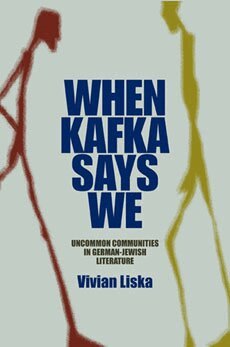
    When Kafka Says We

    Uncommon Communities in German-Jewish Literature

    AvVivian Liska

    Inbunden, Engelska, 2009

    Del i serien Helen and Martin Schwartz Lectures in Jewish Studies

    407 kr

    Beställningsvara. Skickas inom 10-15 vardagar. Fri frakt över 249 kr.

    Beskrivning

    Taking as its starting point Franz Kafka's complex relationship to Jews and to communities in general, When Kafka Says We explores the ambivalent responses of major German-Jewish writers to self-enclosed social, religious, ethnic, and ideological groups. Vivian Liska shows that, for Kafka and others, this ambivalence inspired innovative modes of writing which, while unmasking the oppressive cohesion of communal groupings, also configured original and uncommon communities. Interlinked close readings of works by German-Jewish writers such as Kafka, Else Lasker-Schüler, Nelly Sachs, Paul Celan, Ilse Aichinger, and Robert Schindel illuminate the ways in which literature can subvert, extend, or reconfigure established visions of communities. Liska's rich and astute analysis uncovers provocative attitudes and insights on a subject of continuing controversy.

    Produktinformation

    • Utgivningsdatum:2009-06-08
    • Mått:156 x 235 x 38 mm
    • Vikt:544 g
    • Format:Inbunden
    • Språk:Engelska
    • Serie:Helen and Martin Schwartz Lectures in Jewish Studies
    • Antal sidor:256
    • Förlag:Indiana University Press
    • ISBN:9780253353085

    Utforska kategorier

    • Litteraturvetenskap inom Skönlitteratur

    Mer om författaren

    Vivian Liska is Professor of German Literature and Director of the Institute of Jewish Studies at the University of Antwerp, Belgium. She is author of The Night of the Hymns: Paul Celan's Poems, 1938–1944 (in German) and editor (with Thomas Nolden) of Contemporary Jewish Writing in Europe: A Guide (IUP, 2008).

    Recensioner i media

    "Liska's title is somewhat misleading: it suggests that the book is primarily about Franz Kafka or that certain aspects of his writing provide the volume's readings and analysis with a unifying thematic-heuristic thread. Rather, this is a collection of—for the most part—previously published work dealing with exemplary 20th-century Jewish authors, poets, and thinkers who wrote, or are still writing, in German—including (in addition to Kafka) Theodor Herzl, Else Lasker-Schüler, Paul Celan, Nelly Sachs, Ilse Aichinger, Robert Menasse, Doron Rabinovici, Robert Schindel, and Hannah Arendt. This does not mean that the volume is without merit. Quite the contrary. Looking at the sociocultural and political context of the 20th century, Liska (Univ. of Antwerp, Belgium) proffers nuanced, insightful, often provocative interpretations of selected works of interest to scholars of these particular writers. She explores how these German-Jewish writers' responses to anti-Semitism, along with their ambivalence about their marginal position, inspired 'unconventional literary approaches toward communities and selves and the relationship between them.' Keying on this level of ambivalence, Liska convincingly shows how these particular works—and literary language more generally—can unmask, subvert, but also reconfigure the 'oppressive cohesion of communal groupings' into new 'original and uncommon communities.' Summing Up: Recommended. Graduate students, researchers, faculty. — Choice *** Do not use until Nov. 1."—E. Williams, Texas A&M University, November 2009"Taking as its starting point Franz Kafka's complex relationship to Jews and to communities in general, When Kafka Says We explores the ambivalent responses of major German-Jewish writers to self-enclosed social, religious, ethnic, and ideological groups. Vivian Liska shows that, for Kafka and others, this ambivalence inspired innovative modes of writing which, while unmasking the oppressive cohesion of communal groupings, also configured original and uncommon communities. Interlinked close readings of works by German-Jewish writers such as Kafka, Else Lasker-Schüler, Nelly Sachs, Paul Celan, Ilse Aichinger, and Robert Schindel illuminate the ways in which literature can subvert, extend, or reconfigure established visions of communities."—Joseph Haberer, Book Editor, SHOFAR"[T]his is a collection of . . . work dealing with exemplary 20th-century Jewish authors, poets, and thinkers who wrote, or are still writing, in German—including (in addition to Kafka) Theodor Herzl, Else Lasker-Schüler, Paul Celan, Nelly Sachs, Ilse Aichinger, Robert Menasse, Doron Rabinovici, Robert Schindel, and Hannah Arendt. . . . Looking at the sociocultural and political context of the 20th century, Liska . . . proffers nuanced, insightful, often provocative interpretations of selected works of interest to scholars of these particular writers. She explores how these German-Jewish writers' responses to anti-Semitism, along with their ambivalence about their marginal position, inspired 'unconventional literary approaches toward communities and selves and the relationship between them.' Keying on this level of ambivalence, Liska convincingly shows how these particular works . . . can unmask, subvert, but also reconfigure the 'oppressive cohesion of communal groupings' into new 'original and uncommon communities.' . . . Recommended. — ChoiceNovember 2009"—"This book convincingly demonstrates a fruitful intersection betwen literary analysis and cultural studies to raise important questions about German Jewish identity and literature and would be a valuable read for those interested in German Jewish studies, Holocaust remembrance, and cultural studies as a whole. July, 2010"—H-Judaic, H-Net Reviews"Several essays here deserve to become important reference points in literary discussions. Spring 2011"—Journal of Jewish Studies"Liska has produced a fascinating volume ...34/2 May 2011"—German Studies Review"[T]his is a convincing and remarkable study, focused, yet of impressive breadth. . . . [S]hould be a mainstay in every university library offering German Studies or Jewish Studies on the graduate or undergraduate levels.Vol. 29, No. 3 Spring 2011"—Shofar"I know of no book quite like Liska's in range, sophisticated analysis, and importance for the appreciation of modern German-Jewish literature in the wake of Kafka."—Geoffrey Hartman, Yale University"Vivian Liska is remarkable for the precision of her readings. . . . She brings to her project a rich and varied sensibility—a mind at home in many languages and literatures and fields of thought."—Stanley Corngold, Princeton University

    Innehållsförteckning

    • AcknowledgmentsList of AbbreviationsIntroduction: Uncommon CommunitiesPart 1. Kafka's Communities1. When Kafka Says We2. Shooting at the Audience: Kafka's Speech on the Yiddish Language3. An Alliance of Foes: Kafka and the FemininePart 2. Revisiting the Common Ground4. A Vision out of Sight: Theodor Herzl's Late "Philosophical Tales"5. Diverting the Lineage: Biblical Women in Else Lasker-Schüler's Hebrew Ballads6. Saving Confusions: Else Lasker-Schüler's Poetics of RedemptionPart 3. Communities of Fate7. A Counter-Prayer: Paul Celan's "In Front of a Candle"8. Roots against Heaven: A Motif in Paul Celan9. The Voice of Israel: Nelly Sachs's "Choirs after Midnight"Part 4. Contentious Commemorations10. A Broken Ring: The Gruppe 47 and Ilse Aichinger's Poetics of Resistance11. After the Silence: Holocaust Remembrance in Contemporary Austrian-Jewish Literature12. Jewish Voices, Human Tone: Robert Menasse's The Expulsion from HellPart 5. Kafka's Companions13. Of Language and Destiny: Paul Celan and Kafka14. A Permanent Shadow: Ilse Aichinger and Kafka15. The Gap between Hannah Arendt and KafkaNotesBibliographyIndex