• Fri frakt över 249 kr
  • •
  • Snabba leveranser
  • •
  • Billiga böcker
Kundservice

Du är på sajten för privatpersoner.

Företag, bibliotek eller offentlig verksamhet?

Du handlar på classic.bokus.com, där alla dina funktioner finns intakta.
Till classic.bokus.com
Bokus logotyp. Gå till startsidan.
  • Erbjudanden
  • Nyheter
  • Student
  • Topplistor
  • Barn & ungdom
  • Bokus Play
  • E-böcker
  • Pocketböcker
  • Spel & pussel

10% rabatt på allt med kod NYSTART10 →

Sidfot

Mina sidor

    Hjälp

    • Kundservice
    • Vanliga frågor och svar
    • Frakt och leverans
    • Retur vid ångerrätt
    • Reklamera vara
    • Betalning
    • Köpvillkor
    • Allmänna villkor
    • Information om webbplatsens tillgänglighet

    Om Bokus

    • Om oss
    • Pressrum
    • För studenter
    • För företag
    • För bibliotek och offentlig verksamhet
    • För leverantörer
    • Hållbarhet

    Populärt

    • Aktuella erbjudanden
    • Presentkort
    • Studentlitteratur
    • Nya böcker
    • Topplistor
    • Signerade böcker
    • Engelska böcker

    Inspiration

    • Boktips
    • BookTok
    • Populära bokserier
    • Barnbokskaraktärer
    • Populära författare
    Logotyp för Bokus
    Följ oss på Facebook (extern länk)Följ oss på Instagram (extern länk)Följ oss på YouTube (extern länk)Följ oss på TikTok (extern länk)
    bokus @ CookiesAnpassa cookiesIntegritetspolicyKöpvillkor
    Till Citymail hemsida (extern länk)Till Budbee hemsida (extern länk)Till Postnord hemsida (extern länk)Till Schenker hemsida (extern länk)Till Early Bird hemsida (extern länk)Till Walleys hemsida (extern länk)
    1. Naturvetenskap och teknik
    2. Teknik och industri
    3. Teknik: allmänt

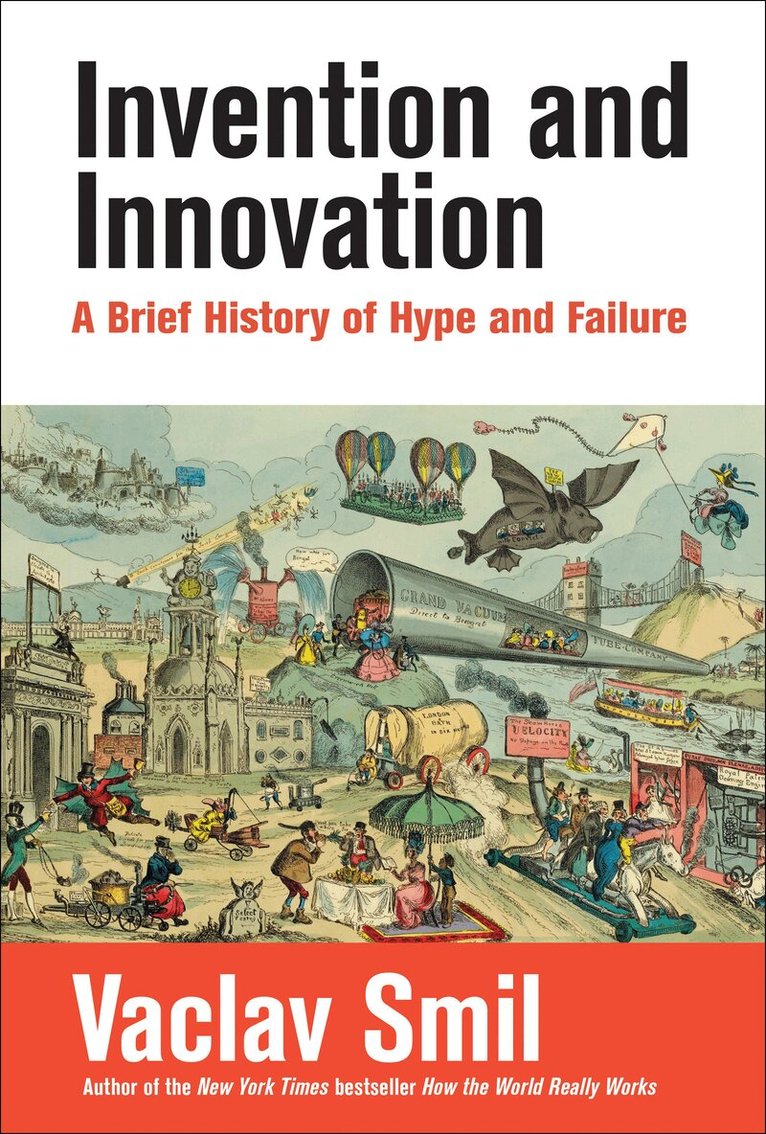
    Invention and Innovation

    A Brief History of Hype and Failure

    AvVaclav Smil

    Häftad, Engelska, 2024

    195 kr

    Skickas . Fri frakt över 249 kr.

    Fler format och utgåvor

    E-bok

    249 kr

    Beskrivning

    Tour the history of human invention—and its attendant breakthroughs and busts—in this history book from the New York Times-bestselling author of How the World Really Works. A BILL GATES RECOMMENDED BOOK: “Every Smil book that I own is marked up with lots of notes that I take while reading. Invention and Innovation is no exception.”The world is never finished catching up with Vaclav Smil, author of New York Times bestsellers How the World Really Works and Energy and Civilization. In Invention and Innovation, the prolific author—a favorite of Bill Gates—pens an insightful and fact-filled jaunt through the history of human invention. Impatient with the hype that so often accompanies innovation, Smil offers in this book a clear-eyed corrective to the overpromises that accompany everything from new cures for diseases to AI. He reminds us that even after we go quite far along the invention-development-application trajectory, we may never get anything real to deploy. Or worse, even after we have succeeded by introducing an invention, its future may be marked by underperformance, disappointment, demise, or outright harm.Drawing on his vast breadth of scientific and historical knowledge, Smil explains the difference between invention and innovation, and looks not only at inventions that failed to dominate as promised (such as the airship, nuclear fission, and supersonic flight), but also at those that turned disastrous (leaded gasoline, DDT, and chlorofluorocarbons). And finally, most importantly, he offers a “wish list” of inventions that we most urgently need to confront the staggering challenges of the twenty-first century.Filled with engaging examples and pragmatic approaches, this book is a sobering account of the folly that so often attends human ingenuity—and how we can, and must, better align our expectations with reality.

    Produktinformation

    • Utgivningsdatum:2024-09-03
    • Mått:152 x 229 x 17 mm
    • Vikt:312 g
    • Format:Häftad
    • Språk:Engelska
    • Antal sidor:232
    • Förlag:MIT Press Ltd
    • ISBN:9780262551014

    Utforska kategorier

    • Teknik: allmänt inom Naturvetenskap och teknik

    Mer om författaren

    Vaclav Smil is Distinguished Professor Emeritus at the University of Manitoba. He is the author of forty books, including New York Times bestseller How the World Really Works and Energy and Civilization, published by the MIT Press. In 2010 he was named by Foreign Policy as one of the Top 100 Global Thinkers. In 2013 Bill Gates wrote on his website that “there is no author whose books I look forward to more than Vaclav Smil.

    Recensioner i media

    Included in BILL GATES's 2023 Holiday Reading ListIncluded in Lit Hub’s Most Anticipated Books of 2023Included in The Next Big Idea Club’s February 2023 Must-Read Books"Every Smil book that I own is marked up with lots of notes that I take while reading. Invention and Innovation is no exception. Even when I disagree with him, I learn a lot from him...he always strengthens my thinking."—Bill Gates, Gates Notes"In what is essentially a history of invention (and therefore, in many ways, a history of civilization) Smil reminds us that human beings tend to fail a lot more than they succeed. And yet we are forever striving after better ways to do things, straining toward some perfectible society that no single generation will ever reach. Though Smil warns against our seemingly innate compulsion to overpromise, he also celebrates our capacity for collective innovation, and recognizes we’re going to need a lot of good ideas to get us out of the 21st century."—Lit Hub"Smil, the author of more than 40 books on scientific subjects and global matters, is always worth reading...An informative, entertaining package from a gifted, original thinker."—Kirkus Reviews"Smil (How the World Really Works), a professor emeritus at the University of Manitoba, takes a thought-provoking look at what “the long trajectory of inventions” suggests about what to expect in the future...This is a solid corrective to the notion that human inventiveness can tackle any challenge."—Publishers Weekly"While general usage tends to regard the terms invention and innovation as interchangeable synonyms, the eagle-eyed engineer will already be aware of the subtle but important difference between the two. While invention is focused on coming up with the ideas and discoveries in the first place, as Vaclav Smil says in his latest in a long line of highly readable analyses of the modern world."—E&T, Engineering & Technology"As an environmentalist and energy writer, Vaclav Smil is well placed to analyse the impact of past and promised inventions and innovations. He distinguishes between these concepts: innovation, he says, involves “mastering new materials, products, processes and ideas”. He focuses engagingly on three types of “failed” invention: welcomed but then unwelcome (for example, leaded petrol and the pesticide DDT); over-hyped (such as nuclear fission and supersonic flight); and undelivered (including travel by vacuum tube and controlled nuclear fusion)."—Nature"The prolific Smil (emer., Univ. of Manitoba), whose 40 published titles include Energy and Civilization and Global Catastrophes and Trends, examines the history of innovation failure since the 1860s. Briefly distinguishing between invention and innovation (an outcome), he sorts the latter into three categories: those that failed to dominate, those that were disastrous, and those still promised but yet to appear. Topical examples include fuel additives, nuclear energy, supersonic flight, hyperloop (vacuum tube) transport, and nitrogen-fixing cereals... Smil deftly supports his arguments with rich details and sobering statistics, calling for the need to improve the life of the world's population while avoiding impacts to the biosphere."—CHOICE"Smil, put a sharp focus on the hype cycle that drives so many tech innovations, like AI and biotech. For one example, he turns his lens on the often-promised microreactor revolution in nuclear power, scoffing that as of yet “no nation has announced any specific, detailed, and binding commitment to what would have to be a multidecadal program of reactor construction.” In other words as we’ve noted here in DFD, the future might be coming, but it’s often hard to build."—Politico

    Innehållsförteckning

    • I Inventions and innovations: a long history and modern infatuation 1II Inventions that turned from welcome to undesirable 19Leaded gasoline 23 DDT 36Chlorofluorocarbons 49III Inventions that were to dominate –- and do not 63Airships 66Nuclear fission 79 Supersonic flight 93IV Inventions that we keep waiting for 107Travel in (near) vacuum (hyperloop) 109Nitrogen-fixing cereals 123Controlled Nuclear Fusion 135V Techno-optimism, exaggerations, and realistic expectations 151Breakthroughs that are not 152Myth of ever-faster innovations 160What we need most 171Further reading 185Index 209