• Fri frakt över 249 kr
  • •
  • Snabba leveranser
  • •
  • Billiga böcker
Kundservice

Du är på sajten för privatpersoner.

Företag, bibliotek eller offentlig verksamhet?

Du handlar på classic.bokus.com, där alla dina funktioner finns intakta.
Till classic.bokus.com
Bokus logotyp. Gå till startsidan.
  • Erbjudanden
  • Nyheter
  • Student
  • Topplistor
  • Barn & ungdom
  • Bokus Play
  • E-böcker
  • Pocketböcker
  • Spel & pussel

10% rabatt på allt med kod: NYSTART10 →

Sidfot

Mina sidor

    Hjälp

    • Kundservice
    • Vanliga frågor och svar
    • Frakt och leverans
    • Retur vid ångerrätt
    • Reklamera vara
    • Betalning
    • Köpvillkor
    • Allmänna villkor
    • Information om webbplatsens tillgänglighet

    Om Bokus

    • Om oss
    • Pressrum
    • För studenter
    • För företag
    • För bibliotek och offentlig verksamhet
    • För leverantörer
    • Hållbarhet

    Populärt

    • Aktuella erbjudanden
    • Presentkort
    • Studentlitteratur
    • Nya böcker
    • Topplistor
    • Signerade böcker
    • Engelska böcker

    Inspiration

    • Boktips
    • BookTok
    • Populära bokserier
    • Barnbokskaraktärer
    • Populära författare
    Logotyp för Bokus
    Följ oss på Facebook (extern länk)Följ oss på Instagram (extern länk)Följ oss på YouTube (extern länk)Följ oss på TikTok (extern länk)
    bokus @ CookiesAnpassa cookiesIntegritetspolicyKöpvillkor
    Till Citymail hemsida (extern länk)Till Budbee hemsida (extern länk)Till Postnord hemsida (extern länk)Till Schenker hemsida (extern länk)Till Early Bird hemsida (extern länk)Till Walleys hemsida (extern länk)
    1. Skönlitteratur
    2. Litteraturvetenskap
    3. Litteraturvetenskap

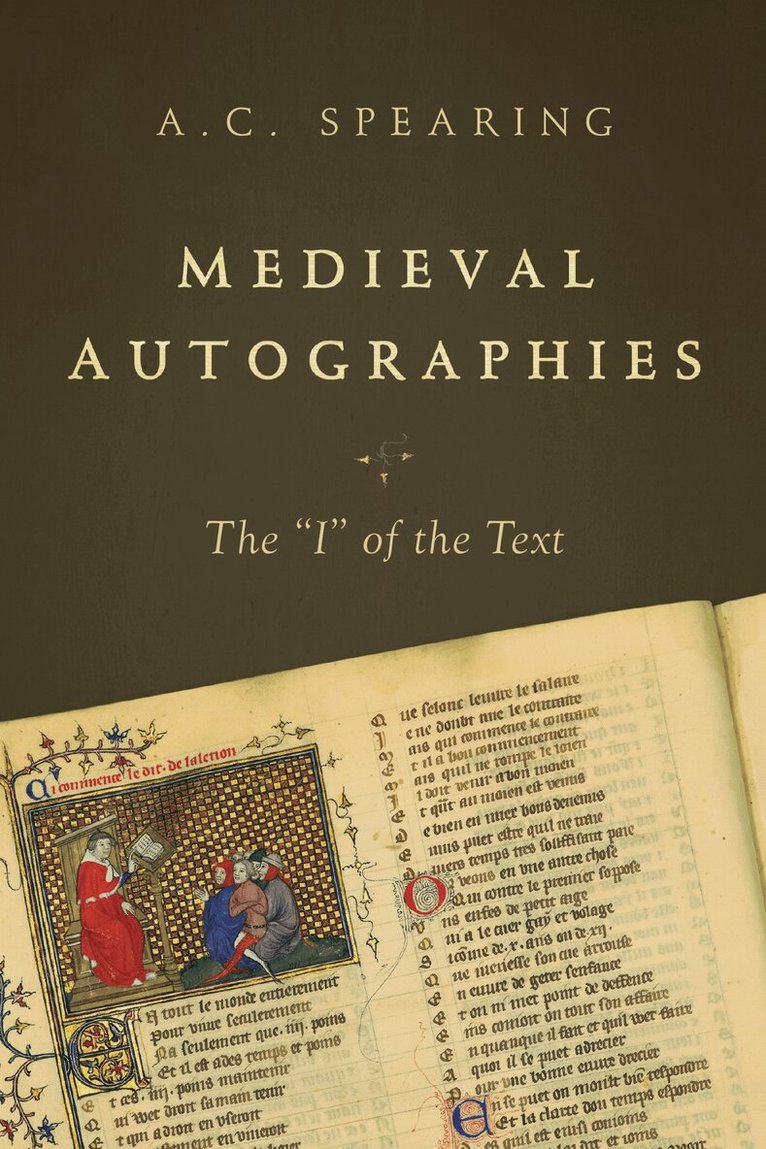
    Medieval Autographies

    The "I" of the Text

    AvA. C. Spearing

    Häftad, Engelska, 2012

    Del i serien Conway Lectures in Medieval Studies

    379 kr

    Beställningsvara. Skickas inom 5-8 vardagar. Fri frakt över 249 kr.

    Beskrivning

    In Medieval Autographies, A. C. Spearing develops a new engagement of narrative theory with medieval English first-person writing, focusing on the roles and functions of the "I" as a shifting textual phenomenon, not to be defined either as autobiographical or as the label of a fictional speaker or narrator. Spearing identifies and explores a previously unrecognized category of medieval English poetry, calling it "autography." He describes this form as emerging in the mid-fourteenth century and consisting of extended nonlyrical writings in the first person, embracing prologues, authorial interventions in and commentaries on third-person narratives, and descendants of the dit, a genre of French medieval poetry. He argues that autography arose as a means of liberation from the requirement to tell stories with preordained conclusions and as a way of achieving a closer relation to lived experience, with all its unpredictability and inconsistencies. Autographies, he claims, are marked by a cluster of characteristics including a correspondence to the texture of life as it is experienced, a montage-like unpredictability of structure, and a concern with writing and textuality. Beginning with what may be the earliest extended first-person narrative in Middle English, Winner and Waster, the book examines instances of the dit as discussed by French scholars, analyzes Chaucer's Wife of Bath's Prologue as a textual performance, and devotes separate chapters to detailed readings of Hoccleve's Regement of Princes prologue, his Complaint and Dialogue, and the witty first-person elements in Osbern Bokenham's legends of saints. An afterword suggests possible further applications of the concept of autography, including discussion of the intermittent autographic commentaries on the narrative in Troilus and Criseyde and Capgrave's Life of Saint Katherine.

    Produktinformation

    • Utgivningsdatum:2012-11-15
    • Mått:152 x 229 x 20 mm
    • Vikt:526 g
    • Format:Häftad
    • Språk:Engelska
    • Serie:Conway Lectures in Medieval Studies
    • Antal sidor:356
    • Förlag:University of Notre Dame Press
    • ISBN:9780268017828

    Utforska kategorier

    • Litteraturvetenskap inom Skönlitteratur

    Mer om författaren

    A. C. Spearing is William R. Kenan Professor of English at the University of Virginia and a Life Fellow of Queens' College, Cambridge. He is the author and editor of fourteen books, including Textual Subjectivity: The Encoding of Subjectivity in Medieval Narratives and Lyrics.

    Recensioner i media

    "A deeply challenging and engaging book, Medieval Autographies: The 'I' of the Text should be required reading in every graduate course in medieval English literature. In wonderfully nuanced close readings of various late medieval texts, A. C. Spearing extends and further theorizes his earlier groundbreaking work in Textual Subjectivity. His proposal of 'autography' as a new way of conceptualizing medieval first-person writing should have profound bearing on how future scholars conceptualize, designate, and discuss 'character,' 'intent,' and 'voice.'" —Peter W. Travis, Dartmouth College"This book offers an account of an often-noted but less often explained development in later medieval literature: the preponderance of texts written in the first person. . . . Spearing argues that the Middle English interest in the first-person prologue emerges out of the Old French dit." —Modern Philology"Medieval Autographies does an excellent job of highlighting both the fluidity of the Middle English poetic "I" and the inventiveness of some of its more familiar wielders. . . . At the same time as he illustrates the fruitfulness of his approach to Chaucer, Spearing also reassures his reader that abandoning familiar narrator-based readings of the author's work need not take all the fun out of explication." —Studies in the Age of Chaucer"One of the many strengths of this book is Spearing's sensitive and careful close readings of the texts themselves. . . . The book is an excellent corrective to certain tendencies in recent medieval scholarship that overstress hidden qualities and psychological complexities in narrators who are either naïve, obtuse, or unreliable. . . . As stimulating as it is engaging, this is a very important book." —Renaissance Quarterly"On the heels of Textual Subjectivity . . . A. C. Spearing once more provides the leverage for medievalists to remain relevant. Added to his 'supergenre,' the medieval category of 'autography,' defined as 'extended, non-lyrical, fictional writings in and of the first person' takes up center stage in Medieval Autographies: The "I" of the Text." —Sixteenth Century Journal"Spearing's book is engaging and perceptive. Grounded on a careful consideration of the primary texts and a nuanced and capacious reading of his peers' works, Medieval Autographies adds a convincing argument against the assumption that we can find modern expressions of subjectivity in medieval texts." —Renaissance and Reformation"Medieval Autographies is a thought-provoking, elegantly written book that challenges us to think about subjectivity as a literary effect available for 'a [wide] variety of expressive purposes,' rather than as the expression of a particular narrator's point of view. . . . Spearing offers an interpretative framework that might fruitfully be applied to many more texts than his book considers and which will stimulate some worthwhile reflection on what we choose to value in them." —Review of English Studies"Medieval Autographies engages with writings in the first person in a way that is sensitive towards what we know of medieval textuality and ideas of self, rather than resorting to modern categories such as 'dramatic monologue' or 'stream of consciousness.' Spearing encourages the reader to appreciate the free and loose structures of the poems discussed, rather than imposing cohesion through analysis." —Parergon"Spearing analyzes the autographies of a number of medieval authors, ranging from the widely read Chaucer, through the less well-known Hoccleve, to the unjustly obscure Bokenham (the further study of whom Spearing hopes to encourage). This important and carefully reasoned study. . . . should be eagerly read by specialists teaching about the Middle Ages. Highly recommended." —Choice". . . Here, [Spearing] not only extends his work [in Textual Subjectivity] to a new series of texts, but grounds it in another 'supergenre,' the medieval French form of first-person poetry known as the dit . . . [literary critics] could find abundant compensation by becoming as accurate and nuanced readers as Spearing. . . ." —Times Literary Supplement