• Fri frakt över 249 kr
  • •
  • Snabba leveranser
  • •
  • Billiga böcker
Kundservice

Du är på sajten för privatpersoner.

Företag, bibliotek eller offentlig verksamhet?

Du handlar på classic.bokus.com, där alla dina funktioner finns intakta.
Till classic.bokus.com
Bokus logotyp. Gå till startsidan.
  • Erbjudanden
  • Nyheter
  • Student
  • Topplistor
  • Barn & ungdom
  • Bokus Play
  • E-böcker
  • Pocketböcker
  • Spel & pussel

10% rabatt på allt med kod: NYSTART10 →

Sidfot

Mina sidor

    Hjälp

    • Kundservice
    • Vanliga frågor och svar
    • Frakt och leverans
    • Retur vid ångerrätt
    • Reklamera vara
    • Betalning
    • Köpvillkor
    • Allmänna villkor
    • Information om webbplatsens tillgänglighet

    Om Bokus

    • Om oss
    • Pressrum
    • För studenter
    • För företag
    • För bibliotek och offentlig verksamhet
    • För leverantörer
    • Hållbarhet

    Populärt

    • Aktuella erbjudanden
    • Presentkort
    • Studentlitteratur
    • Nya böcker
    • Topplistor
    • Signerade böcker
    • Engelska böcker

    Inspiration

    • Boktips
    • BookTok
    • Populära bokserier
    • Barnbokskaraktärer
    • Populära författare
    Logotyp för Bokus
    Följ oss på Facebook (extern länk)Följ oss på Instagram (extern länk)Följ oss på YouTube (extern länk)Följ oss på TikTok (extern länk)
    bokus @ CookiesAnpassa cookiesIntegritetspolicyKöpvillkor
    Till Citymail hemsida (extern länk)Till Budbee hemsida (extern länk)Till Postnord hemsida (extern länk)Till Schenker hemsida (extern länk)Till Early Bird hemsida (extern länk)Till Walleys hemsida (extern länk)
    1. Skönlitteratur
    2. Poesi

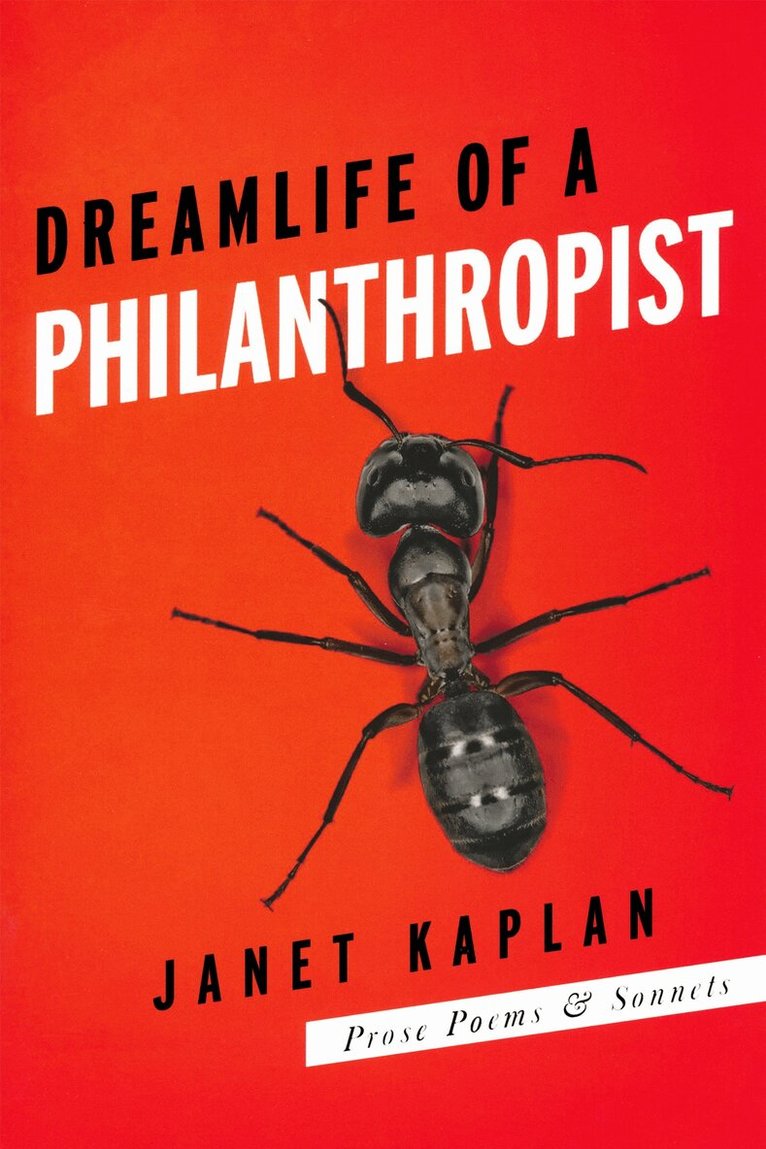
    Dreamlife of a Philanthropist

    AvJanet Kaplan

    Häftad, Engelska, 2011

    Del i serien Ernest Sandeen Prize in Poetry

    224 kr

    Beställningsvara. Skickas inom 5-8 vardagar. Fri frakt över 249 kr.

    Beskrivning

    With a salve in one hand and a burcher's knife in the other, Janet Kaplan offers her masterful third collection, Dreamlife of a Philanthropist, winner of the 2011 Ernest Sandeen prize in Poetry. The prose poems and sonnets in Dreamlife are packed with postmodern language-leaping, modern irony and absurdity, and a poet's ageless ear for the pleasures of the lyric and formal experimentation. These are poems that can never quite abandon the hope that life--and language—are worthy pursuits; but they never offer up easy assurances about the benefits of humanity to anyone or anything. Get ready for dogs that wail and overtake the scene; an invitation to make love on a mattress of ants; and the philanthropist of the title, who dreams that people are tuned into fish. It's "good luck and bad in random but equal measure," Kaplan writes in "Life and Times."

    Produktinformation

    • Utgivningsdatum:2011-02-15
    • Mått:152 x 229 x 4 mm
    • Vikt:110 g
    • Format:Häftad
    • Språk:Engelska
    • Serie:Ernest Sandeen Prize in Poetry
    • Antal sidor:72
    • Förlag:University of Notre Dame Press
    • ISBN:9780268033224
    • Utmärkelser:Winner of Ernest Sandeen Prize in Poetry 2011 (United States)

    Utforska kategorier

    • Poesi inom Skönlitteratur

    Mer om författaren

    Janet Kaplan is the author of two previous poetry collections, The Groundnote and The Glazier's Country. She teaches at Hofstra University and Fordham University, where she is currently Poet in Residence.

    Recensioner i media

    ". . . this collection has sustained richness, an irrepressible energy, at a deeper level. The voice is so consistently free of the usual taint of writer-ego that one almost gets the feeling that the poems have written themselves. . . . Kaplan leads us into each strange corner with such sureness that we are willing to go, honored to be there, and satisfied after each one that we have been shown a glimpse of something rare." —The Prose-Poem Project"Composed of (often comestible) daily objects made strange, Dreamlife of a Philanthropist bears echoes of ekphrasis and takes its cue from both the linguistically excitable and fabular lineages of the prose poem. Here we find ourselves face-to-face with "Organic bomber planes, zucchini flowers, captions. All of it blurry, a Seurat that never comes clear, no matter how far in the future one stands." Kaplan challenges the prose poem form by dividing many of her pieces into 14 numbered sections—an unrhymed sonnet riff—or by writing into her titles, ending, rather than beginning, with the thrust of naming. As such, Dreamlife employs the poem-as-object while slyly evading its containment. And the voice here charms, leading us into a landscape of Tender Buttons meets Claes Oldenberg or René Magritte. We have seen this world before, but this book calls for an experience of new proportions." —Karla Kelsey"'The mind's no place for a life,' writes Janet Kaplan, nudging reason off the stool where it had sat so preciously balanced. Some poems seek to re-wire the mechanism of their own creation; and here, in poems whose wit cannot be told apart from their momentum, we find thinking at work against itself, undoing conclusion, battling intent, in order to recover some lost ground of form's unconscious foundation. The ambition is high, though humble as you read it. Kaplan is capable of cosmogonic play and radical domesticity (as if one were different from the other). The poems here hover above their own titles, this dream-life of the poem more important than the poem itself, a place in which thinking is not yet thought, intent not yet conclusive, not language even as a form of life, but language in the process of making that life possible. It isn't a mental life; it is too real for that easy confine. Let's just call it the necessary life—a life of serious play." —Dan Beachy-Quick"Imagination reaches over to kiss reality on the neck in these poems. God and the universe have walk-on parts, as do symmetry, prescription drugs, children, mothers, fathers . . . all in the context of a vibrant animal world placed in the shifting sands of language, with the excitement of a threatened slide into chaos lurking beneath every lovely lyric turn." —Maria Melendez"In Janet Kaplan's work, the elements of thought—language, shifting self, recurrence, movement—combine into powerful compounds, compounds into machines whose primary purpose is to give shape and music to the void. These machines amaze the world to life, and Kaplan's reader may feel, as I do, lucky to be there at the inception." —Brian Clements