• Fri frakt över 249 kr
  • •
  • Snabba leveranser
  • •
  • Billiga böcker
Kundservice

Du är på sajten för privatpersoner.

Företag, bibliotek eller offentlig verksamhet?

Du handlar på classic.bokus.com, där alla dina funktioner finns intakta.
Till classic.bokus.com
Bokus logotyp. Gå till startsidan.
  • Erbjudanden
  • Nyheter
  • Student
  • Topplistor
  • Barn & ungdom
  • Bokus Play
  • E-böcker
  • Pocketböcker
  • Spel & pussel

10% rabatt på allt med kod: NYSTART10 →

Sidfot

Mina sidor

    Hjälp

    • Kundservice
    • Vanliga frågor och svar
    • Frakt och leverans
    • Retur vid ångerrätt
    • Reklamera vara
    • Betalning
    • Köpvillkor
    • Allmänna villkor
    • Information om webbplatsens tillgänglighet

    Om Bokus

    • Om oss
    • Pressrum
    • För studenter
    • För företag
    • För bibliotek och offentlig verksamhet
    • För leverantörer
    • Hållbarhet

    Populärt

    • Aktuella erbjudanden
    • Presentkort
    • Studentlitteratur
    • Nya böcker
    • Topplistor
    • Signerade böcker
    • Engelska böcker

    Inspiration

    • Boktips
    • BookTok
    • Populära bokserier
    • Barnbokskaraktärer
    • Populära författare
    Logotyp för Bokus
    Följ oss på Facebook (extern länk)Följ oss på Instagram (extern länk)Följ oss på YouTube (extern länk)Följ oss på TikTok (extern länk)
    bokus @ CookiesAnpassa cookiesIntegritetspolicyKöpvillkor
    Till Citymail hemsida (extern länk)Till Budbee hemsida (extern länk)Till Postnord hemsida (extern länk)Till Schenker hemsida (extern länk)Till Early Bird hemsida (extern länk)Till Walleys hemsida (extern länk)
    1. Filosofi och religion
    2. Filosofi
    3. Filosofiska discipliner

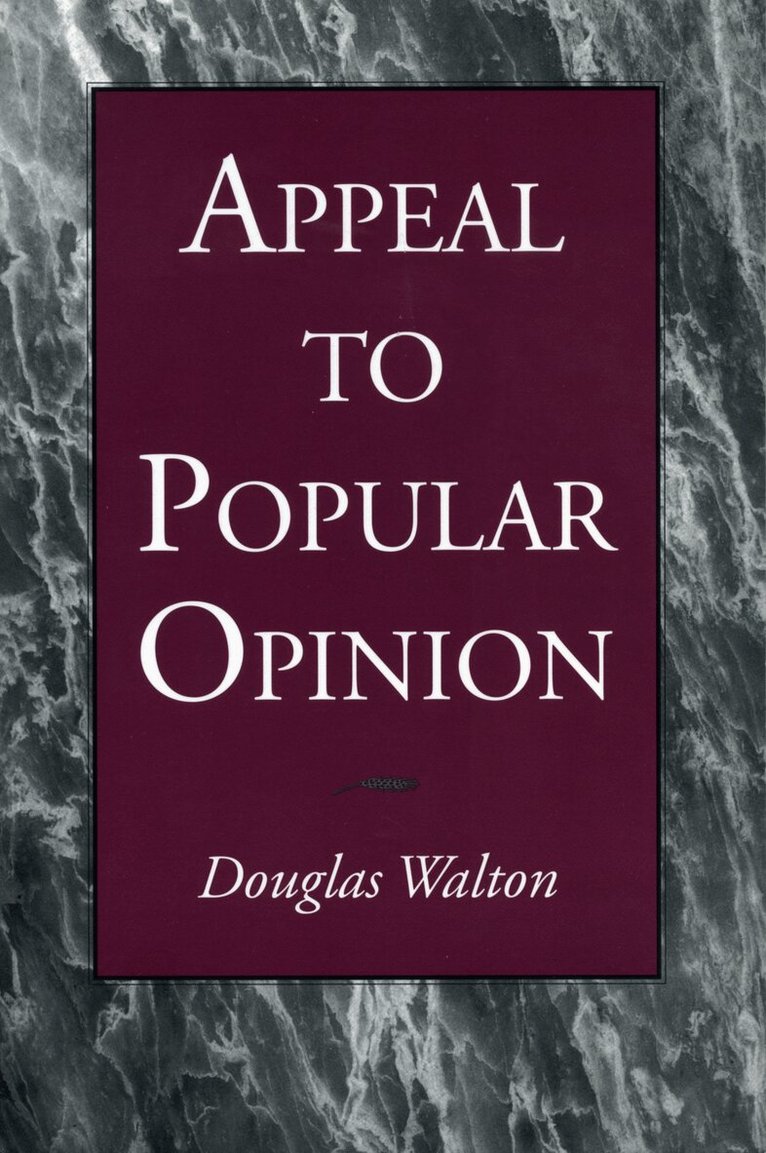
    Appeal to Popular Opinion

    AvDouglas Walton

    Häftad, Engelska, 1998

    448 kr

    Skickas . Fri frakt över 249 kr.

    Beskrivning

    Arguments from popular opinion have long been regarded with suspicion, and in most logic textbooks the ad populum argument is classified as a fallacy. Douglas Walton now asks whether this negative evaluation is always justified, particularly in a democratic system where decisions are based on majority opinion.In this insightful book, Walton maintains that there is a genuine type of argumentation based on commonly accepted opinions and presumptions that should represent a standard of rational decision-making on important issues, especially those of a personal and political nature. He shows how to judge arguments based on appeals to popular opinion in a more balanced way, identifying eleven subtypes of the ad populum argument and providing a pragmatic method to evaluate each of these types.Walton has examined dozens of logic texts and drawn on a wide range of literature to reveal the many uses and misuses of popular opinion. He contrasts the traditional discussion of ad populum in Greek rhetoric with recent textbook treatment, then contrasts these contemporary views with his own dialectical perspective in order to clarify often confused appeals to prejudice and appeals to common knowledge.Although appeal to popular opinion has long been a powerful argumentative tactic, this is the first book to systematically describe and evaluate it as a well-defined type of argument with its own special characteristics. It enables us to deal with these often deceptive arguments in a critically balanced way and makes an original contribution to an important strand of rhetoric.

    Produktinformation

    • Utgivningsdatum:1998-09-15
    • Mått:152 x 229 x 21 mm
    • Vikt:494 g
    • Format:Häftad
    • Språk:Engelska
    • Antal sidor:304
    • Förlag:Pennsylvania State University Press
    • ISBN:9780271030173

    Utforska kategorier

    • Filosofiska discipliner inom Filosofi och religion

    Mer om författaren

    Douglas Walton is Professor of Philosophy at the University of Winnipeg. Among his other books are The Place of Emotion in Argument (1992), Arguments from Ignorance (1995), and Appeal to Expert Opinion (1997), all from Penn State Press.

    Recensioner i media

    “This is an insightful book, usefully complementing Walton’s earlier works and helpfully exploring an area too long neglected. It is an excellent contribution not only to critical reasoning but also to rhetoric, and includes valuable advice about avoiding misunderstandings and better appreciating advertisements. I heartily recommend this book.”—Rod L. Evans International Philosophical Quarterly