Inbunden, Engelska, 1991
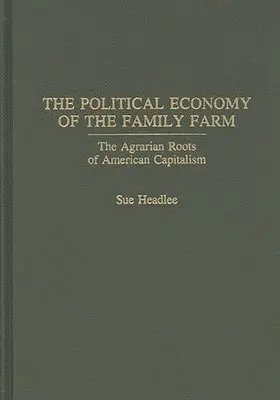
Political Economy of the Family Farm
Av Sue Headlee
1068 kr
Beställningsvara. Skickas inom 10-15 vardagar. Fri frakt över 249 kr.
Beskrivning
Agriculture played an important role in the transition to capitalism in the United States in the mid-nineteenth century. In her study, Sue Headlee argues that the family farm system, with its progressive nature and egalitarian class structure, revolutionized this transition to capitalism. The family farm is examined in light of its economic and political implications, showing the relationship between the family farm and fledgling industrial capitalism, a relationship that fostered the simultaneous industrial and agricultural revolutions and the creation of an agro-industrial complex. Headlee focuses on the adoption of the horse-drawn mechanical reaper (to harvest wheat) by family farmers in the 1850s. The neoclassical economic explanation, with its emphasis on the farm as a profit-maximizing firm, is criticized for its lack of recognition of the role of the family farm's egalitarian class structure. This look at the economic history of the United States has lessons for the Third World today: agricultural development is vital to the transition to capitalism; the agrarian class structures of Third World countries may be holding back that transition; and a family farm/land reform approach would lead to increases in productivity and in the material well-being of society.Headlee's analysis supports three important debates in political economy, thus providing the historical and theoretical context for understanding the role of agriculture in the transition to capitalism in general and in the particular case of the United States. Her findings conclude that agrarian class structures can explain the differential patterns of development in pre-industrial Europe. Further evidence is presented that the internal class structure of agrarian society is the crucial causal factor in the transition to capitalism and that market developments alone are not sufficient. Lastly and most controversially, Headlee acknowledges the importance of the Civil War in propelling the triumph of American capitalism, allowing the Republican Party (an alliance of family farmers and industrial capitalists) to take control of the state from the Democratic Party of the southern plantation owners. This book will be of interest to scholars in political economy, economic history, agrarian economics, and development economics.
Produktinformation
- Utgivningsdatum: 1991-11-30
- Mått: 157 x 235 x 18 mm
- Vikt: 533 g
- Format: Inbunden
- Språk: Engelska
- Antal sidor: 224
- Förlag: Bloomsbury Publishing Plc
- ISBN: 9780275938062
Utforska kategorier
Betyg & recensioner
0 recensioner
Inga recensioner tillgängliga.