• Fri frakt över 249 kr
  • •
  • Snabba leveranser
  • •
  • Billiga böcker
Kundservice

Du är på sajten för privatpersoner.

Företag, bibliotek eller offentlig verksamhet?

Du handlar på classic.bokus.com, där alla dina funktioner finns intakta.
Till classic.bokus.com
Bokus logotyp. Gå till startsidan.
  • Erbjudanden
  • Nyheter
  • Student
  • Topplistor
  • Barn & ungdom
  • Bokus Play
  • E-böcker
  • Pocketböcker
  • Spel & pussel

10% rabatt på allt med kod NYSTART10 →

Sidfot

Mina sidor

    Hjälp

    • Kundservice
    • Vanliga frågor och svar
    • Frakt och leverans
    • Retur vid ångerrätt
    • Reklamera vara
    • Betalning
    • Köpvillkor
    • Allmänna villkor
    • Information om webbplatsens tillgänglighet

    Om Bokus

    • Om oss
    • Pressrum
    • För studenter
    • För företag
    • För bibliotek och offentlig verksamhet
    • För leverantörer
    • Hållbarhet

    Populärt

    • Aktuella erbjudanden
    • Presentkort
    • Studentlitteratur
    • Nya böcker
    • Topplistor
    • Signerade böcker
    • Engelska böcker

    Inspiration

    • Boktips
    • BookTok
    • Populära bokserier
    • Barnbokskaraktärer
    • Populära författare
    Logotyp för Bokus
    Följ oss på Facebook (extern länk)Följ oss på Instagram (extern länk)Följ oss på YouTube (extern länk)Följ oss på TikTok (extern länk)
    bokus @ CookiesAnpassa cookiesIntegritetspolicyKöpvillkor
    Till Citymail hemsida (extern länk)Till Budbee hemsida (extern länk)Till Postnord hemsida (extern länk)Till Schenker hemsida (extern länk)Till Early Bird hemsida (extern länk)Till Walleys hemsida (extern länk)
    1. Samhälle och politik
    2. Sociologi och antropologi

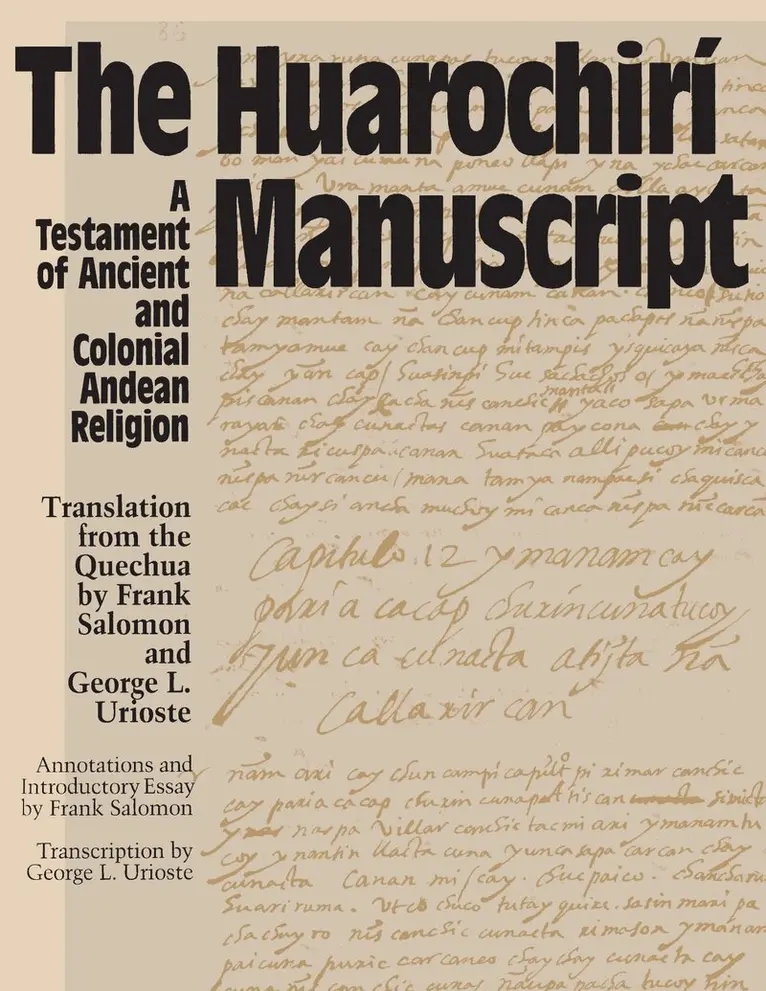
    Huarochiri Manuscript

    A Testament of Ancient and Colonial Andean Religion

    AvFrank Salomon

    Häftad, Engelska, 1991

    438 kr

    Beställningsvara. Skickas inom 10-15 vardagar. Fri frakt över 249 kr.

    Beskrivning

    One of the great repositories of a people's world view and religious beliefs, the HuarochirÍ Manuscript may bear comparison with such civilization-defining works as Gilgamesh, the Popul Vuh, and the Sagas. This translation by Frank Salomon and George L. Urioste marks the first time the HuarochirÍ Manuscript has been translated into English, making it available to English-speaking students of Andean culture and world mythology and religions.The HuarochirÍ Manuscript holds a summation of native Andean religious tradition and an image of the superhuman and human world as imagined around A.D. 1600. The tellers were provincial Indians dwelling on the west Andean slopes near Lima, Peru, aware of the Incas but rooted in peasant, rather than imperial, culture. The manuscript is thought to have been compiled at the behest of Father Francisco de Avila, the notorious "extirpator of idolatries." Yet it expresses Andean religious ideas largely from within Andean categories of thought, making it an unparalleled source for the prehispanic and early colonial myths, ritual practices, and historic self-image of the native Andeans.Prepared especially for the general reader, this edition of the HuarochirÍ Manuscript contains an introduction, index, and notes designed to help the novice understand the culture and history of the HuarochirÍ-area society. For the benefit of specialist readers, the Quechua text is also supplied.

    Produktinformation

    • Utgivningsdatum:1991-09-01
    • Mått:216 x 279 x 15 mm
    • Vikt:653 g
    • Format:Häftad
    • Språk:Engelska
    • Antal sidor:288
    • Förlag:University of Texas Press
    • ISBN:9780292730533

    Utforska kategorier

    • Sociologi och antropologi inom Samhälle och politik

    Mer om författaren

    Frank Salomon is John V. Murra Professor of Anthropology at the University of Wisconsin, Madison.George L. Urioste is professor of anthropology at the University of Nevada, Las Vegas.

    Recensioner i media

    This work represents the most fulsome and developed narrative available to us of how local people in a provincial setting in the Inca Empire conceived of their society and its past.... This book will stand for some time as the definitive transcription and English translation of a seminal document in Andean cultural history. (American Anthropologist) Although some Christian influence is discernible, the HuarochirÍ cycle is as close as we are likely to come to a purely Andean expression of the supernatural.... Urioste's transcription of the Quechua is included, and an Introductory Essay by Frank Salomon is an excellent study aid for both novices and adepts. (Latin American Indian Literatures Journal)

    Innehållsförteckning

    • AcknowledgmentsIntroductory Essay: The HuarochirÍ Manuscript The manuscript as testamentAndean religion and "Inca religion"General outline of the HuarochirÍ manuscriptEarly times and peoplesThe Paria Caca cycle and the myths of group identityChaupi Ñamca and the mythology of genderThe Incas as seen from HuarochirÍThe Spanish invasion as seen from HuarochirÍSpecialized chaptersThe HuarochirÍ region's people and their historic situationInto the world of the huacasPacha: 'earth, world, time, place'Camay: a concept of specific essence and force, 'to charge with being, to infuse with species power'Huaca: 'superhuman person, shrine, holy and powerful object'; huaca priesthoodYuriy/yumay: concepts of human birth and descentAyllu: corporate landholding collectivity self-defined as ancestor-focused kindredLlacta: 'village' as cultic and territorial unitThe original textThe possible genesis of the text in the local conjuncturePrevious editions of the HuarochirÍ manuscriptThe character of the present translation Language substrates and non-Quechua languages Quechua other than the "general" dialectLanguage(s) of the Jaqi (Aymara) familyNon-Quechua, non-Jaqi native lexicon?SpanishThe problem of redactionThe problem of validationTranslation of style Framing sentencesNarrative passagesVersified speech in semantic coupletsOther translation conventionsNote conventionsTranscription conventionsToponymic and onomastic spelling conventionsIndex and glossaryThe HuarochirÍ Manuscript [Preface]Chapter 1. How the Idols of Old Were, and How They Warred among Themselves, and How the Natives Existed at That TimeChapter 2. How Cuni Raya Vira Cocha Acted in His Own Age. The Life of Cuni Raya Vira Cocha. How Caui Llaca Gave Birth to His Child, and What FollowedChapter 3. What Happened to the Indians in Ancient Times When the Ocean Overflowed Chapter 4. How the Sun Disappeared for Five Days. In What Follows We Shall Tell a Story about the Death of the SunChapter 5. How in Ancient Times Paria Caca Appeared on a Mountain Named Condor Coto in the Form of Five Eggs, and What Followed. Here Will Begin the Account of Paria Caca's EmergenceChapter 6. How Paria Caca Was Born as Five Falcons and Then Turned into Persons, and How, Already Victorious over All the Yunca of Anchi Cocha, He Began to Walk toward Paria Caca Mountain, and What Happened along the WayChapter 7. How Those Cupara People Revere the One Called Chuqui Suso Even to This DayChapter 8. How Paria Caca Ascended. How One Man Came Back with His Child by Following Paria Caca's Commands, and, Finally, How He Struggled with Huallallo CaruinchoChapter 9. How Paria Caca, Having Accomplished All This, Began to Ordain His Own CultChapter 10. Who Chaupi Ñamca Was, Where She Dwells, and How She Arranged Her CultChapter 11. How People Danced the Chanco Dance. In Speaking of These Matters, We Shall Also Tell Who Tutay Quiri, the Child of Paria Caca, Was. The Story Is Like ThisChapter 12. How Paria Caca's Children Undertook the Conquest of All the Yunca PeopleChapter 13. MamaChapter 14.Chapter 15. Next We Shall Write about What Was Mentioned in the SecondChapter, Namely, Whether Cuni Raya Existed before or after CaruinchoChapter 16. Here We Shall Write on Whether Paria Caca, Born from Five Eggs, Was Composed of Brothers or Whether Paria Caca Was Their Father, Things of This KindChapter 17.Chapter 18.Chapter 19.Chapter 20. Here Begins the Life of Llocllay Huancupa. In What Follows, We Shall Also Write about Its EndChapter 21. Although a Dream Is Not Valid, We Shall Speak about That Demon's Frightful Deeds and Also about the Way in Which Don CristÓbal Defeated HimChapter 22.Chapter 23. We Shall Write Here about the Inca's Summons to All the Huacas. We ShallAlso Speak Here of Maca Uisa's VictoryChapter 24. Next We Shall Write about the Customs of the Checa, the Machua Yunca Festival and Its Dances, and, Finally, about the Origin of the PeopleChapter 25. Here We Shall Write How the Wind Blew the Colli People from Yaru Tini Down to the Lower YuncaChapter 26. How Paria Caca Defeated Maca Calla. How He Established His Children after His VictoryChapter 27. How in Former Times, on the Fifth Day after Their Death, People Said, "I'm Back!" We Shall Write about These ThingsChapter 28. How People Used to Feed the Spirits of the Dead during Paria Caca's Festival and How They Thought about All Saints' Day in Former TimesChapter 29. How Something Called the Yacana Comes Down from the Sky to Drink Water. We Shall Also Speak about the Other Stars and Their NamesChapter 30. How Two Huacas, a Male and a Female, Dwell in the Lake of the Allauca in Purui. We Shall Write about Their LivesChapter 31. As in the Previous Chapter We Spoke about the Existence of a Certain Lake, Likewise We Shall Now Tell about the Lake of the Concha Ayllu, the One Called Yansa. The Story Is Like This[Supplement I][Supplement II]Transcription of the HuarochirÍ ManuscriptGlossary of Untranslated WordsBibliographic ReferencesIndex