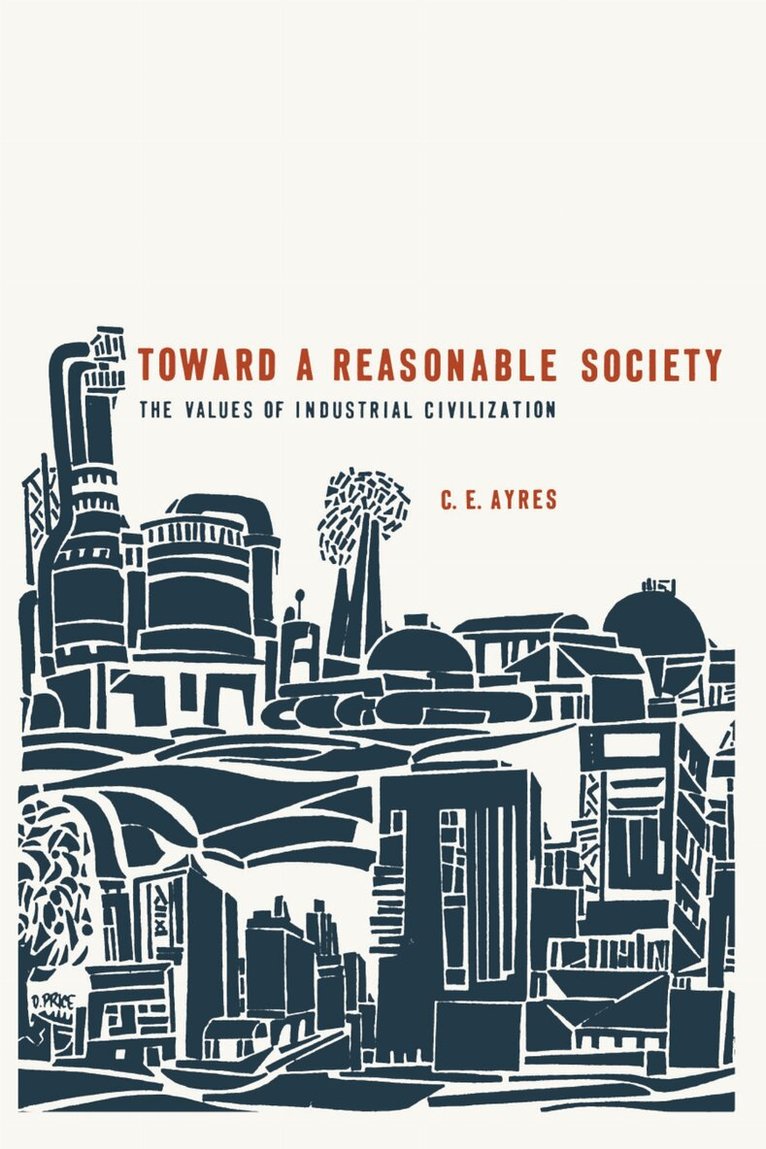
Häftad, Engelska, 1961
Toward a Reasonable Society
Av C. E. Ayres
332 kr
Beställningsvara. Skickas inom 10-15 vardagar. Fri frakt över 249 kr.
Beskrivning
Those who despair of our age will find in this stimulating book heartening answers to their questions about the fate of Western civilization and indications of the course humanity should follow if it is to save itself and the world. The course is not new. According to Ayres, it is the same course that humanity has taken from the dawn of history, but with too many detours in pursuit of false values. It is the course that has brought us to the point of civilization where we now stand-the course of developing knowledge and expanding truth, of our increasing ability to exploit nature for our own welfare. From the earliest stick tool-through the invention of the wheel, the Industrial Revolution, and the marvelous scientific and technological developments of the space age-science and technology, knowledge and skill, have enabled humankind to create for itself an increasingly better life. But with this development has come a sense of conflict between our secular culture and our traditional values, a conflict requiring a reevaluation of values. This reevaluation is the subject of Ayres' book. His theme is that the abiding values are those relating to the common human experience shared by all peoples, those values deriving from the quest for knowledge, from the never-ending struggle to harness the forces of nature to human use. They are measured in terms of a standard of value that has the same meaning for all people. And they have their validity in the cause-and-effect relationship basic to all human reasoning and to the oneness and interrelatedness of all life. Toward a Reasonable Society is a defense of industrial culture. It is a creative work, drawing upon numerous areas of knowledge-ethics, sociology, economics, anthropology, history, philosophy, psychology, biology, music, the graphic arts, mathematics, the physical sciences-to show the uniformities and the unchangeables in the oneness of human life. It is an attack upon nostalgia and a defense of current arts, crafts, knowledge, wisdom, and individual character. It is an inspiring definition of freedom, equality, security, abundance, and other values of a democratic society. In being all these things it assumes a point of view that looks toward the future. And it is exciting reading. The author's closely reasoned discourse leads with inevitable progress from one chapter to the next, with something like the suspense of a detective story. Each chapter is an intellectual episode leaving the reader with an eagerness to see what the next development will be. The concreteness of the numerous examples enhances the clarity of the prose. The compelling note is optimism for the future in further development of the industrial society that has achieved the most successful way of life humankind has ever known.
Produktinformation
- Utgivningsdatum: 1961-01-01
- Mått: 152 x 229 x 18 mm
- Vikt: 454 g
- Format: Häftad
- Språk: Engelska
- Antal sidor: 310
- Förlag: University of Texas Press
- ISBN: 9780292780262
Utforska kategorier
Betyg & recensioner
0 recensioner
Inga recensioner tillgängliga.