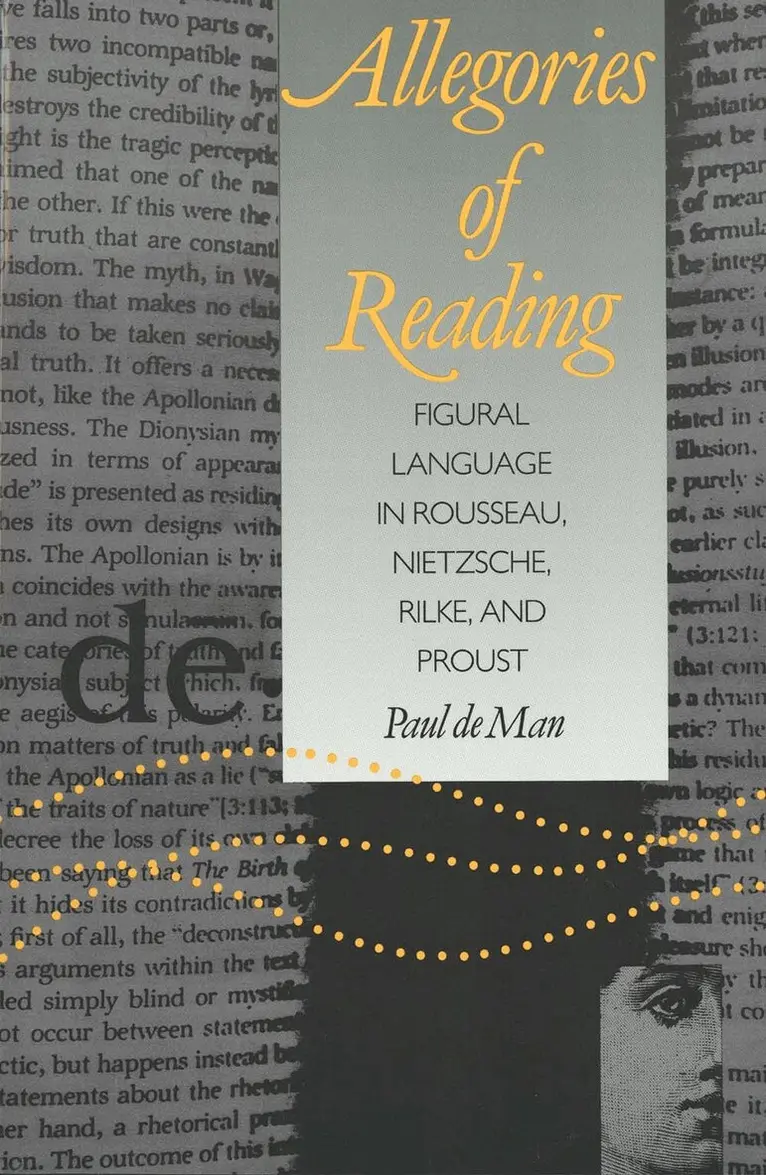
Häftad, Engelska, 1982
Allegories of Reading
Av Paul de Man
305 kr
Skickas idag. Fri frakt över 249 kr.
Beskrivning
This important theoretical work by Paul de Man sets forth a mode of reading and interpretation based on exemplary texts by Rousseau, Nietzsche, Rilke, and Proust. The readings start from unresolved difficulties in the critical traditions engendered by these authors, and they return to the places in the text where those difficulties are most apparent or most incisively reflected upon. The close reading leads to the elaboration of a more general model of textual understanding, in which de Man shows that the thematic aspects of the texts—their assertions of truth or falsehood as well as their assertions of values—are linked to specific modes of figuration that can be identified and described. The description of synchronic figures of substitution leads, by an inner logic embedded in the structure of all tropes, to extended, narrative figures or allegories. De Man poses the question whether such self-generating systems of figuration can account fully for the intricacies of meaning and of signification they produce. Throughout the book, issues in contemporary criticism are addressed analytically rather than polemically. Traditional oppositions are put in question by a rhetorical analysis which demonstrates why literary texts are such powerful sources of meaning yet epistemologically so unreliable. Since the structure which underlies this tension belongs to language in general and is not confined to literary texts, the book, starting out as practical and historical criticism or as the demonstration of a theory of literary reading, leads into larger questions pertaining to the philosophy of language. "Through elaborate and elegant close readings of poems by Rilke, Proust’s Remembrance, Nietzsche’s philosophical writings and the major works of Rousseau, de Man concludes that all writing concerns itself with its own activity as language, and language, he says, is always unreliable, slippery, impossible….Literary narrative, because it must rely on language, tells the story of its own inability to tell a story....De Man demonstrates, beautifully and convincingly, that language turns back on itself, that rhetoric is untrustworthy."—Julia Epstein, Washington Post Book World"The study follows out of the thinking of Nietzsche and Genette (among others), yet moves in strikingly new directions....De Man’s text, almost certain to be endlessly provocative, is worthy of repeated re-reading."—Ralph Flores, Library Journal"Paul de Man continues his work in the tradition of ‘deconstructionist criticism,’… [which] begins with the observation that all language is constructed; therefore the task of criticism is to deconstruct it and reveal what lies behind. The title of his new work reflects de Man’s preoccupation with the unreliability of language. … The contributions that the book makes, both in the initial theoretical chapters and in the detailed analyses (or deconstructions) of particular texts are undeniable."—Caroline D. Eckhardt, World Literature Today
Produktinformation
- Utgivningsdatum: 1982-09-01
- Mått: 156 x 235 x 19 mm
- Vikt: 454 g
- Format: Häftad
- Språk: Engelska
- Antal sidor: 320
- Förlag: Yale University Press
- ISBN: 9780300028454
Utforska kategorier
Betyg & recensioner
0 recensioner
Inga recensioner tillgängliga.