• Fri frakt över 249 kr
  • •
  • Snabba leveranser
  • •
  • Billiga böcker
Kundservice

Du är på sajten för privatpersoner.

Företag, bibliotek eller offentlig verksamhet?

Du handlar på classic.bokus.com, där alla dina funktioner finns intakta.
Till classic.bokus.com
Bokus logotyp. Gå till startsidan.
  • Erbjudanden
  • Nyheter
  • Student
  • Topplistor
  • Barn & ungdom
  • Bokus Play
  • E-böcker
  • Pocketböcker
  • Spel & pussel

10% rabatt på allt med kod: NYSTART10 →

Sidfot

Mina sidor

    Hjälp

    • Kundservice
    • Vanliga frågor och svar
    • Frakt och leverans
    • Retur vid ångerrätt
    • Reklamera vara
    • Betalning
    • Köpvillkor
    • Allmänna villkor
    • Information om webbplatsens tillgänglighet

    Om Bokus

    • Om oss
    • Pressrum
    • För studenter
    • För företag
    • För bibliotek och offentlig verksamhet
    • För leverantörer
    • Hållbarhet

    Populärt

    • Aktuella erbjudanden
    • Presentkort
    • Studentlitteratur
    • Nya böcker
    • Topplistor
    • Signerade böcker
    • Engelska böcker

    Inspiration

    • Boktips
    • BookTok
    • Populära bokserier
    • Barnbokskaraktärer
    • Populära författare
    Logotyp för Bokus
    Följ oss på Facebook (extern länk)Följ oss på Instagram (extern länk)Följ oss på YouTube (extern länk)Följ oss på TikTok (extern länk)
    bokus @ CookiesAnpassa cookiesIntegritetspolicyKöpvillkor
    Till Citymail hemsida (extern länk)Till Budbee hemsida (extern länk)Till Postnord hemsida (extern länk)Till Schenker hemsida (extern länk)Till Early Bird hemsida (extern länk)Till Walleys hemsida (extern länk)
    1. Skönlitteratur
    2. Essäer

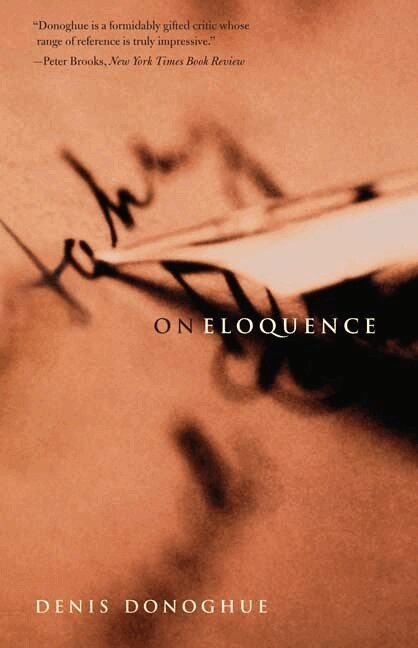
    On Eloquence

    AvDenis Donoghue

    Häftad, Engelska, 2010

    446 kr

    Beställningsvara. Skickas inom 5-8 vardagar. Fri frakt över 249 kr.

    Beskrivning

    An eloquent reminder of why we should care about—and revel in—eloquence in literature and speechOn Eloquence questions the common assumption that eloquence is merely a subset of rhetoric, a means toward a rhetorical end. Denis Donoghue, an eminent and prolific critic of the English language, holds that this assumption is erroneous. While rhetoric is the use of language to persuade people to do one thing rather than another, Donoghue maintains that eloquence is “gratuitous, ideally autonomous, in speech and writing an upsurge of creative vitality for its own sake.” He offers many instances of eloquence in words, and suggests the forms our appreciation of them should take. Donoghue argues persuasively that eloquence matters, that we should indeed care about it. “Because we should care about any instances of freedom, independence, creative force, sprezzatura,” he says, “especially when we live—perhaps this is increasingly the case—in a culture of the same, featuring official attitudes, stereotypes of the officially enforced values, sedated language, a politics of pacification.” A noteworthy addition to Donoghue’s long-term project to reclaim a disinterested appreciation of literature as literature, this volume is a wise and pleasurable meditation on eloquence, its unique ability to move or give pleasure, and its intrinsic value.

    Produktinformation

    • Utgivningsdatum:2010-01-22
    • Mått:132 x 205 x 12 mm
    • Vikt:231 g
    • Format:Häftad
    • Språk:Engelska
    • Antal sidor:208
    • Förlag:Yale University Press
    • ISBN:9780300158397

    Utforska kategorier

    • Essäer inom Skönlitteratur
    • Litteraturvetenskap inom Skönlitteratur

    Mer om författaren

    Denis Donoghue is University Professor and Henry James Professor of English and American Letters, New York University. Among his many books are The Practice of Reading; Words Alone: The Poet T. S. Eliot; Speaking of Beauty (a New York Times Notable Book of the Year); and The American Classics: A Personal Essay, all published by Yale University Press.

    Recensioner i media

    "Donoghue is a formidably gifted critic whose range of reference is truly impressive." Peter Brooks, New York Times Book Review "In this book, Donoghue continues his case for reading for aesthetic pleasure rather than to have our political values endorsed or abused. This is an argument that needs to be made, and it is all the more crucial that a critic of Donoghue's stature make it." David Rosen, Trinity College"