• Fri frakt över 249 kr
  • •
  • Snabba leveranser
  • •
  • Billiga böcker
Kundservice

Du är på sajten för privatpersoner.

Företag, bibliotek eller offentlig verksamhet?

Du handlar på classic.bokus.com, där alla dina funktioner finns intakta.
Till classic.bokus.com
Bokus logotyp. Gå till startsidan.
  • Erbjudanden
  • Student
  • Topplistor
  • Barn & ungdom
  • Bokus Play
  • E-böcker
  • Ljudböcker
  • Pocketböcker
  • Spel & pussel

10% rabatt på allt med kod NYSTART10 →

Sidfot

Mina sidor

    Hjälp

    • Kundservice
    • Vanliga frågor och svar
    • Frakt och leverans
    • Retur vid ångerrätt
    • Reklamera vara
    • Betalning
    • Köpvillkor
    • Allmänna villkor
    • Information om webbplatsens tillgänglighet

    Om Bokus

    • Om oss
    • Pressrum
    • För studenter
    • För företag
    • För bibliotek och offentlig verksamhet
    • För leverantörer
    • Hållbarhet

    Populärt

    • Aktuella erbjudanden
    • Presentkort
    • Studentlitteratur
    • Nya böcker
    • Topplistor
    • Signerade böcker
    • Engelska böcker

    Inspiration

    • Boktips
    • BookTok
    • Populära bokserier
    • Barnbokskaraktärer
    • Populära författare
    Logotyp för Bokus
    Följ oss på Facebook (extern länk)Följ oss på Instagram (extern länk)Följ oss på YouTube (extern länk)Följ oss på TikTok (extern länk)
    bokus @ CookiesAnpassa cookiesIntegritetspolicyKöpvillkor
    Till Citymail hemsida (extern länk)Till Budbee hemsida (extern länk)Till Postnord hemsida (extern länk)Till Schenker hemsida (extern länk)Till Early Bird hemsida (extern länk)Till Walleys hemsida (extern länk)
    1. Naturvetenskap och teknik
    2. Matematik och naturvetenskap
    3. Kemi
    4. Fysikalisk kemi

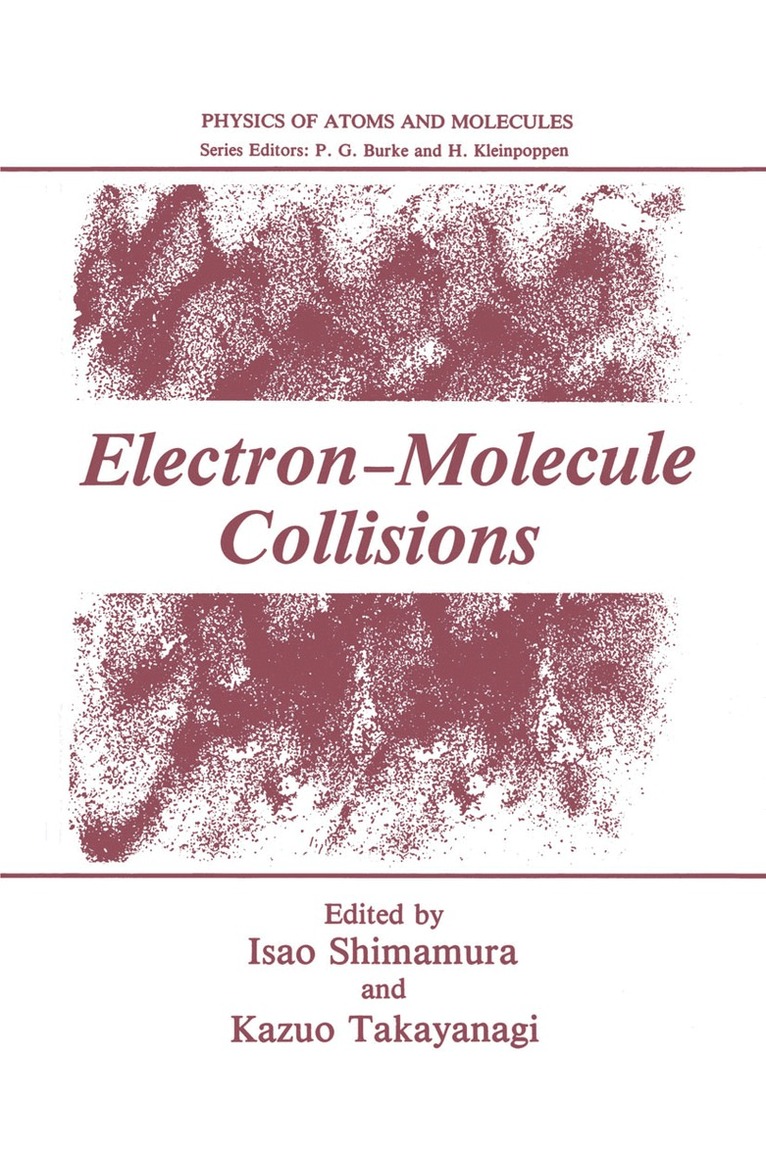
    Electron-Molecule Collisions

    AvIsao Shimamura,Kazuo Takayanagi

    Inbunden, Engelska, 1984

    Del i serien Physics of Atoms and Molecules

    2 161 kr

    Beställningsvara. Skickas inom 10-15 vardagar. Fri frakt över 249 kr.

    Beskrivning

    Scattering phenomena play an important role in modern physics. Many significant discoveries have been made through collision experiments. Amongst diverse kinds of collision systems, this book sheds light on the collision of an electron with a molecule. The electron-molecule collision provides a basic scattering problem. It is scattering by a nonspherical, multicentered composite particle with its centers having degrees of freedom of motion. The molecule can even disintegrate, Le., dissociate or ionize into fragments, some or all of which may also be molecules. Although it is a difficult problem, the recent theoretical, experimental, and computational progress has been so significant as to warrant publication of a book that specializes in this field. The progress owes partly to technical develop­ ments in measurements and computations. No less important has been the great and continuing stimulus from such fields of application as astrophysics, the physics of the earth's upper atmosphere, laser physics, radiation physics, the physics of gas discharges, magnetohydrodynamic power generation, and so on. This book aims at introducing the reader to the problem of electron­ molecule collisions, elucidating the physics behind the phenomena, and review­ ing, to some extent, up-to-date important results. This book should be appropri­ ate for graduate reading in physics and chemistry. We also believe that investi­ gators in atomic and molecular physics will benefit much from this book.

    Produktinformation

    • Utgivningsdatum:1984-12-31
    • Mått:155 x 235 x 32 mm
    • Vikt:993 g
    • Format:Inbunden
    • Språk:Engelska
    • Serie:Physics of Atoms and Molecules
    • Antal sidor:570
    • Upplaga:1984
    • Förlag:Springer Science+Business Media
    • ISBN:9780306415319

    Utforska kategorier

    • Fysikalisk kemi inom Naturvetenskap och teknik

    Innehållsförteckning

    • 1. Introduction to Electron-Molecule Collisions.- 1. Introduction.- 2. Cross Sections.- 3. Electron-Molecule Interactions.- 4. Resonance Effect.- 5. Calculation of the Total Cross Section as a Potential Scattering Problem.- 6. Theoretical Formulation of Inelastic Scattering Processes.- 2. Rotational Excitation of Molecules by Slow Electrons.- 1. Introduction.- 2. Classical Sudden Collisions and Angular-Momentum Transfer.- 3. Quantum-Mechanical Sudden Collisions and Angular-Momentum Transfer.- 4. Division of the Configuration Space.- 5. Physics in the Potential Scattering Region.- 6. Physics in the Compound-System Region.- Appendix: Summary of Formulas.- References and Notes.- 3. Vibrational Excitation of Molecules by Slow Electrons.- 1. Introduction.- 2. Virtual States and Resonances.- 3. Vibrational Excitation. I: Wave-Function Enhancement without Trapping.- 4. Vibrational Excitation. II: Electron Scattering at a Shape Resonance; Impulse Limit.- 5. Vibrational Excitation. III: Long-Lived Resonances and Nuclear Relaxation.- 6. Current Developments.- Appendix A: Resonance Scattering of Electrons by a Target with Fixed Nuclei.- Appendix B: Resonance Scattering of an Electron by a Molecule with Relaxing Nuclei.- Appendix C: The Impulse Approximation.- Appendix D: Wave Packets.- References and Notes.- 4. Dissociation of Molecules by Slow Electrons.- 1. Introduction.- 2. Dissociation of Molecules into Ground Electronic State Fragments.- 3. Dissociation into Excited Fragments.- 4. Dissociative Ionization.- 5. Dissociative Attachment.- 6. Dissociative Attachment to Ultracold Molecules and Molecular Clusters.- 7. Dissociative Recombination.- References and Notes.- 5. Molecular Spectroscopy By Electron Scattering.- 1. Introduction.- 2. Resonance Spectroscopy of Molecules.- 3. Electron Energy-Loss Spectroscopy.- References.- 6. Experimental Techniques for Cross-Section Measurements.- 1. Introduction.- 2. Definition of Cross Sections.- 3. Measurement of Total, Integral, and Momentum-Transfer Cross Sections.- 4. Measurement of Differential Cross Sections.- 5. Electron Collision Measurements at High Energies; Generation of Optical Data.- 6. Electron Scattering in Electromagnetic Fields.- 7. Closing Remarks.- References.- 7. Computational Methods for Low-Energy Electron-Molecule Collisions.- 1. Introduction.- 2. Derivation of the Radial Equations.- 3. Numerical Solution of the Fixed-Nuclei Equations.- 4. Vibrational Excitation and Dissociative Attachment.- 5. Electronic Excitation.- 6. Conclusions.- References.