Inbunden, Engelska, 1987
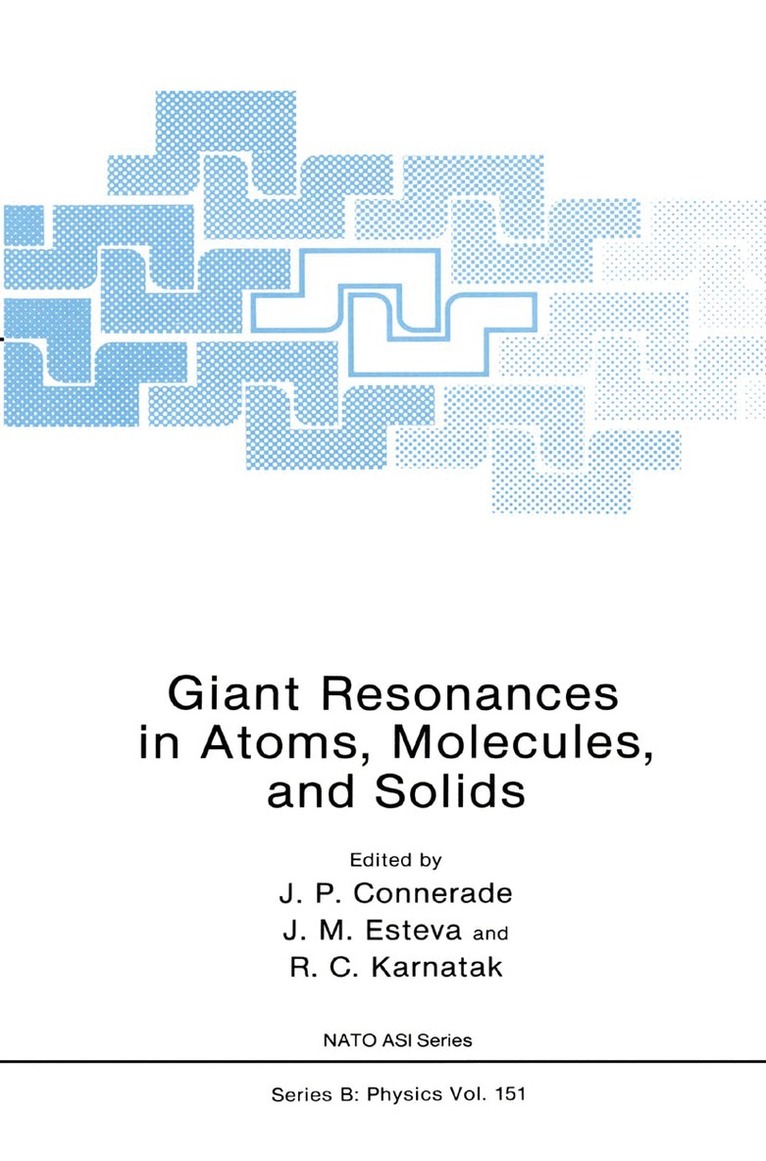
Giant Resonances in Atoms, Molecules, and Solids
Av J.P. Connerade, J.M. Esteva, R.C. Karnatak
2179 kr
Beställningsvara. Skickas inom 10-15 vardagar. Fri frakt över 249 kr.
Beskrivning
Often, a new area of science grows at the confines between recognised subject divisions, drawing upon techniques and intellectual perspectives from a diversity of fields. Such growth can remain unnoticed at first, until a characteristic fami ly of effects, described by appropriate key words, has developed, at which point a distinct subject is born. Such is very much the case with atomic 'giant resonances'. For a start, their name itself was borrowed from the field of nuclear collective resonances. The energy range in which they occur, at the juncture of the extreme UV and the soft X-rays, remains to this day a meeting point of two different experimental techniques: the grating and the crystal spectrometer. The impetus of synchrotron spectroscopy also played a large part in developing novel methods, described by many acronyms, which are used to study 'giant resonances' today. Finally, although we have described them as 'atomic' to differentiate them from their counterparts in Nuclear Physics, their occurrence on atomic sites does not inhibit their existence in molecules and solids. In fact, 'giant resonances' provide a new unifying theme, cutting accross some of the traditional scientific boundaries. After much separate development, the spectroscopies of the atom in various environments can meet afresh around this theme of common interest. Centrifugal barrier effects and 'giant resonances' proper emerged almost simultaneously in the late 1960's from two widely separated areas of physics, namely the study of free atoms and of condensed matter.
Produktinformation
- Utgivningsdatum: 1987-06-30
- Mått: 178 x 254 x 37 mm
- Vikt: 1 225 g
- Format: Inbunden
- Språk: Engelska
- Serie: NATO Science Series B:
- Antal sidor: 570
- Upplaga: 1987
- Förlag: Springer Science+Business Media
- ISBN: 9780306425646
Utforska kategorier
Betyg & recensioner
0 recensioner
Inga recensioner tillgängliga.