• Fri frakt över 249 kr
  • •
  • Snabba leveranser
  • •
  • Billiga böcker
Kundservice

Du är på sajten för privatpersoner.

Företag, bibliotek eller offentlig verksamhet?

Du handlar på classic.bokus.com, där alla dina funktioner finns intakta.
Till classic.bokus.com
Bokus logotyp. Gå till startsidan.
  • Erbjudanden
  • Nyheter
  • Student
  • Topplistor
  • Barn & ungdom
  • Bokus Play
  • E-böcker
  • Pocketböcker
  • Spel & pussel

10% rabatt på allt med kod: NYSTART10 →

Sidfot

Mina sidor

    Hjälp

    • Kundservice
    • Vanliga frågor och svar
    • Frakt och leverans
    • Retur vid ångerrätt
    • Reklamera vara
    • Betalning
    • Köpvillkor
    • Allmänna villkor
    • Information om webbplatsens tillgänglighet

    Om Bokus

    • Om oss
    • Pressrum
    • För studenter
    • För företag
    • För bibliotek och offentlig verksamhet
    • För leverantörer
    • Hållbarhet

    Populärt

    • Aktuella erbjudanden
    • Presentkort
    • Studentlitteratur
    • Nya böcker
    • Topplistor
    • Signerade böcker
    • Engelska böcker

    Inspiration

    • Boktips
    • BookTok
    • Populära bokserier
    • Barnbokskaraktärer
    • Populära författare
    Logotyp för Bokus
    Följ oss på Facebook (extern länk)Följ oss på Instagram (extern länk)Följ oss på YouTube (extern länk)Följ oss på TikTok (extern länk)
    bokus @ CookiesAnpassa cookiesIntegritetspolicyKöpvillkor
    Till Citymail hemsida (extern länk)Till Budbee hemsida (extern länk)Till Postnord hemsida (extern länk)Till Schenker hemsida (extern länk)Till Early Bird hemsida (extern länk)Till Walleys hemsida (extern länk)
    1. Naturvetenskap och teknik
    2. Matematik och naturvetenskap
    3. Kemi
    4. Fysikalisk kemi

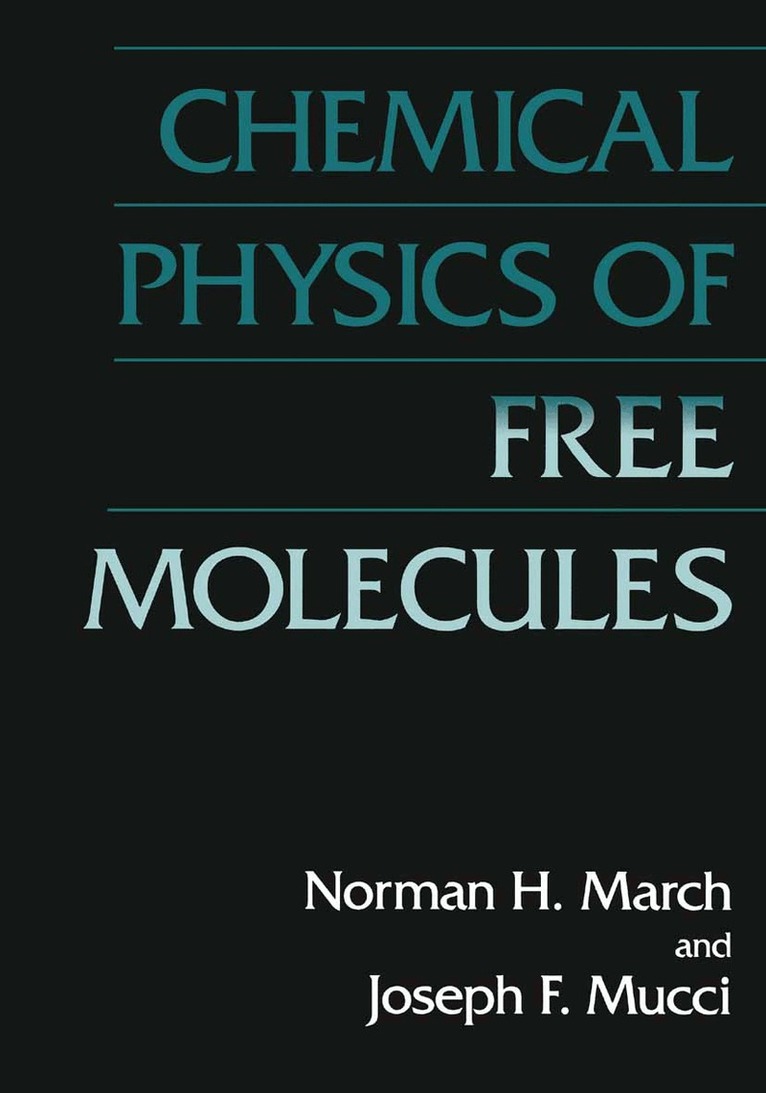
    Chemical Physics of Free Molecules

    AvNorman H. March,J.F. Mucci

    Inbunden, Engelska, 1993

    1 086 kr

    Beställningsvara. Skickas inom 10-15 vardagar. Fri frakt över 249 kr.

    Fler format och utgåvor

    Häftad

    1 086 kr

    Beskrivning

    In this introductory chemical physics textbook, the authors discuss the interactions, bonding, electron density, and experimental techniques of free molecules, and apply spectroscopic methods to determine molecular parameters, dynamics, and chemical reactions.

    Produktinformation

    • Utgivningsdatum:1993-08-31
    • Mått:178 x 254 x 27 mm
    • Vikt:979 g
    • Format:Inbunden
    • Språk:Engelska
    • Antal sidor:393
    • Upplaga:1993
    • Förlag:Springer Science+Business Media
    • ISBN:9780306442704

    Utforska kategorier

    • Fysikalisk kemi inom Naturvetenskap och teknik
    • Fysik inom Naturvetenskap och teknik

    Innehållsförteckning

    • One Chemical Concepts and Experimental Techniques.- Two The Nature of Bonding in Diatoms.- Three Molecular Interactions.- Four Electron Density Description of Molecules.- Five Molecular Parameters Determined by Spectroscopic Methods.- Six Molecular Orbital Methods and Polyatomic Molecules.- Seven Chemical Reactions, Dynamics, and Laser Spectroscopy.- A1.1. Wave Functions for the Hydrogen Atom.- A1.2. The Periodic Table and Atomic Ground States.- A1.3. Total Energies of Heavy Atomic Ions—Coulomb Field Model.- A1.4. Orthogonality of Solutions of the Schrödinger Equation.- A2.1. Variation Principle.- A2.3. Born-Oppenheimer Approximation.- A2.4. Slater- and Gaussian-Type Orbitals.- A2.6. Virial and Hellmann-Feynman Theorems.- A3.1. Topics Relevant to the Treatment of Intermolecular Forces.- A3.2. Bibliography for Further Study of Intermolecular Forces.- A4.1. The Correspondence between Cells in Phase Space and Quantum-Mechanical Energy Levels.- A4.2. The Kinetic Energy Density of an Inhomogeneous Electron Gas.- A4.3. The Chemical Potential, Teller’s Theorem, and Scaling of Energies of Homonuclear Diatoms.- A4.4. The Self-Consistent Field in the Helium Atom.- A4.5. The Self-Consistent Field Treatment of Binding Energies of Heavy Positive Atomic Ions.- A4.6. The Hartree-Fock Self-Consistent Field Method.- A4.7. The Dirac-Slater Exchange Energy and Existence of a One-Body Potential Including Both Exchange and Correlation.- A4.8. Proof that the Ground-State Energy of a Molecule Is Uniquely Determined by the Electron Density.- A4.9. Modeling of the Chemical Potential in Hydrogen Halides and Mixed Halides.- A4.10. X-Ray Scattering by Neon-Like Molecules.- A4.11. Two-Center Calculations from the Thomas-Fermi Theory.- A5.1. Rotational Energy Levels of Some Simple Classes ofMolecules: The Symmetric Rotor.- A5.2. The Rotational Partition Function in Relation to Spectroscopic Intensities.- A5.3. Normal Modes of Vibration of Molecules.- A5.4. The Franck-Condon Principle.- A5.5. Time-Dependent Perturbation Theory and Selection Rules for Electric Dipole Transitions in Atoms.- A5.6. Spin-Orbit Coupling.- A5.7. Dirac’s Relativistic Wave Equation for One Electron.- A5.8. Relativistic Electron Density Theory for Molecules Composed of Heavy Atoms.- A6.1. The Jahn-Teller Effect.- A6.2. Koopmans’ Theorem and Its Use in Interpreting Photoelectron Spectra.- A7.1. Symmetry Arguments for Electrocyclic Reactions.- A7.2. Chemical Reactions: Arrhenius’ Empirical Work, the Collision Theory, and the Absolute Rate or Transition State Theory.- Advanced Problems.- AI. Some Advanced Aspects of Quantum-Mechanical Perturbation Theory.- AII. The Formation of Acetylene from Two CH Fragments.- AIII. MacDonald’s Theorem.- AIV. Spectroscopic Nomenclature.- AV. The Wentzel-Kramers-Brillouin Semiclassical Method for Calculating Eigenvalues for Central Fields.- AVI. Electron Correlation in the Helium Atom and the Slow Convergence of Configuration Interaction.- Further Problems.- References.