• Fri frakt över 249 kr
  • •
  • Snabba leveranser
  • •
  • Billiga böcker
Kundservice

Du är på sajten för privatpersoner.

Företag, bibliotek eller offentlig verksamhet?

Du handlar på classic.bokus.com, där alla dina funktioner finns intakta.
Till classic.bokus.com
Bokus logotyp. Gå till startsidan.
  • Erbjudanden
  • Nyheter
  • Student
  • Topplistor
  • Barn & ungdom
  • Bokus Play
  • E-böcker
  • Pocketböcker
  • Spel & pussel

10% rabatt på allt med kod NYSTART10 →

Sidfot

Mina sidor

    Hjälp

    • Kundservice
    • Vanliga frågor och svar
    • Frakt och leverans
    • Retur vid ångerrätt
    • Reklamera vara
    • Betalning
    • Köpvillkor
    • Allmänna villkor
    • Information om webbplatsens tillgänglighet

    Om Bokus

    • Om oss
    • Pressrum
    • För studenter
    • För företag
    • För bibliotek och offentlig verksamhet
    • För leverantörer
    • Hållbarhet

    Populärt

    • Aktuella erbjudanden
    • Presentkort
    • Studentlitteratur
    • Nya böcker
    • Topplistor
    • Signerade böcker
    • Engelska böcker

    Inspiration

    • Boktips
    • BookTok
    • Populära bokserier
    • Barnbokskaraktärer
    • Populära författare
    Logotyp för Bokus
    Följ oss på Facebook (extern länk)Följ oss på Instagram (extern länk)Följ oss på YouTube (extern länk)Följ oss på TikTok (extern länk)
    bokus @ CookiesAnpassa cookiesIntegritetspolicyKöpvillkor
    Till Citymail hemsida (extern länk)Till Budbee hemsida (extern länk)Till Postnord hemsida (extern länk)Till Schenker hemsida (extern länk)Till Early Bird hemsida (extern länk)Till Walleys hemsida (extern länk)
    1. Psykologi och pedagogik
    2. Psykologi
    3. Socialpsykologi och gruppsykologi

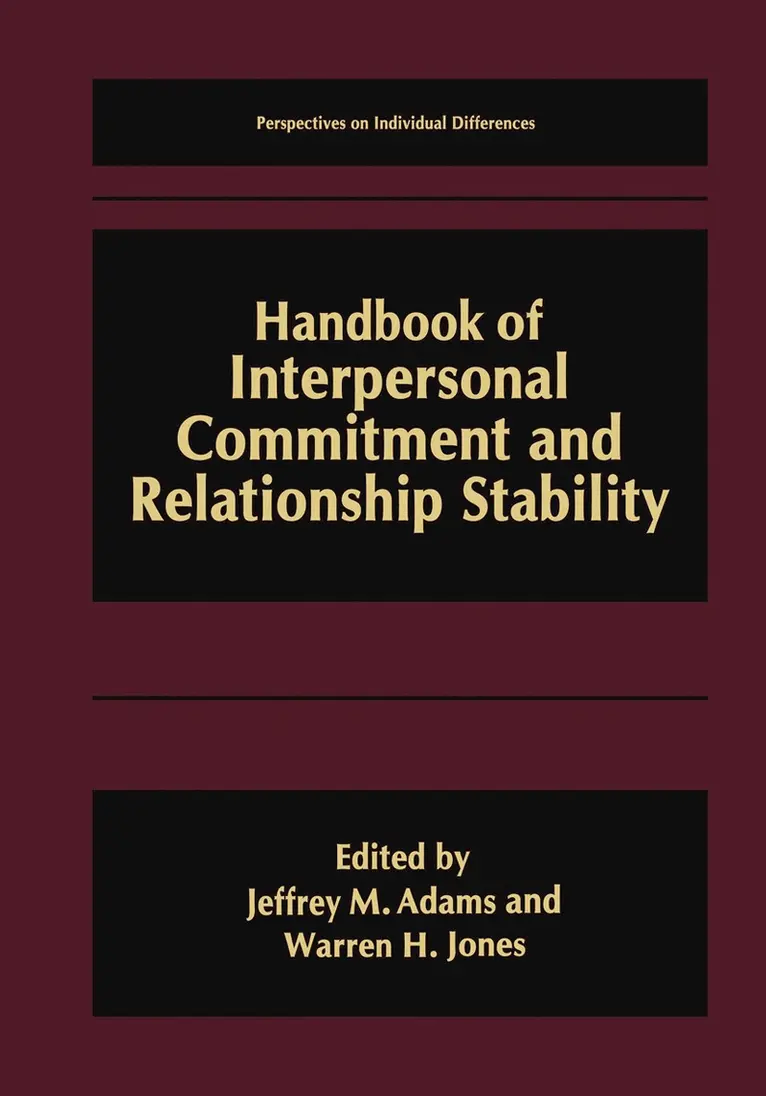
    Handbook of Interpersonal Commitment and Relationship Stability

    AvJeffrey M. Adams,Warren H. Jones

    Inbunden, Engelska, 1999

    Del i serien Perspectives on Individual Differences

    2 101 kr

    Beställningsvara. Skickas inom 10-15 vardagar. Fri frakt över 249 kr.

    Beskrivning

    A fundamental assumption underlying the formation of our most important relationships is that they will persist indefinitely into the future. As an acquaintanceship turns into a friend­ ship, for example, both members of this newly formed interpersonal bond are likely to expect that their interactions will become increasingly frequent, diverse, and intimate over time. This expectation is perhaps most apparent in romantically involved couples who, through a variety of verbal and symbolic means, make explicit pledges to a long-lasting relationship. In either case, it is clear that these relationships represent something valuable to the individuals in­ volved and are pursued with great enthusiasm. Virtually all close relationships are formed within the context of mutually rewarding in­ teractions and/or strong physical attraction between partners. Friends and romantically in­ volved couples alike are drawn to one another because of similarity of attitudes, interests, and personality and, quite simply, because they enjoy one another's company. This enjoyment, cou­ pled with the novelty that characterizes new relationships, almost makes the continuation of the relationship a foregone conclusion. As relationships progress, however, their novelty fades, conflicts may arise between partners, negative life events may occur, and the satisfaction that previously characterized the relationships may diminish.

    Produktinformation

    • Utgivningsdatum:1999-09-30
    • Mått:178 x 254 x 35 mm
    • Vikt:1 230 g
    • Format:Inbunden
    • Språk:Engelska
    • Serie:Perspectives on Individual Differences
    • Antal sidor:532
    • Upplaga:1999
    • Förlag:Springer Science+Business Media
    • ISBN:9780306461484

    Utforska kategorier

    • Socialpsykologi och gruppsykologi inom Psykologi och pedagogik

    Innehållsförteckning

    • I. Introduction.- 1. Interpersonal Commitment in Historical Perspective.- II. Conceptualization and Measurement of Interpersonal Commitment.- 2. Duty toward Whom? Reconsidering Attractions and Barriers as Determinants of Commitment in a Relationship.- 3. Conceiving Couple Commitment: Choice, Promise, and Fulfillment.- 4. Personal, Moral, and Structural Commitment to Relationships: Experiences of Choice and Constraint.- III. The Development of Interpersonal Commitment.- 5. Interpersonal Experience in Infancy as a Foundation for the Capacity in Adults for Stable Relationships.- 6. Attachment Processes and Commitment to Romantic Relationships.- 7. The Development of Commitment to Marriage: A Phenomenological Approach.- 8. Commitment in the Early Years of Marriage.- IV. Basic Commitment Processes in Relationships.- 9. The Dynamics of Interpersonal Commitment and the Issue of Salience.- 10. Marital Commitment and Family Life Transitions: A Social Exchange Perspective on the Construction and Deconstruction of Intimate Relationships.- 11. Commitment and Adversity: A Reciprocal Relation.- 12. The Relationship of Exchange and Commitment.- 13. What Attachment Styles and Love Styles Add to the Understanding of Commitment and Relationship Stability.- 14. Interpersonal Commitments: The Interplay of Social Networks and Individual Identities.- V. Commitment within Diverse Populations.- 15. Stability and Commitment in Friendships.- 16. The Bereavement Experience: Continuing Commitment after the Loss of a Loved One.- 17. Examples of Commitment in Postdivorce Relationships between Ex-Spouses.- 18. Levels and Styles of Commitment in Marriage: The Case of Asian Indian Immigrants.- 19. Commitment and Sexual Behaviors in Adolescent Dating Relationships.- 20. The Constraints of Innovation: Commitment and Stability among Same-Sex Couples.- VI. Clinical Issues and Applications.- 21. Perceived Partner Commitment and Attachment Style: Clinical Implications of a Cognitive Perspective.- 22. Using What We Know: Commitment and Cognitions in Marital Therapy.- 23. Dominant Discourse in Heterosexual Relationships: Inhibitors or Facilitators of Interpersonal Commitment and Relationship Stability?.- 24. Communication Processes in Marital Commitment: An Integrative Approach.- VII. Related Constructs.- 25. Commitment and Trust in Close Relationships: An Interdependence Analysis.- 26. Buffering the Effects of Betrayal: The Role of Apology, Forgiveness, and Commitment.- 27. Jealousy and Problems of Commitment.- 28. Deconstructing Stability: The Distinction between the Course of a Close Relationship and Its Endpoint.- VIII. Conclusion.- 29. Future Directions for Commitment Research.