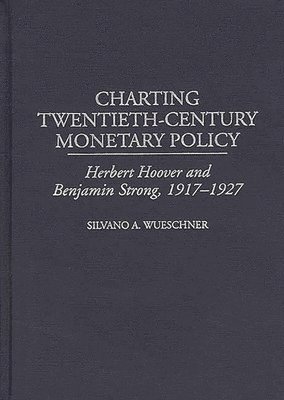
Charting Twentieth-Century Monetary Policy
Herbert Hoover and Benjamin Strong, 1917-1927
E-bok
PDF, Engelska, 1999Del i serien Contributions in Economics and Economic History
1 178 kr
Läs direkt i Bokus Reader – eller ladda ned till din enhet (PDF kräver ofta zoom och scroll på små skärmar).
Fler format och utgåvor
Beskrivning
Herbert Hoover, as Secretary of Commerce, and Benjamin Strong, as Governor of the Federal Reserve Bank of New York, played a critical role in the formulation of American monetary policy during the 1920s. Yet little attention has been given to the relationship between them—at first cooperative, then increasingly one of conflict and factionalism—or to the impact of that relationship on policy formulation. This book sheds new light on their roles in policy making and relates those roles to larger conflicts over where policy should be made, how the Federal Reserve System should be structured, and the balance that should be struck between international, national, and regional considerations.
Focusing on the Hoover-Strong relationship from a political rather than a purely economic perspective, the book's scope includes both domestic and international aspects of Federal Reserve policy formulation. New sources have enabled the author to provide both fresh details and a broader interpretation. Elaborating on the belief that the Depression resulted from policies developed during the autumn of 1927, the author contends that the foundation for those policies was laid with America's decision to underwrite the Dawes plan, the decision to underwrite England's return to the gold standard, and the involvement in European monetary stabilization—all issues over which Hoover and Strong disagreed.
Focusing on the Hoover-Strong relationship from a political rather than a purely economic perspective, the book's scope includes both domestic and international aspects of Federal Reserve policy formulation. New sources have enabled the author to provide both fresh details and a broader interpretation. Elaborating on the belief that the Depression resulted from policies developed during the autumn of 1927, the author contends that the foundation for those policies was laid with America's decision to underwrite the Dawes plan, the decision to underwrite England's return to the gold standard, and the involvement in European monetary stabilization—all issues over which Hoover and Strong disagreed.