• Fri frakt över 249 kr
  • •
  • Snabba leveranser
  • •
  • Billiga böcker
Kundservice

Du är på sajten för privatpersoner.

Företag, bibliotek eller offentlig verksamhet?

Du handlar på classic.bokus.com, där alla dina funktioner finns intakta.
Till classic.bokus.com
Bokus logotyp. Gå till startsidan.
  • Erbjudanden
  • Nyheter
  • Student
  • Topplistor
  • Barn & ungdom
  • Bokus Play
  • E-böcker
  • Pocketböcker
  • Spel & pussel

10% rabatt på allt med kod NYSTART10 →

Sidfot

Mina sidor

    Hjälp

    • Kundservice
    • Vanliga frågor och svar
    • Frakt och leverans
    • Retur vid ångerrätt
    • Reklamera vara
    • Betalning
    • Köpvillkor
    • Allmänna villkor
    • Information om webbplatsens tillgänglighet

    Om Bokus

    • Om oss
    • Pressrum
    • För studenter
    • För företag
    • För bibliotek och offentlig verksamhet
    • För leverantörer
    • Hållbarhet

    Populärt

    • Aktuella erbjudanden
    • Presentkort
    • Studentlitteratur
    • Nya böcker
    • Topplistor
    • Signerade böcker
    • Engelska böcker

    Inspiration

    • Boktips
    • BookTok
    • Populära bokserier
    • Barnbokskaraktärer
    • Populära författare
    Logotyp för Bokus
    Följ oss på Facebook (extern länk)Följ oss på Instagram (extern länk)Följ oss på YouTube (extern länk)Följ oss på TikTok (extern länk)
    bokus @ CookiesAnpassa cookiesIntegritetspolicyKöpvillkor
    Till Citymail hemsida (extern länk)Till Budbee hemsida (extern länk)Till Postnord hemsida (extern länk)Till Schenker hemsida (extern länk)Till Early Bird hemsida (extern länk)Till Walleys hemsida (extern länk)
    1. Data och IT
    2. Databaser

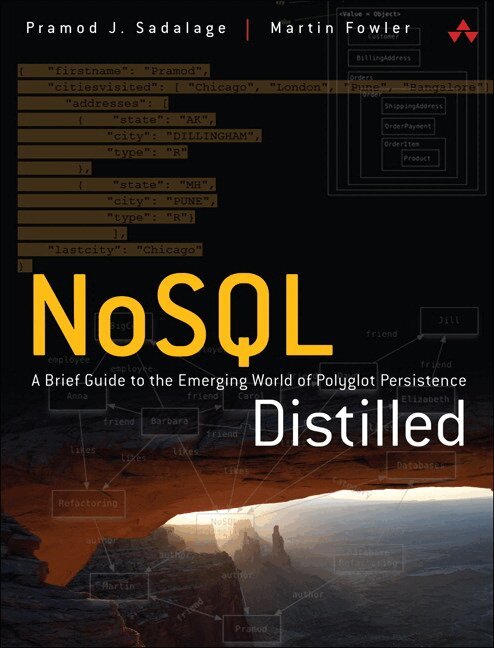
    NoSQL Distilled

    A Brief Guide to the Emerging World of Polyglot Persistence

    AvPramod Sadalage,Martin Fowler

    Häftad, Engelska, 2012

    304 kr

    Beställningsvara. Skickas inom 7-10 vardagar. Fri frakt över 249 kr.

    Beskrivning

    The need to handle increasingly larger data volumes is one factor driving the adoption of a new class of nonrelational “NoSQL” databases. Advocates of NoSQL databases claim they can be used to build systems that are more performant, scale better, and are easier to program.


    NoSQL Distilled is a concise but thorough introduction to this rapidly emerging technology. Pramod J. Sadalage and Martin Fowler explain how NoSQL databases work and the ways that they may be a superior alternative to a traditional RDBMS. The authors provide a fast-paced guide to the concepts you need to know in order to evaluate whether NoSQL databases are right for your needs and, if so, which technologies you should explore further.


    The first part of the book concentrates on core concepts, including schemaless data models, aggregates, new distribution models, the CAP theorem, and map-reduce. In the second part, the authors explore architectural and design issues associated with implementing NoSQL. They also present realistic use cases that demonstrate NoSQL databases at work and feature representative examples using Riak, MongoDB, Cassandra, and Neo4j.


    In addition, by drawing on Pramod Sadalage’s pioneering work, NoSQL Distilled shows how to implement evolutionary design with schema migration: an essential technique for applying NoSQL databases. The book concludes by describing how NoSQL is ushering in a new age of Polyglot Persistence, where multiple data-storage worlds coexist, and architects can choose the technology best optimized for each type of data access.


    Produktinformation

    • Utgivningsdatum:2012-08-30
    • Mått:175 x 231 x 13 mm
    • Vikt:318 g
    • Format:Häftad
    • Språk:Engelska
    • Antal sidor:192
    • Upplaga:1
    • Förlag:Pearson Education
    • ISBN:9780321826626

    Utforska kategorier

    • Databaser inom Data och IT
    • Grafik och bildbehandling inom Data och IT

    Mer om författaren

    Pramod J. Sadalage, Principal Consultant at ThoughtWorks, enjoys the rare role of bridging the divide between database professionals and application developers. He regularly consults with clients who have particularly challenging data needs requiring new technologies and techniques. He developed pioneering techniques that allowed relational databases to be designed in an evolutionary manner based on version-controlled schema migrations. With Scott Ambler, he coauthored Refactoring Databases(Addison-Wesley, 2006).  Martin Fowler, Chief Scientist at ThoughtWorks, focuses on better ways to design software systems and improve developer productivity. His books include Patterns of Enterprise Application Architecture; UML Distilled, Third Edition; Domain-Specific Languages (with Rebecca Parsons); and Refactoring: Improving the Design of Existing Code (with Kent Beck, John Brant, and William Opdyke). All are published by Addison-Wesley.

    Innehållsförteckning

    • Preface xiii  Part I: Understand  1  Chapter 1: Why NoSQL? 31.1 The Value of Relational Databases 31.2 Impedance Mismatch 51.3 Application and Integration Databases 61.4 Attack of the Clusters 81.5 The Emergence of NoSQL 91.6 Key Points 12  Chapter 2: Aggregate Data Models 132.1 Aggregates 142.2 Key-Value and Document Data Models 202.3 Column-Family Stores 212.4 Summarizing Aggregate-Oriented Databases 232.5 Further Reading 242.6 Key Points 24  Chapter 3: More Details on Data Models 253.1 Relationships 253.2 Graph Databases 263.3 Schemaless Databases 283.4 Materialized Views 303.5 Modeling for Data Access 313.6 Key Points 36  Chapter 4: Distribution Models 374.1 Single Server 374.2 Sharding 384.3 Master-Slave Replication 404.4 Peer-to-Peer Replication 424.5 Combining Sharding and Replication 434.6 Key Points 44  Chapter 5: Consistency 475.1 Update Consistency 475.2 Read Consistency 495.3 Relaxing Consistency 525.4 Relaxing Durability 565.5 Quorums 575.6 Further Reading 595.7 Key Points 59  Chapter 6: Version Stamps 616.1 Business and System Transactions 616.2 Version Stamps on Multiple Nodes 636.3 Key Points 65  Chapter 7: Map-Reduce 677.1 Basic Map-Reduce 687.2 Partitioning and Combining 697.3 Composing Map-Reduce Calculations 727.4 Further Reading 777.5 Key Points 77  Part II: Implement 79  Chapter 8: Key-Value Databases 818.1 What Is a Key-Value Store 818.2 Key-Value Store Features 838.3 Suitable Use Cases 878.4 When Not to Use 87  Chapter 9: Document Databases 899.1 What Is a Document Database? 909.2 Features 919.3 Suitable Use Cases 979.4 When Not to Use 98  Chapter 10: Column-Family Stores 9910.1 What Is a Column-Family Data Store? 9910.2 Features 10010.3 Suitable Use Cases 10710.4 When Not to Use 109  Chapter 11: Graph Databases 11111.1 What Is a Graph Database? 11111.2 Features 11311.3 Suitable Use Cases 12011.4 When Not to Use 121  Chapter 12: Schema Migrations 12312.1 Schema Changes 12312.2 Schema Changes in RDBMS 12312.3 Schema Changes in a NoSQL Data Store 12812.4 Further Reading 13212.5 Key Points 132  Chapter 13: Polyglot Persistence 13313.1 Disparate Data Storage Needs 13313.2 Polyglot Data Store Usage 13413.3 Service Usage over Direct Data Store Usage 13613.4 Expanding for Better Functionality 13613.5 Choosing the Right Technology 13813.6 Enterprise Concerns with Polyglot Persistence 13813.7 Deployment Complexity 13913.8 Key Points 140  Chapter 14: Beyond NoSQL 14114.1 File Systems 14114.2 Event Sourcing 14214.3 Memory Image 14414.4 Version Control 14514.5 XML Databases 14514.6 Object Databases 14614.7 Key Points 146  Chapter 15: Choosing Your Database 14715.1 Programmer Productivity 14715.2 Data-Access Performance 14915.3 Sticking with the Default 15015.4 Hedging Your Bets 15015.5 Key Points 15115.6 Final Thoughts 152  Bibliography 153Index 157