• Fri frakt över 249 kr
  • •
  • Snabba leveranser
  • •
  • Billiga böcker
Kundservice

Du är på sajten för privatpersoner.

Företag, bibliotek eller offentlig verksamhet?

Du handlar på classic.bokus.com, där alla dina funktioner finns intakta.
Till classic.bokus.com
Bokus logotyp. Gå till startsidan.
  • Erbjudanden
  • Nyheter
  • Student
  • Topplistor
  • Barn & ungdom
  • Bokus Play
  • E-böcker
  • Pocketböcker
  • Spel & pussel

10% rabatt på allt med kod: NYSTART10 →

Sidfot

Mina sidor

    Hjälp

    • Kundservice
    • Vanliga frågor och svar
    • Frakt och leverans
    • Retur vid ångerrätt
    • Reklamera vara
    • Betalning
    • Köpvillkor
    • Allmänna villkor
    • Information om webbplatsens tillgänglighet

    Om Bokus

    • Om oss
    • Pressrum
    • För studenter
    • För företag
    • För bibliotek och offentlig verksamhet
    • För leverantörer
    • Hållbarhet

    Populärt

    • Aktuella erbjudanden
    • Presentkort
    • Studentlitteratur
    • Nya böcker
    • Topplistor
    • Signerade böcker
    • Engelska böcker

    Inspiration

    • Boktips
    • BookTok
    • Populära bokserier
    • Barnbokskaraktärer
    • Populära författare
    Logotyp för Bokus
    Följ oss på Facebook (extern länk)Följ oss på Instagram (extern länk)Följ oss på YouTube (extern länk)Följ oss på TikTok (extern länk)
    bokus @ CookiesAnpassa cookiesIntegritetspolicyKöpvillkor
    Till Citymail hemsida (extern länk)Till Budbee hemsida (extern länk)Till Postnord hemsida (extern länk)Till Schenker hemsida (extern länk)Till Early Bird hemsida (extern länk)Till Walleys hemsida (extern länk)
    1. Språk och ordböcker
    2. Språkundervisning och språkinlärning

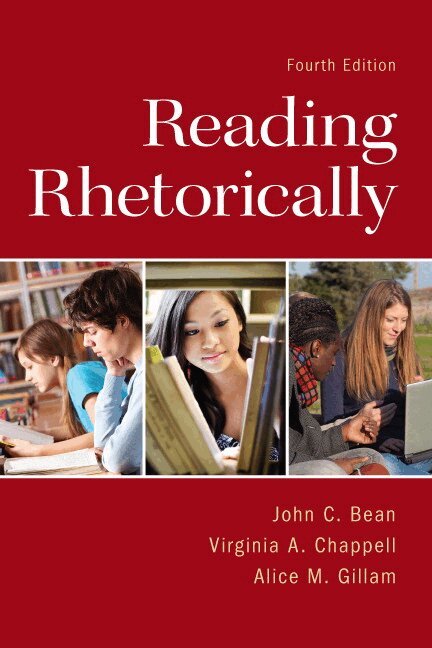
    Reading Rhetorically

    AvJohn Bean,Virginia Chappell

    Häftad, Engelska, 2013

    950 kr

    Beställningsvara. Skickas inom 7-10 vardagar. Fri frakt över 249 kr.

    Beskrivning

    Offering concise yet thorough treatment of academic reading and writing in college, Reading Rhetorically, 4th.ed., shows students how to analyze texts by recognizing rhetorical strategies and genre conventions, and how to incorporate other writers’ texts into their own research-based papers.

    Four important features of this text:

    1. Its emphasis on academic writing as a process in which writers engage with other texts

    2. Its emphasis on reading as an interactive process of composing meaning

    3. Its treatment rhetorical analysis as both an academic genre that sharpens students' reading acuity and as a tool for academic research

    4. Its analytical framework for understanding and critiquing how visual texts interact with verbal texts

    This brief rhetoric teaches students how to see texts positioned in a conversation with other texts, how to recognize a text's rhetorical aims and persuasive strategies, and how to analyze texts for both content and method.

    Produktinformation

    • Utgivningsdatum:2013-04-18
    • Mått:152 x 228 x 8 mm
    • Vikt:220 g
    • Format:Häftad
    • Språk:Engelska
    • Antal sidor:192
    • Upplaga:4
    • Förlag:Pearson Education
    • ISBN:9780321846624

    Utforska kategorier

    • Språkundervisning och språkinlärning inom Språk och ordböcker
    • Kreativt skrivande inom Språk och ordböcker

    Innehållsförteckning

    • Contents  Chapter 1  Reading to Write: Strategies for College WritingWhat Do We Mean by “Reading Rhetorically”?The Demands and Pleasures of Academic ReadingReading and Writing as ConversationJoining the ConversationFor Writing and DiscussionReading and Writing as Acts of ComposingReading Rhetorically as a Strategy for Academic Writing The Purposes of the Author Whose Text You Are ReadingYour Own Purposes as an Active Reader/WriterQuestions Rhetorical Readers AskFor Writing and DiscussionAn Extended Example: Researching the Promise of BiofuelsChapter Summary  Chapter 2Analyzing Your Reading and Writing ContextRhetorical Context: Purpose, Audience, and GenreAnalyzing an Author’s PurposeFWD on Table 2.1 Identifying an Author’s Intended AudienceAnalyzing a Text’s GenreFor Writing and DiscussionAnalyzing Your Own Rhetorical Context as Reader/WriterDetermining Your Purpose, Audience, and GenreMatching Your Reading Strategies to Your Purpose as Reader/WriterHow Expert Readers Use Rhetorical Knowledge to Read EfficientlyUsing Genre Knowledge to Read Efficiently      Using a Text’s Social/Historical Context to Make Predictions and Ask QuestionsTypical Reading-Based Writing Assignments Across the CurriculumWriting to Understand Course Content More FullyIn-Class FreewritingReading or Learning LogsDouble-Entry JournalsShort Thought Pieces or Postings to a Discussion BoardWriting to Report Your Understanding of What a Text SaysWriting to Practice the Conventions of a Particular Type of TextWriting to Make Claims About a TextWriting to Extend the ConversationChapter Summary  Chapter 3Listening to a TextWriting as You ReadPreparing to ReadRecalling Background KnowledgeUsing Visual Elements to Plan and PredictSpot ReadingAn Extended Example: Spot Reading in Kirk Savage’s Monument WarsListening As You Read InitiallyNoting Organizational SignalsMarking Unfamiliar Terms and ReferencesIdentifying Points of DifficultyAnnotatingConnecting the Visual to the VerbalVisuals That Enhance Verbal ContentVisuals That Support Verbal ContentVisuals That Extend Verbal ContentFor Writing and DiscussionListening as You RereadListening As You RereadMapping the Idea StructureDescribing What Verbal Texts Say and DoFor Writing and DiscussionDescribing What Visual Texts DoWriting About How Texts Work: Guidelines and Two ExamplesHow Summaries Are Used in Academic and Workplace SettingsGuidelines for Writing a SummaryJaime’s Process Notes for Summarizing “Chew on This”Sample Summary with Attributive TagsGuidelines for Writing a Rhetorical Précis Jaime’s Rhetorical PrécisA Brief Writing ProjectChapter SummaryKirk Savage, The Conscience of the Nation  Chapter 4Questioning a TextWhat It Means to Question a TextExamining a Writer’s Credibility and Appeals to Ethos For Writing and DiscussionExamining a Writer’s Appeals to Reason or LogosReasonsEvidenceAssumptionsFor Writing and DiscussionExamining a Writer’s Strategies for Engaging Readers, or PathosFor Writing and DiscussionExamining a Writer’s LanguageFor Writing and DiscussionExamining a Text’s IdeologyFor Writing and DiscussionExamining a Text’s Use of Visual ElementsVisual Elements and Ethical AppealsVisual Elements and Logical AppealsVisual Elements and Audience AppealsVisual ArgumentsExploring Your Responses to a TextBefore/After ReflectionsThe Believing and Doubting GameInterviewing the AuthorWriting a Rhetorical Analysis Paper: Guidelines and an ExampleGuidelines for Writing a Rhetorical AnalysisAn Annotated Rhetorical Analysis of “A Lifesaving Checklist”Chapter SummaryAtul Gawande, “A Lifesaving Checklist”    Chapter 5Using Rhetorical Reading for Researched WritingRhetorical Reading and Information LiteracyFormulating and Analyzing QuestionsEstablishing Your PurposeUsing Question Analysis to Plan a Research StrategyTips for Finding Reliable SourcesTip #1. Preferred Sources Have Undergone Solid Editorial Review and Fact-Checking Library Databases and Web Search EnginesTip #2. Specialized Periodicals for General Audiences Can Be Very UsefulTip #3. Weigh Questions About RelevanceTip #4. Ask a LibrarianTips for Evaluating SourcesTip #5. Read the Abstracts and Discussion Sections of Scholarly ArticlesTip #6. Examine a Text’s Currency and ScopeTip #7. Check Authors’ and Experts’ Basis of AuthorityTip #8. Consider the Reputation of Publishers and SponsorsChapter Summary  Chapter 6Making Knowledge: Incorporating Reading into WritingAsserting Your Authority as a Reader and Writer Managing Your Writing ProcessStrategies for Getting StartedStrategies for Generating IdeasStrategies for Writing a First DraftStrategies for Evaluating Your Draft for RevisionStrategies for Peer Response and RevisionStrategies for Editing and Polishing Your Final DraftIntegrating Material from Readings into Your WritingUsing SummaryUsing ParaphraseUsing Direct QuotationAvoiding PlagiarismUsing Attributive Tags to Frame Sources RhetoricallyUsing Parenthetical CitationsUnderstanding Academic Citation ConventionsChapter SummaryIncorporating Reading into Writing: An Example in MLA Format  AppendixBuilding an MLA CitationFormatting MLA In-Text CitationsQuick Guidelines for Placement and ContentVariationsSetting Up an MLA Works Cited ListThe BasicsProcess AdviceModel MLA Citation FormatsCitation Models for in PeriodicalsCitation Models for Books and Other Nonperiodical Print SourcesCitation Models for Web Sources