• Fri frakt över 249 kr
  • •
  • Snabba leveranser
  • •
  • Billiga böcker
Kundservice

Du är på sajten för privatpersoner.

Företag, bibliotek eller offentlig verksamhet?

Du handlar på classic.bokus.com, där alla dina funktioner finns intakta.
Till classic.bokus.com
Bokus logotyp. Gå till startsidan.
  • Erbjudanden
  • Nyheter
  • Student
  • Topplistor
  • Barn & ungdom
  • Bokus Play
  • E-böcker
  • Pocketböcker
  • Spel & pussel

10% rabatt på allt med kod: NYSTART10 →

Sidfot

Mina sidor

    Hjälp

    • Kundservice
    • Vanliga frågor och svar
    • Frakt och leverans
    • Retur vid ångerrätt
    • Reklamera vara
    • Betalning
    • Köpvillkor
    • Allmänna villkor
    • Information om webbplatsens tillgänglighet

    Om Bokus

    • Om oss
    • Pressrum
    • För studenter
    • För företag
    • För bibliotek och offentlig verksamhet
    • För leverantörer
    • Hållbarhet

    Populärt

    • Aktuella erbjudanden
    • Presentkort
    • Studentlitteratur
    • Nya böcker
    • Topplistor
    • Signerade böcker
    • Engelska böcker

    Inspiration

    • Boktips
    • BookTok
    • Populära bokserier
    • Barnbokskaraktärer
    • Populära författare
    Logotyp för Bokus
    Följ oss på Facebook (extern länk)Följ oss på Instagram (extern länk)Följ oss på YouTube (extern länk)Följ oss på TikTok (extern länk)
    bokus @ CookiesAnpassa cookiesIntegritetspolicyKöpvillkor
    Till Citymail hemsida (extern länk)Till Budbee hemsida (extern länk)Till Postnord hemsida (extern länk)Till Schenker hemsida (extern länk)Till Early Bird hemsida (extern länk)Till Walleys hemsida (extern länk)
    1. Medicin
    2. Andra medicinska specialiteter
    3. Idrottsmedicin och idrottsskador

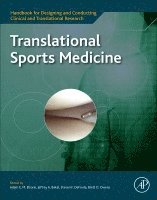
    Translational Sports Medicine

    AvJeffrey A. Bakal,Steve DeFroda

    Häftad, Engelska, 2023

    Del i serien Handbook for Designing and Conducting Clinical and Translational Research

    1 722 kr

    Beställningsvara. Skickas inom 10-15 vardagar. Fri frakt över 249 kr.

    Beskrivning

    Translational Sports Medicine covers the principles of evidence-based medicine and applies these principles to the design of translational investigations. This title is an indispensable tool in grant writing and funding efforts with its practical, straightforward approach that will help aspiring investigators navigate challenging considerations in study design and implementation. It provides valuable discussions of the critical appraisal of published studies in translational sports medicine, allowing the reader to learn how to evaluate the quality of such studies with respect to measuring outcomes and to make effective use of all types of evidence in patient care.

    In short, this practical guidebook will be of interest to every medical researcher or sports medicine clinician who has ever had a good clinical idea but not the knowledge of how to test it. Readers will come to fully understand important concepts, including case-control study, prospective cohort study, randomized trial and reliability study. Medical researchers will benefit from greater confidence in their ability to initiate and execute their own investigations, avoid common pitfalls in translational sports medicine, and know what is needed in collaboration.


    • Focuses on the principles of evidence-based medicine and applies these principles to translational investigations within sports medicine
    • Details discussions of the critical appraisal of published studies in translational sports medicine, supporting evaluation with respect to measuring outcomes and making effective use of all types of evidence in patient care
    • Written by experts in the sports medicine field

    Produktinformation

    • Utgivningsdatum:2023-08-17
    • Mått:216 x 276 x 35 mm
    • Vikt:1 860 g
    • Format:Häftad
    • Språk:Engelska
    • Serie:Handbook for Designing and Conducting Clinical and Translational Research
    • Antal sidor:620
    • Förlag:Elsevier Science
    • ISBN:9780323912594

    Utforska kategorier

    • Idrottsmedicin och idrottsskador inom Medicin
    • Biologi inom Naturvetenskap och teknik

    Mer om författaren

    Dr. Bakal is the Program Director for Provincial Research Data Services at Alberta Health Services, which operates the Alberta Strategy for Patient Oriented Research (SPOR) data platform. He also leads the Health Service Statistical and Analytics Methods teams. Over 10 years, he has worked with health services data, including randomized clinical trials. He completed his PhD jointly through the Department of Mathematics and Statistics and the School of Physical Health and Education at Queen’s University. His work includes methodological contributions and analyses supporting international studies spanning business strategy, ophthalmology, cardiology, and geriatric medicine, as well as analyses of kinematic data, through peer-reviewed publications and conference presentations. Current interests include developing statistical methodology for time-to-event data and building classification tools to support patient decision-making processes. Steven DeFroda currently works as a sports medicine fellow at Rush University Medical Center. Steven does research in Orthopedic Surgery, with specific interest in athletic injuries of the knee, shoulder, and elbow. Specific interests include clinical and functional outcomes, biomechanics, and patient quality of life. Dr. Owens is a fellowship-trained, board certified orthopedic sports medicine surgeon, specializing in arthroscopic repair of sports-related injuries as well as complex knee and shoulder reconstructions. He is Chief of Sports Medicine at the Miriam Hospital in Providence, RI and Director of the Rhode Island Cartilage Repair Center. He is Professor of Orthopaedic Surgery at Brown University Alpert Medical School. He is currently a Team Physician for Brown University and the Providence Bruins. He serves as a consultant for URI Athletics. Dr. Owens was named by fellow orthopedists in Orthopedics This Week as one of the “Top 28 North American Knee Surgeons.” He has published over 200 articles in peer-reviewed medical journals, given over 200 national or international presentations, co-edited three textbooks on orthopedic injuries, and serves as Associate Editor for the American Journal of Sports Medicine. His research has garnered awards from the American Orthopedic Society for Sports Medicine. Dr Adam E. M. Eltorai, MD, PhD completed his graduate studies in Biomedical Engineering and Biotechnology along with his medical degree from Brown University. His work has spanned the translational spectrum with a focus on medical technology innovation and development. Dr. Eltorai has published numerous articles and books.

    Recensioner i media

    "This book is a comprehensive how-to for sports medicine researchers at all levels... includes practical guidelines, such as figures on FDA premarketing processes for medical device classification, thus serving as a reference to better understand regulatory entities... [A] guide for health care providers and scientists to improve the quality of the literature coming out of the sports medicine field [and] a step-by-step detailed manuscript that starts by outlining how to write a research question and what pitfalls to avoid when doing so... This book is unique because it focuses on sports and musculoskeletal medicine, discussing relevant sports technologies, medical devices, and interventions such as biologics injections, and addresses potential issues that are unique to sports medicine research... The book is organized chronologically, in a way that is easy for the reader to follow as they actively go through the process of conducting translational research." --©Doody’s Review Service, 2024, Yuka Kobayashi, DO (Medical College of Wisconsin)

    Innehållsförteckning

    • INTRODUCTION1. Introduction2. Translational Process3. Scientific Method4. Basic ResearchPRE-CLINICAL5. Overview of preclinical research6. What Problem Are You Solving?7. Types of Interventions8. Beyond Drugs and Surgery: A Look at Orthobiologics9. Drug Testing10. Device Discovery and Prototyping11. Device Testing12. Diagnostic Discovery13. Diagnostic Testing14. Preclinical: discussion of FDA product categories (what the FDA covers, regulated or not)15. Procedural Technique Development16. Behavioral Intervention studies17. Artificial IntelligenceCLINICAL: FUNDAMENTALS18. Introduction to Clinical Research: What is it? Why is it Needed?19. The Question: Types of Research question and How to Develop Them20. Study Population: Who and Why Them?21. Outcome Measurements: What data is being Collected and Why?22. Optimizing the Question: Balancing Significance and FeasibilitySTATISTICAL PRINCIPLES23. Common Issues in Analysis24. Basic Statistical Principles25. Distribution26. Research hypotheses and Error Types27. Power28. Multivariable regression models29. How to choose appropriate bivariate test30. Categorical Variable Analyses: Chi-square, Fisher exact, Mantel-Haenszel31. Analysis of Variance: ANOVA32. Correlation33. Statistical bias34. Basic Science Statistics35. Sample Size36. Statistical SoftwareCLINICAL: STUDY TYPES37. Design Principles: Hierarchy of Study Types38. Case Series: Design, Measures, and an Example39. Case-control Study40. Cohort Studies41. Cross-section Study42. Longitudinal Study: Design, Measures, Classic Example43. Meta-analysis44. Cost-effectiveness Study: Design, Measures, Classic Example45. Diagnostic Test Evaluation: Design, Measures, Classic Example46. Reliability Study: Design, Measures, Classic Example47. Database Types and Basic Data Management Design Principles for Healthcare Research48. Survey Studies and Questionnaires49. Qualitative Methods and Mixed MethodsCLINICAL: TRIALS50. Randomized and Controlled Trials51. Nonrandomized Controlled Trials52. Historical Control: Design, Measures, Classic Example53. Cross-over Studies54. Withdrawal Studies: Design, Measures, Classic Example55. Factorial Design: Design, Measures, Classic Example56. Group or Cluster Controlled Trials: Design, Measures, Classic Example57. Hybrid Design: Design, Measures, Classic Example58. Large, Pragmatic: Clinical Trials59. Equivalence and Noninferiority: Design, Measures, Classic Example60. Adaptive Design Measures61. Randomization: Fixed or Adaptive Procedures62. Blinding: Who, When, and and How?63. Multicenter Consideration64. Phase 0 Trials: Window of Opportunity65. Registries66. Phases of Clinical Trials67. IDEAL FrameworkCLINICAL PREPARATION68. Patient Perspectives69. Budgeting70. Ethics and Review Boards71. Regulatory Considerations for Sports Medicine Technologies: New Drugs and Medical Devices72. Funding Approaches73. Conflicts of Interest74. Subject Recruitment75. Data Management76. A Practical Guide to Conducting Research in the Acute Setting77. Special Populatoins78. Subject Adherence79. Time-to-Event Outcomes and Survival Analysis80. Monitoring Committee in Clinical TrialsREGULATORY BASICS81. FDA Overview82. Investigational New Drug (IND) Application83. New Drug Application84. Medical Devices85. Radiation-emitting Electronic Products86. Orphan Drugs87. Biological Drugs88. Combination Products89. Cosmetics in Sports Medicine90. CMC and GxP91. Non-US Regulatory92. Post-Market Drug Safety Monitoring93. Post-Market Device Safety MonitoringCLINICAL IMPLEMENTATION94. Implementation Research95. Design and Analysis96. Mixed-methods Research97. Implementation of Multimodal Concussion Research Within Military Medical Environments98. Guideline DevelopmentPUBLIC HEALTH99. Public Health100. Edpidemiology of Sports Injuries101. Factors102. Good Questions103. Population and Environmental Specific Considerations104. Law, Policy, and Ethics105. Healthcare Institutions and Systems106. Public Health Institutions and SystemsPRACTICAL RESOURCES107. Presenting Data108. Manuscript Preparation109. Promoting Research110. Quality Improvement111. Team Science and Building a Team112. Types of Intellectual Property113. Venture Pathways114. Utilizing National Institutes of Health (NIH) Grants to Fund Translational Research115. Sample Forms and Templates