• Fri frakt över 249 kr
  • •
  • Snabba leveranser
  • •
  • Billiga böcker
Kundservice

Du är på sajten för privatpersoner.

Företag, bibliotek eller offentlig verksamhet?

Du handlar på classic.bokus.com, där alla dina funktioner finns intakta.
Till classic.bokus.com
Bokus logotyp. Gå till startsidan.
  • Erbjudanden
  • Nyheter
  • Student
  • Topplistor
  • Barn & ungdom
  • Bokus Play
  • E-böcker
  • Pocketböcker
  • Spel & pussel

10% rabatt på allt med kod NYSTART10 →

Sidfot

Mina sidor

    Hjälp

    • Kundservice
    • Vanliga frågor och svar
    • Frakt och leverans
    • Retur vid ångerrätt
    • Reklamera vara
    • Betalning
    • Köpvillkor
    • Allmänna villkor
    • Information om webbplatsens tillgänglighet

    Om Bokus

    • Om oss
    • Pressrum
    • För studenter
    • För företag
    • För bibliotek och offentlig verksamhet
    • För leverantörer
    • Hållbarhet

    Populärt

    • Aktuella erbjudanden
    • Presentkort
    • Studentlitteratur
    • Nya böcker
    • Topplistor
    • Signerade böcker
    • Engelska böcker

    Inspiration

    • Boktips
    • BookTok
    • Populära bokserier
    • Barnbokskaraktärer
    • Populära författare
    Logotyp för Bokus
    Följ oss på Facebook (extern länk)Följ oss på Instagram (extern länk)Följ oss på YouTube (extern länk)Följ oss på TikTok (extern länk)
    bokus @ CookiesAnpassa cookiesIntegritetspolicyKöpvillkor
    Till Citymail hemsida (extern länk)Till Budbee hemsida (extern länk)Till Postnord hemsida (extern länk)Till Schenker hemsida (extern länk)Till Early Bird hemsida (extern länk)Till Walleys hemsida (extern länk)
    1. Samhälle och politik
    2. Sociologi och antropologi
    3. Sociologi

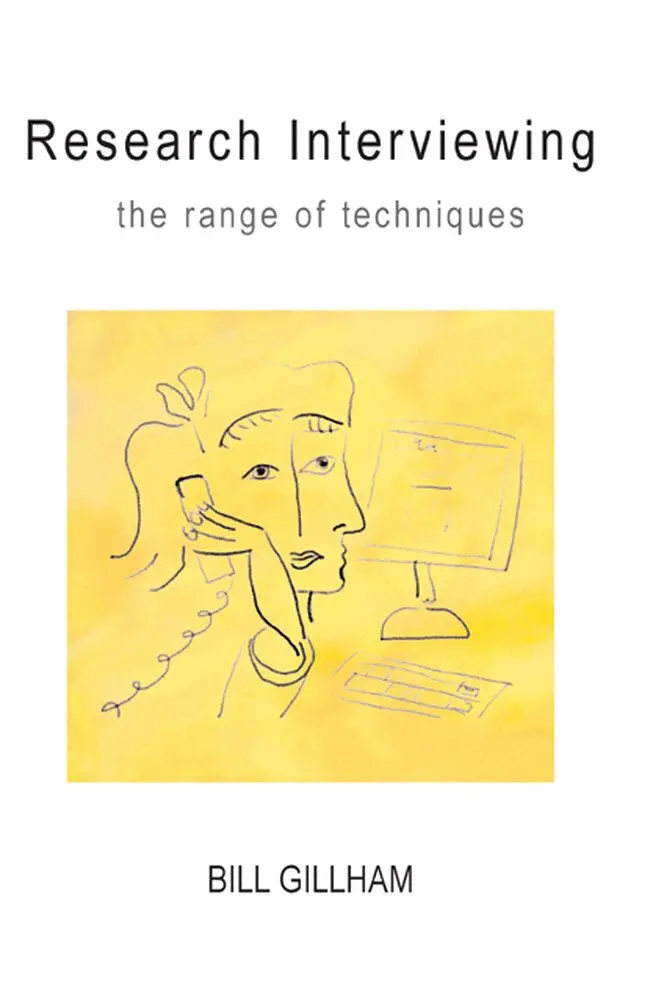
    Research Interviewing: The Range of Techniques

    AvBill Gillham

    Häftad, Engelska, 2005

    328 kr

    Beställningsvara. Skickas inom 3-6 vardagar. Fri frakt över 249 kr.

    Fler format och utgåvor

    E-bok

    317 kr

    Beskrivning

    * The most comprehensive book available on methods in research interviewing!

    * What is research interviewing?

    * What techniques are used? Exactly what do you do in each technique?

    * How is interview data analysed and written up?

    The robust, real-world approach makes this book appropriate for practitioner researchers and postgraduate students up to PhD level. Covers distance and face-to-face interviewing, from the un-structured and naturalistic to the highly structured, focused and time-efficient.

    Emphasis is placed on using the most appropriate methods for the research purpose and how to identify which method is practicable. Based on over thirty years of teaching and supervising research and postgraduate students, the author anticipates questions and difficulties at a level of practical detail. Practical and easy to use, this book is essential for anyone doing research interviewing.

    Produktinformation

    • Utgivningsdatum:2005-08-16
    • Mått:166 x 235 x 15 mm
    • Vikt:370 g
    • Format:Häftad
    • Språk:Engelska
    • Antal sidor:200
    • Förlag:McGraw-Hill Education
    • ISBN:9780335215867

    Utforska kategorier

    • Sociologi inom Samhälle och politik

    Mer om författaren

    Dr. Bill Gillham has had over thirty years experience of teaching and supervising postgraduate and research students at the Universities of Nottingham and Strathclyde and from a new perspective, as PhD Coordinator in the School of Design at Glasgow School of Art. He has written, edited, contributed to, and translated over thirty books in areas as diverse as child safety, written and spoken language, introductory psychology, child development, and research methods.

    Innehållsförteckning

    • Preface AcknowledgementsList of tablesList of figuresPART ONE: PRINCIPLES AND PRACTICE1Research interviewing: key issues2The ethics of interviewing3The importance of question/topic development4Different techniques and the ‘cost’ development factor5The core skills of interviewingPART TWO: FACE-TO-FACE METHODS6Ethnographic methods: the interviewer as participant-observer in real-life contexts7The unstructured interview8The élite interview9Group interviewing10The semi-structured interview11Structured interviewing: the use of recording schedules12The video interview13The interview as a qualitative experimentPART THREE: DISTANCE METHODS14The telephone interview15The e-mail interview16The ‘open’ questionnaire interviewPART FOUR: ANALYSIS AND INTERPRETATION OF CONTENT17Transcribing the interview18Narrative overview versus categorical analysis19Deriving categories (coding) from the data20Quantitative analysis of categorical data21Writing up interview data22Combining interview data with data from other sourcesReferencesIndex