• Fri frakt över 249 kr
  • •
  • Snabba leveranser
  • •
  • Billiga böcker
Kundservice

Du är på sajten för privatpersoner.

Företag, bibliotek eller offentlig verksamhet?

Du handlar på classic.bokus.com, där alla dina funktioner finns intakta.
Till classic.bokus.com
Bokus logotyp. Gå till startsidan.
  • Erbjudanden
  • Student
  • Topplistor
  • Barn & ungdom
  • Bokus Play
  • E-böcker
  • Ljudböcker
  • Pocketböcker
  • Spel och pussel

Upp till 25% på utvalda nyheter →

Sidfot

Mina sidor

    Hjälp

    • Kundservice
    • Vanliga frågor och svar
    • Frakt och leverans
    • Retur vid ångerrätt
    • Reklamera vara
    • Betalning
    • Köpvillkor
    • Allmänna villkor
    • Information om webbplatsens tillgänglighet

    Om Bokus

    • Om oss
    • Pressrum
    • För studenter
    • För företag
    • För bibliotek och offentlig verksamhet
    • För leverantörer
    • Hållbarhet

    Populärt

    • Aktuella erbjudanden
    • Presentkort
    • Studentlitteratur
    • Nya böcker
    • Topplistor
    • Signerade böcker
    • Engelska böcker

    Inspiration

    • Boktips
    • BookTok
    • Barnbokskaraktärer
    • Populära författare
    Logotyp för Bokus
    Följ oss på Facebook (extern länk)Följ oss på Instagram (extern länk)Följ oss på YouTube (extern länk)Följ oss på TikTok (extern länk)
    bokus @ CookiesAnpassa cookiesIntegritetspolicyKöpvillkor
    Till Citymail hemsida (extern länk)Till Budbee hemsida (extern länk)Till Postnord hemsida (extern länk)Till Schenker hemsida (extern länk)Till Early Bird hemsida (extern länk)Till Walleys hemsida (extern länk)
    1. Naturvetenskap och teknik
    2. Teknik och industri
    3. Energiteknik

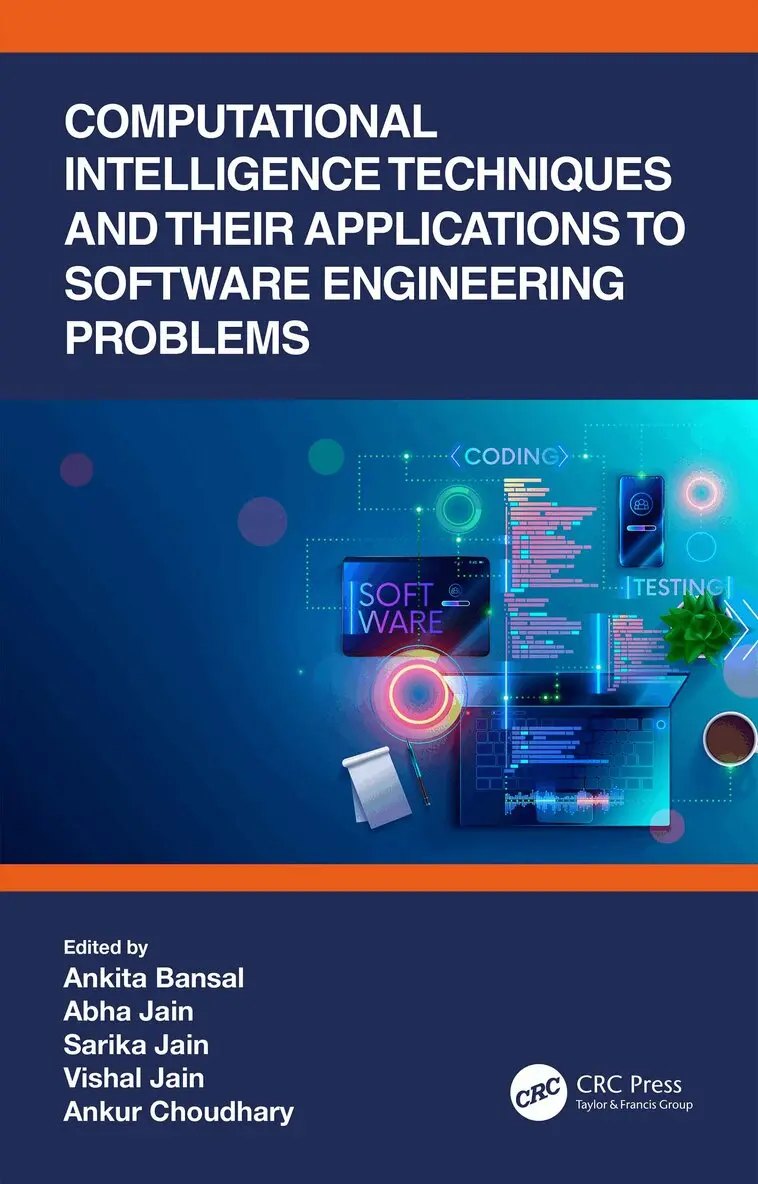
    Computational Intelligence Techniques and Their Applications to Software Engineering Problems

    AvAnkita Bansal,Abha Jain

    Häftad, Engelska, 2024

    Del i serien Computational Intelligence Techniques

    721 kr

    Beställningsvara. Skickas inom 10-15 vardagar. Fri frakt över 249 kr.

    Beskrivning

    Computational Intelligence Techniques and Their Applications to Software Engineering Problems focuses on computational intelligence approaches as applicable in varied areas of software engineering such as software requirement prioritization, cost estimation, reliability assessment, defect prediction, maintainability and quality prediction, size estimation, vulnerability prediction, test case selection and prioritization, and much more. The concepts of expert systems, case-based reasoning, fuzzy logic, genetic algorithms, swarm computing, and rough sets are introduced with their applications in software engineering. The field of knowledge discovery is explored using neural networks and data mining techniques by determining the underlying and hidden patterns in software data sets. Aimed at graduate students and researchers in computer science engineering, software engineering, information technology, this book: Covers various aspects of in-depth solutions of software engineering problems using computational intelligence techniques Discusses the latest evolutionary approaches to preliminary theory of different solve optimization problems under software engineering domain Covers heuristic as well as meta-heuristic algorithms designed to provide better and optimized solutions Illustrates applications including software requirement prioritization, software cost estimation, reliability assessment, software defect prediction, and more Highlights swarm intelligence-based optimization solutions for software testing and reliability problems

    Produktinformation

    • Utgivningsdatum:2024-10-04
    • Mått:156 x 234 x 15 mm
    • Vikt:460 g
    • Format:Häftad
    • Språk:Engelska
    • Serie:Computational Intelligence Techniques
    • Antal sidor:251
    • Förlag:Taylor & Francis Ltd
    • ISBN:9780367529802

    Utforska kategorier

    • Energiteknik inom Naturvetenskap och teknik
    • Systemvetenskap och AI inom Data och IT
    • Programmeringsböcker inom Data och IT

    Mer om författaren

    Ankita Bansal is an assistant professor at Netaji Subhas University of Technology (NSUT), Delhi, India. Prior to joining NSUT, Dr. Bansal worked as a full-time research scholar at Delhi Technological University (formerly Delhi College of Engineering). She received her master’s and doctoral degrees in computer science from Delhi Technological University (DTU). Her research interests include: software quality, soft computing, database management, machine learning, and meta heuristic models. Abha Jain is an assistant professor at Shaheed Rajguru College of Applied Sciences for Women, Delhi University, India. Prior to joining the college, she worked as a full-time research scholar and received a doctoral research fellowship from Delhi Technological University. She received her master’s and doctorate degrees in software engineering from DTU. Her research interests include: data mining, software quality, and statistical and machine learning models. She has published papers in international journals and conferences. Sarika Jain graduated from Jawaharlal Nehru University (India) in 2001. She has served in the field of education for over 19 years and is currently in service at the National Institute of Technology Kurukshetra, India. Dr. Jain has authored/co-authored over 100 publications including books. Her current research interests include: knowledge management and analytics, semantic web, ontological engineering, and intelligent systems. Dr. Jain has supervised two doctorate scholars (five ongoing) who are now pursuing their postdoctorates. She has two research-funded projects: one is ongoing, funded by CRIS TEQUIP-III, and the other is completed, funded by DRDO India. She has also applied for a patent. Dr. Jain has been supervising DAAD interns from different German universities and works in collaboration with various researchers across the globe including: Germany, Austria, Australia, Malaysia, the US, Romania, and many others. She is a member of IEEE and ACM and a Life Member of CSI, IAENG, and IACSIT.Vishal Jain is an associate professor with Bharati Vidyapeeth’s Institute of Computer Applications and Management (BVICAM), New Delhi, India (affiliated with Guru Gobind Singh Indraprastha University, and accredited by the All India Council for Technical Education). He first joined BVICAM as an assistant professor. Before that, he worked for several years at the Guru Premsukh Memorial College of Engineering, Delhi, India. He has more than 350 research citation indices with Google Scholar (h-index score 9 and i-10 index 9), and has authored more than 70 research papers in reputed conferences and journals including Web of Science and Scopus. Dr. Jain has authored and edited more than 10 books with various reputed publishers including Springer, Apple Academic Press, Scrivener, Emerald, and IGI-Global. His research areas include: information retrieval, semantic web, ontology engineering, data mining, adhoc networks, and sensor networks. He was a recipient of the: Young Active Member Award for 2012–13 from the Computer Society of India, Best Faculty Award for 2017, and Best Researcher Award for 2019 from BVICAM, New Delhi.Ankur Choudhary majored in computer science and engineering and pursued a PhD from the School of ICT, Gautam Buddha University (GBU), Greater Noida, India. He has approximately 15+ years of teaching experience and is currently a professor at Sharda Univeristy, Greater Noida, India. His areas of research include: nature-inspired optimization, artificial intelligence, software engineering, medical image processing, and digital watermarking. Dr. Choudhary has published research papers in various SCI/Scopus indexed international conferences and journals, and is associated with various international journals as a reviewer and editorial board member. He has organized conferences, special sessions at international conferences, served and delivered as session chair.

    Innehållsförteckning

    • 1. Implementation of Artificial Intelligence Techniques for Improving Software Engineering. 2. Software effort estimation: Machine learning vs. Hybrid algorithms. 3. Implementation of Data Mining Techniques for Software Development Effort Estimation. 4. Empirical Software Measurements with Machine Learning. 5. Project Estimation And Scheduling Using Computational Intelligence. 6. Application of Intuitionistic Fuzzy Similarity Measures in Strategic Decision-Making. 7. Nature-Inspired Approaches to Test Suite Minimization for Regression Testing. 8. Identification and Construction of Reusable Components from Object-Oriented Legacy Systems using various Software Artifacts. 9. A Software Component Evaluation and Selection Approach Using Fuzzy Logic. 10. Smart Predictive Analysis for Testing Messaging-passing Applications. 11. Status of Agile Practices in the Software Industry in 2019. 12. Agile Methodologies: A Performance Analysis To Enhance Software Quality. 13. Pre-Trained Deep Neural Networks for Age Prediction from IRIS Biometrics. 14. Hybrid Intelligent Decision Support Systems to Select The Optimum Fuel Blend in CI Engine. 15. Understanding the Significant Challenges of Software Engineering in Cloud Environment.