• Fri frakt över 249 kr
  • •
  • Snabba leveranser
  • •
  • Billiga böcker
Kundservice

Du är på sajten för privatpersoner.

Företag, bibliotek eller offentlig verksamhet?

Du handlar på classic.bokus.com, där alla dina funktioner finns intakta.
Till classic.bokus.com
Bokus logotyp. Gå till startsidan.
  • Erbjudanden
  • Nyheter
  • Student
  • Topplistor
  • Barn & ungdom
  • Bokus Play
  • E-böcker
  • Pocketböcker
  • Spel & pussel

10% rabatt på allt med kod NYSTART10 →

Sidfot

Mina sidor

    Hjälp

    • Kundservice
    • Vanliga frågor och svar
    • Frakt och leverans
    • Retur vid ångerrätt
    • Reklamera vara
    • Betalning
    • Köpvillkor
    • Allmänna villkor
    • Information om webbplatsens tillgänglighet

    Om Bokus

    • Om oss
    • Pressrum
    • För studenter
    • För företag
    • För bibliotek och offentlig verksamhet
    • För leverantörer
    • Hållbarhet

    Populärt

    • Aktuella erbjudanden
    • Presentkort
    • Studentlitteratur
    • Nya böcker
    • Topplistor
    • Signerade böcker
    • Engelska böcker

    Inspiration

    • Boktips
    • BookTok
    • Populära bokserier
    • Barnbokskaraktärer
    • Populära författare
    Logotyp för Bokus
    Följ oss på Facebook (extern länk)Följ oss på Instagram (extern länk)Följ oss på YouTube (extern länk)Följ oss på TikTok (extern länk)
    bokus @ CookiesAnpassa cookiesIntegritetspolicyKöpvillkor
    Till Citymail hemsida (extern länk)Till Budbee hemsida (extern länk)Till Postnord hemsida (extern länk)Till Schenker hemsida (extern länk)Till Early Bird hemsida (extern länk)Till Walleys hemsida (extern länk)
    1. Skönlitteratur
    2. Litteraturvetenskap
    3. Litteraturvetenskap

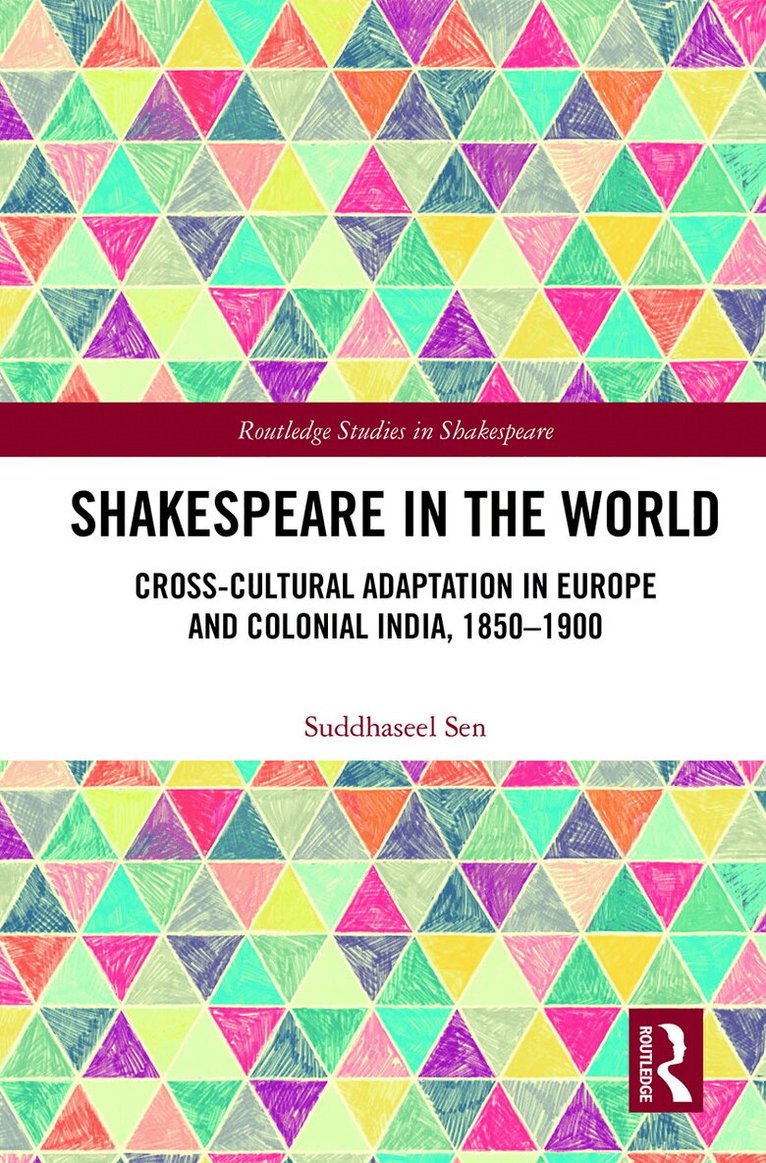
    Shakespeare in the World

    Cross-Cultural Adaptation in Europe and Colonial India, 1850-1900

    AvSuddhaseel Sen

    Häftad, Engelska, 2022

    Del i serien Routledge Studies in Shakespeare

    783 kr

    Beställningsvara. Skickas inom 10-15 vardagar. Fri frakt över 249 kr.

    Fler format och utgåvor

    Inbunden

    2 366 kr

    E-bok

    926 kr

    E-bok

    926 kr

    Beskrivning

    Shakespeare in the World traces the reception histories and adaptations of Shakespeare in the nineteenth century, when his works became well-known to non-Anglophone communities in both Europe and colonial India. Sen provides thorough and searching examinations of nineteenth-century theatrical, operatic, novelistic, and prose adaptations that are still read and performed, in order to argue that, crucial to the transmission and appeal of Shakespeare’s plays were the adaptations they generated in a wide range of media. These adaptations, in turn, made the absorption of the plays into different "national" cultural traditions possible, contributing to the development of "nationalist cosmopolitanisms" in the receiving cultures. Sen challenges the customary reading of Shakespeare reception in terms of "hegemony" and "mimicry," showing instead important parallels in the practices of Shakespeare adaptation in Europe and colonial India. Shakespeare in the World strikes a fine balance between the Bard’s iconicity and his colonial and post-colonial afterlives, and is an important contribution to Shakespeare studies.

    Produktinformation

    • Utgivningsdatum:2022-04-29
    • Mått:152 x 229 x 19 mm
    • Vikt:405 g
    • Format:Häftad
    • Språk:Engelska
    • Serie:Routledge Studies in Shakespeare
    • Antal sidor:248
    • Förlag:Taylor & Francis Ltd
    • ISBN:9780367568870

    Utforska kategorier

    • Litteraturvetenskap inom Skönlitteratur

    Mer om författaren

    Suddhaseel Sen is Assistant Professor of English in the Department of Humanities and Social Sciences at IIT Bombay. He has a PhD in English (Collaborative Programme in South Asian Studies) from the University of Toronto and a second PhD in Musicology from Stanford University. Sen has been a Research Fellow for the Balzan Research Project, Towards a Global History of Music, directed by Reinhard Strohm. His publications include essays on Shakespeare adaptations; cross-cultural exchanges between Indian and British musicians; Richard Wagner and German Orientalism; nineteenth-century Bengali literature and culture; and films by Satyajit Ray and Vishal Bhardwaj, among others.

    Recensioner i media

    “This comparative and interdisciplinary study of the historical spread of Shakespeare among non-Anglophone nations in Europe and India sheds important new light on individual novelistic, operatic, and dramatic adaptations, while at the same time both theorising a major revision to postcolonial thinking and offering a new vision for Shakespeare studies. Sen’s concept of ‘performative transculturation’ allows for a welcome and more encompassing vision of artistic innovation over time and across cultures. He complicates simple binaries, especially of European/Indian acceptance or rejection of Western culture/Shakespeare, revealing instead the rich middle ground in between these extremes of reception. In the process, Sen’s innovative ‘relational’ approach to reading cross-cultural adaptations also makes a major contribution to adaptation theory.”--Linda Hutcheon, University Professor Emeritus, English and Comparative Literature, University of Toronto“Shakespeare in the World is a notable contribution to Shakespeare studies in general, and the study of Shakespeare in non-Anglophone, non-Western, post/ colonial locations in particular, because it traces the afterlife of Shakespeare’s plays in the genres of drama/theatre and opera in Indian as well as European languages. In his immersive use of adaptation studies for this purpose, Suddhaseel Sen effectively deconstructs the paradigms of ‘hegemony,’ ‘conquest,’ ‘subalternity,’ ‘subjection,’ ‘mimicry,’ and ‘vernacular’ cultural expression that have dominated the study of colonial power relations, the presence of English, and the dissemination of the English literary canon in India. He then offers counterconcepts such as ‘nationalist cosmopolitanisms,’ ‘performative transculturation,’ ‘artistic self-fashioning,’ and ‘epistemic decolonisation’ to construct and present an alternative narrative of cultural relations. These moves imply a refreshing restoration of agency to the colonial subject, and a recognition of multiple layers of complexity in the reception and absorption of a ‘universal’ figure such as Shakespeare.”--Aparna Dharwadker, Professor of English and Interdisciplinary, Theatre Studies, University of Wisconsin-Madison"This is a richly rewarding book, suggesting important adjustments to the manner in which adaptations, in reaction against discourses of fidelity, have served diverse cultural formations. Sen insists eloquently on attention to individuals and specific circumstances and goals, rather than vague pigeonholing of artists and audiences in accordance with (admittedly) well-intentioned liberal consensus"--Russell Jackson, Shakespeare Survey "In many ways, Shakespeare in the World is an unconventional, and at times daring, work... [Shakespeare in the World] makes a significant contribution to the recent move towards decolonizing Shakespeare studies. It importantly attempts to shake basic Anglo-centric assumptions about global Shakespeares as a phenomenon, going back to one of the foundational moments of Shakespeare transmission in colonial India."--Amrita Sen, Shakespeare Quarterly"Sen tells us that “Much more will be gained if such scholars come together, using a methodologically open-ended tool such as adaptation theory, to produce collaborative and genuinely interdisciplinary research” (196). This may be one of the most important points of the book, for it takes a difficult subject and discussion and concludes it with hope and optimism. The end of the book is not the end of the conversation; Sen has offered us a way forward that expands the way we read, watch, listen, and respond to Shakespeare’s works in all its forms. As a Shakespeare scholar, professor, and actor, I applaud and appreciate his message."--Sharon Emmerichs, University of Alaska Anchorage

    Innehållsförteckning

    • List of Musical ExamplesAcknowledgements Preliminary NotesIntroductionShakespeare’s Reception in Non-Anglophone Cultures: Analytical Paradigms Theorising Shakespeare Reception Relationally Shakespeare and “Nationalist Cosmopolitanism” Adaptation Theory and Cross-Cultural Receptions of ShakespeareThe Case Studies: Patterns and Interconnections PART 11 Shakespeare Reception in France: Ambroise Thomas’s Hamlet and Its IntertextsIntroductionShakespeare’s Hamlet: Texts and Performances up to the Nineteenth CenturyHamlet in France: From Ducis to Dumas and Meurice Thomas’s Hamlet as Opera Lyrique The Operatic Ophélie The Afterlife of Thomas’s Hamlet 2 Nationalism and Aesthetic Self-Fashioning: GiuseppeVerdi’s Otello Introduction Jealousy and Vengeance in Othello and Otello (i): Racial Discourses Jealousy and Vengeance in Othello and Otello (ii): Religious Discourses Jealousy and Vengeance in Othello and Otello (iii): The Pressures of PatriarchyVerdi’s Musical Choices and the Subversion of Racial Stereotypes regarding Jealousy Conclusion PART 2 3 Challenging the Civilising Mission: Responses to The Tempest by Bankimchandra Chatterjee and Rabindranath Tagore Introduction Bankim and Bengali Literature After 1857 Bankim’s Life and Literary Career Kapālakunḍalā: Plot and Intertexts The Tempest, Kapālakunḍalā, and Women in Nineteenth-Century Bengal (i): A Historical PerspectiveThe Tempest, Kapālakunḍalā, and Women in Nineteenth-Century Bengal (ii): A Symbolic Perspective Bankim, Tagore, and the Reception History of The Tempest 4 Two Contrasting Cases of Transculturation of Shakespeare From Nineteenth-Century Bengal: Ishwarchandra Vidyasagar’s Bhrāntivilās and Girishchandra Ghosh’s Macbeth Introduction Part I: Vidyasagar’s Bhrāntivilās Life and Times of Ishwarchandra Vidyasagar Rereading The Comedy of Errors: Bhrāntivilās and Its Intertexts Bhrāntivilās and Feminist Readings of Errors Part II: Girishchandra Ghosh’s Macbeth The Life and Career of Girishchandra Ghosh Girishchandra Ghosh’s Macbeth: A Case of Colonial Mimicry? Conclusion Contents Conclusion Adaptation Studies: Synchronic and Diachronic Approaches Nationalist Cosmopolitanism and Post-Colonial Mimicry Cross-Cultural Shakespeare and New Analytical Frameworks Appendix 1 “Imitation” Appendix 2 “Śakuntalā, Miranda, and Desdemona”ReferencesIndex