• Fri frakt över 249 kr
  • •
  • Snabba leveranser
  • •
  • Billiga böcker
Kundservice

Du är på sajten för privatpersoner.

Företag, bibliotek eller offentlig verksamhet?

Du handlar på classic.bokus.com, där alla dina funktioner finns intakta.
Till classic.bokus.com
Bokus logotyp. Gå till startsidan.
  • Erbjudanden
  • Nyheter
  • Student
  • Topplistor
  • Barn & ungdom
  • Bokus Play
  • E-böcker
  • Pocketböcker
  • Spel & pussel

10% studentrabatt med kod TERM26

Sidfot

Mina sidor

    Hjälp

    • Kundservice
    • Vanliga frågor och svar
    • Frakt och leverans
    • Retur vid ångerrätt
    • Reklamera vara
    • Betalning
    • Köpvillkor
    • Allmänna villkor
    • Information om webbplatsens tillgänglighet

    Om Bokus

    • Om oss
    • Pressrum
    • För studenter
    • För företag
    • För bibliotek och offentlig verksamhet
    • För leverantörer
    • Hållbarhet

    Populärt

    • Aktuella erbjudanden
    • Presentkort
    • Studentlitteratur
    • Nya böcker
    • Topplistor
    • Signerade böcker
    • Engelska böcker

    Inspiration

    • Boktips
    • BookTok
    • Populära bokserier
    • Barnbokskaraktärer
    • Populära författare
    Logotyp för Bokus
    Följ oss på Facebook (extern länk)Följ oss på Instagram (extern länk)Följ oss på YouTube (extern länk)Följ oss på TikTok (extern länk)
    bokus @ CookiesAnpassa cookiesIntegritetspolicyKöpvillkor
    Till Citymail hemsida (extern länk)Till Budbee hemsida (extern länk)Till Postnord hemsida (extern länk)Till Schenker hemsida (extern länk)Till Early Bird hemsida (extern länk)Till Walleys hemsida (extern länk)
    1. Psykologi och pedagogik
    2. Psykologi
    3. Psykologiska teorier och skolor

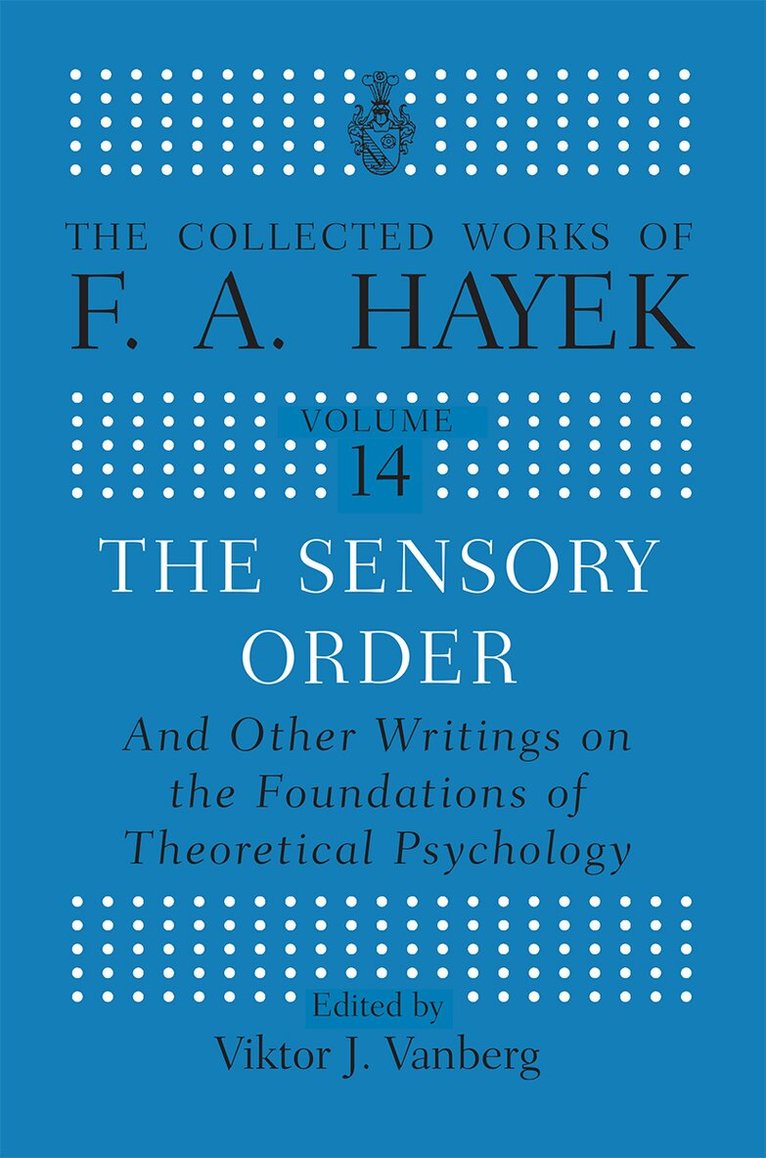
    Sensory Order and Other Writings on the Foundations of Theoretical Psychology

    AvF.A Hayek,Viktor J. Vanberg

    Häftad, Engelska, 2020

    Del i serien Collected Works of F.A. Hayek

    679 kr

    Beställningsvara. Skickas inom 10-15 vardagar. Fri frakt över 249 kr.

    Fler format och utgåvor

    Inbunden

    2 365 kr

    E-bok

    801 kr

    E-bok

    799 kr

    Beskrivning

    The Sensory Order, first published in 1952, sets forth F. A. Hayek's classic theory of mind in which he describes the mental mechanism that classifies perceptions that cannot be accounted for by physical laws. Hayek's substantial contribution to theoretical psychology has been addressed in the work of Thomas Szasz, Gerald Edelman, and Joaquin Fuster.

    Produktinformation

    • Utgivningsdatum:2020-09-30
    • Mått:224 x 28 x 150 mm
    • Vikt:615 g
    • Format:Häftad
    • Språk:Engelska
    • Serie:Collected Works of F.A. Hayek
    • Antal sidor:404
    • Förlag:Taylor & Francis Ltd
    • ISBN:9780367667740

    Utforska kategorier

    • Psykologiska teorier och skolor inom Psykologi och pedagogik

    Mer om författaren

    F. A. Hayek (1899-1992), recipient of the Medal of Freedom in 1991 and co-winner of the Nobel Memorial Prize in Economics in 1974, taught at the University of London, the University of Chicago, and the University of Freiburg.Viktor J. Vanberg is Professor Emeritus of Freiburg University and a senior research fellow of the Walter Eucken Institut in Freiburg.

    Recensioner i media

    "A most encouraging example of a sustained attempt to bring together information, inference, and hypothesis in the several fields of biology, psychology, and philosophy."— Quarterly Review of Biology

    Innehållsförteckning

    • PrefaceIntroductionI. The Nature of the Problem1. What is Mind?2. The Phenomenal and the Physical World3. Stimulus, Impulse, and the Theory of the Specific Energy of the Nerves4. Differences in Quality are Differences in the Effects5. The Unitary Character of the Sensory Order6. The Order of Sensory Qualities not Confined to Conscious Experience7. The Denial or Disregard of Our Problem by Behaviorism8. The 'Absolute' Qualities of Sensations a Phantom-ProblemII. An Outline of the Theory1. The Principle of the Explanation2. The Sensory Order in its Static and in its Dynamic Aspects3. The Principle of Classification4. Multiple Classification5. The Central ThesisIII. The Nervous System as an Instrument of Classification1. An Inventory of the Physiological Data2. Simplifying Assumptions on which the Operation of the Principle will be Discussed3. Elementary Forms of Classification4. Complex Forms of Classification5. The Classification of the Relation Between Classes6. The Universal Character of the Process of Classification: Gestalt Phenomena and Abstract ConceptsIV. Sensation and Behaviour1. Sensations and the Organism2. Evolution and the Hierarchal Order of the Nervous System3. From Specific Reflex to Generalized Evaluation4. Proprioception of Low-Level Responses5. Postures and Movements Connected with Perception6. Patterns of Motor Responses7. Biogenic Needs and Drives8. Emotions and the James-Lange TheoryV. The Structure of the Mental Order1. Pre-Sensory Experience or 'Linkages'2. The Gradual Formation of a 'Map' Reproducing Relations Between Events in the Environment3. The 'Map' and the 'Model'4. Associative Processes5. Mechanical and Purposive Behaviour6. The Model-Object RelationshipVI. Consciousness and Conceptual Thought1. Conscious and Unconscious Mental Processes2. Criteria of Consciousness3. The Common Space-Time Framework4. Attention5. The Functions of Consciousness6. 'Concrete' and 'Abstract'7. Conceptual ThoughtVII. Confirmations and Verification of the Theory1. Observed Facts for which the Theory Accounts2. Older Theories Comprised as Special Cases3. New Experiments Suggested4. Possibilities of Experimental RefutationVIII. Philosophical Consequences1. Pre-Sensory Experience and Pure Empiricism2. Phenomenalism and the Inconstancy of Sensory Qualities3. Dualisms and Materialism4. The Nature of Explanation5. Explanation of the Principle6. The Limits of Explanation7. The Division of the Sciences and the 'Freedom of the Will'BibliographyIndex