• Fri frakt över 249 kr
  • •
  • Snabba leveranser
  • •
  • Billiga böcker
Kundservice

Du är på sajten för privatpersoner.

Företag, bibliotek eller offentlig verksamhet?

Du handlar på classic.bokus.com, där alla dina funktioner finns intakta.
Till classic.bokus.com
Bokus logotyp. Gå till startsidan.
  • Erbjudanden
  • Nyheter
  • Student
  • Topplistor
  • Barn & ungdom
  • Bokus Play
  • E-böcker
  • Pocketböcker
  • Spel & pussel

10% rabatt på allt med kod: NYSTART10 →

Sidfot

Mina sidor

    Hjälp

    • Kundservice
    • Vanliga frågor och svar
    • Frakt och leverans
    • Retur vid ångerrätt
    • Reklamera vara
    • Betalning
    • Köpvillkor
    • Allmänna villkor
    • Information om webbplatsens tillgänglighet

    Om Bokus

    • Om oss
    • Pressrum
    • För studenter
    • För företag
    • För bibliotek och offentlig verksamhet
    • För leverantörer
    • Hållbarhet

    Populärt

    • Aktuella erbjudanden
    • Presentkort
    • Studentlitteratur
    • Nya böcker
    • Topplistor
    • Signerade böcker
    • Engelska böcker

    Inspiration

    • Boktips
    • BookTok
    • Populära bokserier
    • Barnbokskaraktärer
    • Populära författare
    Logotyp för Bokus
    Följ oss på Facebook (extern länk)Följ oss på Instagram (extern länk)Följ oss på YouTube (extern länk)Följ oss på TikTok (extern länk)
    bokus @ CookiesAnpassa cookiesIntegritetspolicyKöpvillkor
    Till Citymail hemsida (extern länk)Till Budbee hemsida (extern länk)Till Postnord hemsida (extern länk)Till Schenker hemsida (extern länk)Till Early Bird hemsida (extern länk)Till Walleys hemsida (extern länk)
    1. Språk och ordböcker
    2. Språkundervisning och språkinlärning

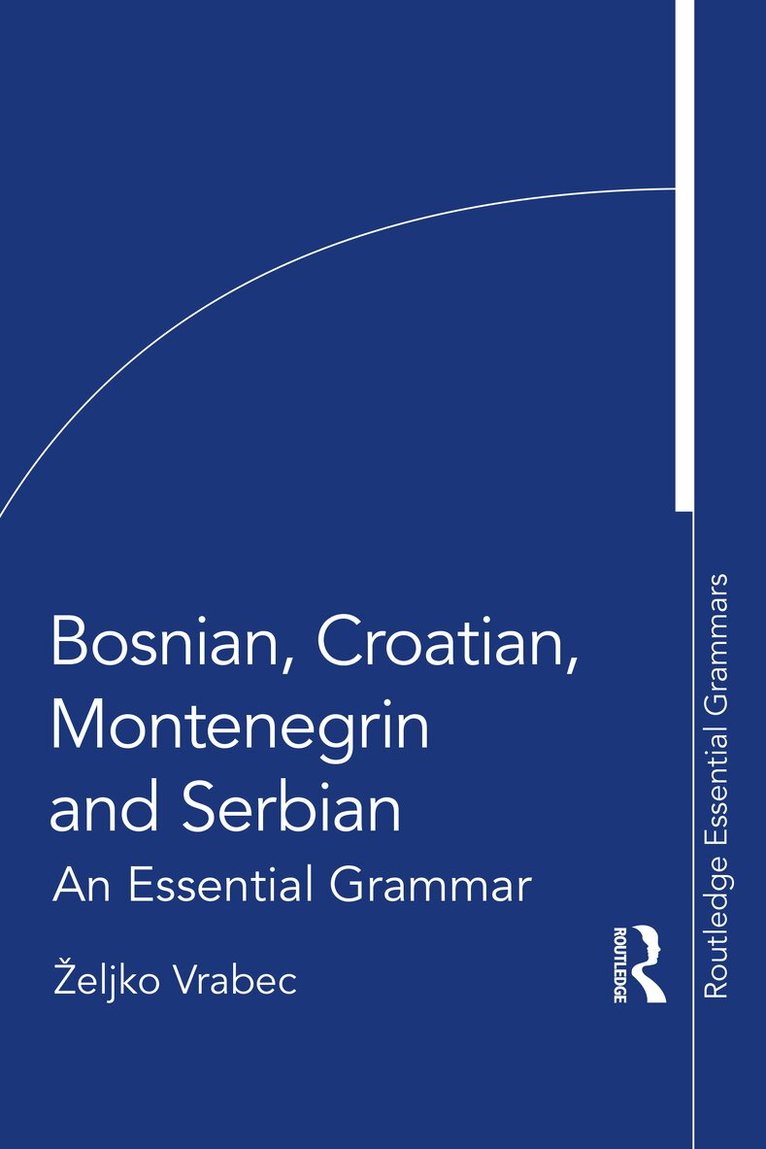
    Bosnian, Croatian, Montenegrin and Serbian

    An Essential Grammar

    AvŽeljko Vrabec

    Häftad, Engelska, 2021

    Del i serien Routledge Essential Grammars

    614 kr

    Beställningsvara. Skickas inom 10-15 vardagar. Fri frakt över 249 kr.

    Fler format och utgåvor

    Inbunden

    2 493 kr

    E-bok

    725 kr

    E-bok

    725 kr

    Beskrivning

    Bosnian, Croatian, Montenegrin and Serbian: An Essential Grammar is intended for beginners and intermediate students who need a reference that explains grammar in straightforward terms. It covers all the main areas of the modern single BCMS grammatical system in an accessible way, and free from jargon. When linguistic terminology is used, it is explained in layman’s terms, the logic of a rule is presented simply and near parallels are drawn with English. This book covers all the grammar necessary for everyday communication (reaching B1 and B2 of the CEFR, ACTFL Intermediate-Intermediate- Mid). The book comprises of extensive chapters on all parts of speech, the creation of different word forms (endings for cases in nouns and adjectives, case forms for pronouns, tenses, verbal modes, verbal aspect etc.) and their uses in sentences. Each rule is illustrated with numerous examples from everyday living language used in Bosnia-Herzegovina, Croatia, Montenegro and Serbia.This is a unique reference book in English aimed at the level of language study that treats BCMS as a single grammar system, explaining and highlighting all the small differences between the four variants of this polycentric language.

    Produktinformation

    • Utgivningsdatum:2021-09-22
    • Mått:156 x 234 x 31 mm
    • Vikt:460 g
    • Format:Häftad
    • Språk:Engelska
    • Serie:Routledge Essential Grammars
    • Antal sidor:322
    • Förlag:Taylor & Francis Ltd
    • ISBN:9780367723637

    Utforska kategorier

    • Språkundervisning och språkinlärning inom Språk och ordböcker

    Mer om författaren

    Željko Vrabec has professional translation experience gained at the BBC and the UN. He is a multilingual specialist with over 25 years of BBC editorial experience in different roles – from copy-editing breaking European stories and writing in-depth political analytical reports to media landscape surveys. Recently he has worked as a dialogue coach and cultural approximation consultant to Oscar-winning actors. In the past few years he has been teaching BCMS at a language school in London.

    Innehållsförteckning

    • IntroductionHow to use this book List of abbreviations The story of "four languages"1.1. Ekavian and Iyekavian pronunciations1.2. Number of speakers, official language names1.3. Brief outline of main grammatical differences2. Alphabet, pronunciation, spelling2.1. Vowels2.2. Consonants2.2.1. Voiced/unvoiced consonants2.2.2. Soft/hard consonants2.3. Consonant and vowel alternations2.3.1. Consonant softening before -E (palatalisation) 2.3.2. Consonant softening before -I (sibilarisation) 2.3.3. J-changes (yotation)2.3.4. Voicing assimilation2.3.5. L/O changes2.3.6. Fleeting -a-2.3.7. Removal of a duplicated consonant2.3.8. Multiple alternations 3. Nouns3.1. Gender3.1.1. Masculine nouns3.1.2. Feminine nouns3.1.3. Neuter nouns3.2. Plural (nominative plural)3.2.1. Masculine nouns3.2.2. Feminine nouns3.2.3. Neuter nouns3.2.4. Neuter collective nouns3.3. Cases3.3.1. Cases in English and BCMS3.3.2. The First and Second Declensions singular3.3.3. Nominative 3.3.4. Genitive3.3.5. Dative3.3.6. Accusative 3.3.7. Vocative3.3.8. Instrumental3.3.9. Locative3.3.10. Accusative vs Locative (destination vs location)3.3.11. First and Second Declension plural3.3.12. Genitive plural 3.3.13. The Third Declension (Feminine nouns ending in a consonant)3.3.14. Frequently used nouns displaying irregularities in declension3.3.15. Only plural nouns (Pluralia tantum) 4. Adjectives4.1. Descriptive and relational adjectives4.2. Gender4.3. Short - long forms4.4. Case endings 4.4.1. Short form cases 4.5. Possessive adjectives (Markov, Vesnin)4.6. Comparison4.6.1. Comparative4.6.2. Superlative4.6.3. How to say "than"?5. Pronouns5.1. Personal pronouns 5.2. Possessive pronouns 5.2.1. Svoj - possessive-reflexive pronoun for all persons5.3. Demonstrative pronouns ovaj - taj - onaj, ovakav, ovoliki 5.4. Interrogative pronouns ko (tko), šta (što), koji, čiji, kakav, koliki5.5. Relative pronouns koji, što, čiji, kakav5.6. Indefinite pronouns5.6.1. Emphasised indefinite pronouns (whatever, whoever)5.7. Reflexive pronoun sebe (se)5.8. Pronoun sav, sva, sve (all, whole)5.9. Pronoun sam, sama, samo6. Numerals6.1. Cardinal numbers6.1.1. Cardinal numbers agreement with nouns, pronouns and adjectives6.2. Ordinal numbers 6.3. Collective numbers -oro (two people, three people)6.4. Numerical nouns -ica (two men, three men)6.5. Approximate numbers -ak6.6. Fractions -ina6.7. Numerals acting as a subject6.8. Numbers used in dates6.8.1. Days of the week6.8.2. Months of the year 6.9. How to tell the time6.10. Expressing age7. Verbs7.1. Infinitives7.2. Conjugations7.2.1. Present tense stem 7.2.2. Three Conjugations 7.3. Types of verbs 7.3.1. Transitive/intransitive verbs7.3.2. Auxiliary verbsa) biti b) htjeti=hteti7.3.3. Regular verbs, pattern verbs, irregular verbs7.3.4. Perfective/Imperfective verbs7.3.5. Verbs of motion 7.3.6. Modal verbs7.3.7. Reflexive verbs 7.4. Tenses7.4.1. Present tense7.4.2. Past tense (Perfect tense)7.4.3. Future tense7.4.4. Future Exact7.5. Moods7.5.1. Imperative7.5.2. Potential mode7.6. Participles7.6.1. L-participle7.6.2. Passive participle7.7. Conditional clauses7.7.1. Realistic - ako7.7.2. Currently possible - kad(a)7.7.3. Unrealistic - da 7.8. Passive voice7.8.1. Present passive7.8.2. Past and future passive7.9. Verbal adverbs7.9.1. Present verbal adverb7.9.2. Past verbal adverb8. Adverbs8.1. -LY adverbs and equivalents in BCMS8.2. Comparison8.3. As stand-alone words8.4. Learning tip: adverb families8.4.1. ne-, ni-, -i adverbs 8.4.2. ov-, t-, on- adverbs 8.4.3. Emphasised indefinite adverbs (wherever, whenever) 9. Prepositions9.1. Prepositions used with only one case9.1.1. Only with the genitive9.1.2. Only with the dative9.1.3. Only with the accusative9.2. Prepositions used with two cases9.2.1. Used with the locative or accusative9.2.2. Used with the instrumental or accusative9.2.3. Learning tip: when to use U, when NA9.2.4. Correlation between U - IZ and NA - SA9.3. Prepositions with verbs of motion10. Conjunctions and particles10.1. Simple conjunctions10.2. Compound conjunctions10.3. Particles11. Sentence structure11.1. Free word order11.2. Enclitics11.3. Direct and indirect speech11.3.1. Reporting statements11.3.2. Reporting questions11.4. Predicate-only sentences11.4.1. Impersonal predicate-only sentences11.4.2. Personalised predicate-only sentences11.5. Negative sentences - multiple negatives 12. Word creation12.1. The power of word creation 12.2. Nouns12.2.1. Suffixes for professions, doers, athletes12.2.2. Suffixes for ethnicities, city dwellers, regional populations12.2.3. -CIJA suffix for adopting foreign words 12.2.4. Diminutives 12.2.5. Augmentatives12.2.6. Location suffixes 12.2.7. Suffix naming types of meat12.2.8. Suffixes for abstract nouns12.2.9. Verbal nouns -NJE12.2.10. Negative nouns NE-12.3. Adjectives12.3.1. Relational adjectives12.3.2. Descriptive adjectives 12.3.3. Adjective prefixes pre-, bez-, ne-12.4. Verbs12.4.1. Suffixes that change foreign words into verbs12.4.2. Prefixes 13. Croatian/Serbian glossary - most common vocabulary differences13.1. Nouns13.2. Adjectives13.3. Verbs13.4. Adverbs13.5. Everyday expressions14. Verb conjugation tables14.1. Irregular verbs14.1.1. biti14.1.2. moći14.1.3. htjeti = hteti14.1.4. slati14.2. A conjugation (regular)14.3. I conjugation (regular)14.3.1. I conjugation pattern -eti -im 14.3.2. I conjugation pattern -ati -im14.4. E conjugation patterns14.4.1. Pattern -ati -ema) stajati - stajemb) pisati - pišemc) zvati - zovem 14.4.2. Pattern -ati -anem14.4.3. Pattern -avati -ajem14.4.4. Pattern -ovati -ujem 14.4.5. Pattern -ivati -ujem14.4.6. Pattern -eti -ema) umjeti-umijemb) donijeti-donesem c) uzeti-uzmem14.4.7. Pattern -iti -ijem14.4.8. Pattern -uti -ujem14.4.9. Pattern -nuti -nem14.4.10. -STI infinitivesa) Pattern -sti -demb) Pattern -sti -dnem or -tnemc) Pattern -sti -zemd) Pattern -sti -stem14.4.11. -ĆI infinitivesa) Pattern -ći -demb) Pattern -ći -đemc) Pattern -ći, -gnem, or -knemd) Pattern -ći, -čemBibliographyIndex