• Fri frakt över 249 kr
  • •
  • Snabba leveranser
  • •
  • Billiga böcker
Kundservice

Du är på sajten för privatpersoner.

Företag, bibliotek eller offentlig verksamhet?

Du handlar på classic.bokus.com, där alla dina funktioner finns intakta.
Till classic.bokus.com
Bokus logotyp. Gå till startsidan.
  • Erbjudanden
  • Nyheter
  • Student
  • Topplistor
  • Barn & ungdom
  • Bokus Play
  • E-böcker
  • Pocketböcker
  • Spel & pussel

10% rabatt på allt med kod: NYSTART10 →

Sidfot

Mina sidor

    Hjälp

    • Kundservice
    • Vanliga frågor och svar
    • Frakt och leverans
    • Retur vid ångerrätt
    • Reklamera vara
    • Betalning
    • Köpvillkor
    • Allmänna villkor
    • Information om webbplatsens tillgänglighet

    Om Bokus

    • Om oss
    • Pressrum
    • För studenter
    • För företag
    • För bibliotek och offentlig verksamhet
    • För leverantörer
    • Hållbarhet

    Populärt

    • Aktuella erbjudanden
    • Presentkort
    • Studentlitteratur
    • Nya böcker
    • Topplistor
    • Signerade böcker
    • Engelska böcker

    Inspiration

    • Boktips
    • BookTok
    • Populära bokserier
    • Barnbokskaraktärer
    • Populära författare
    Logotyp för Bokus
    Följ oss på Facebook (extern länk)Följ oss på Instagram (extern länk)Följ oss på YouTube (extern länk)Följ oss på TikTok (extern länk)
    bokus @ CookiesAnpassa cookiesIntegritetspolicyKöpvillkor
    Till Citymail hemsida (extern länk)Till Budbee hemsida (extern länk)Till Postnord hemsida (extern länk)Till Schenker hemsida (extern länk)Till Early Bird hemsida (extern länk)Till Walleys hemsida (extern länk)
    1. Djur och Natur
    2. Naturböcker
    3. Växtböcker

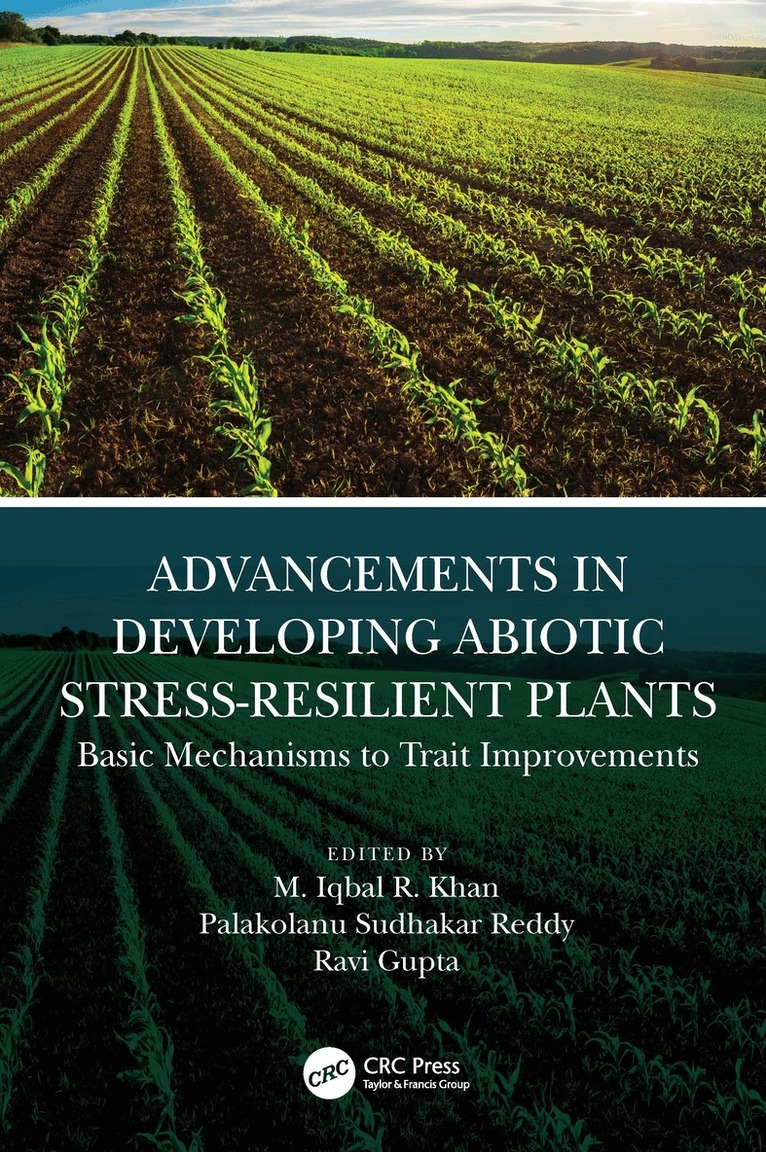
    Advancements in Developing Abiotic Stress-Resilient Plants

    Basic Mechanisms to Trait Improvements

    AvM. Iqbal R. Khan,Palakolanu Reddy

    Häftad, Engelska, 2022

    1 004 kr

    Beställningsvara. Skickas inom 10-15 vardagar. Fri frakt över 249 kr.

    Beskrivning

    Plants often encounter abiotic stresses including drought, salinity, flooding, high/low temperatures, and metal toxicity, among others. The majority of these stresses occur simultaneously and thus limit crop production. Therefore, the need of the hour is to improve the abiotic stresses tolerance of crop plants by integrating physiology, omics, and modern breeding approaches. This book covers various aspects including (1) abiotic stress responses in plants and progress made so far in the allied areas for trait improvements, (2) integrates knowledge gained from basic physiology to advanced omics tools to assist new breeding technologies, and (3) discusses key genes, proteins, and metabolites or pathways for developing new crop varieties with improved tolerance traits.

    Produktinformation

    • Utgivningsdatum:2022-06-21
    • Mått:178 x 254 x 28 mm
    • Vikt:780 g
    • Format:Häftad
    • Språk:Engelska
    • Antal sidor:386
    • Förlag:Taylor & Francis Ltd
    • ISBN:9780367748043

    Utforska kategorier

    • Växtböcker inom Djur och Natur
    • Botanik inom Naturvetenskap och teknik
    • Agronomi och lantbruk inom Naturvetenskap och teknik

    Mer om författaren

    Dr. M. Iqbal R. Khan is an Assistant Professor of Botany at Jamia Hamdard, New Delhi, India. His current research interests are elucidation physiological and molecular mechanisms associated with abiotic stress tolerance. Dr. Khan has found a significant role of phytohormones and suggested that phytohormones play an important in controlling stress responses, and interact in coordination with each other for defense signal networking to fine-tune tolerance mechanisms. He is also exploring the role of plant signaling molecules and their impact on plant homeostasis under abiotic stresses. He has been recognized as a Young Scientist Award by the Indian Society of Plant Physiology, Young Scientist Platinum Jubilee Award by The National Academy of Sciences, India (NASI), and Junior Scientist of the Year from National Environmental Science Academy New Delhi, India.Dr. Palakolanu Sudhakar Reddy is a Scientist (Cell, Molecular biology and Genetic engineering) at International Crops Research Institute for the Semi-Arid Tropics (ICRISAT), Telengala, India. He has a PhD from International Centre for Genetic Engineering and Biotechnology (ICGEB), New Delhi, where he focused on “Identification and characterization of the Heat Shock Proteins from Pennisetum glaucum”. He was a primary team member for developing high-throughput, low-cost methodologies for the isolation of promoters and genes, sequencing for phage DNA and identification of stable reference genes for qRT-PCR studies. He has been awarded with several National and International awards, including Leibniz-DAAD Postdoctoral Fellowship, Young Scientist and INSPIRE Faculty Awards from the Department of Science and Technology (DST), Government of India. He is an associate fellow of Andhra Pradesh Akademi of Sciences from 2015. He worked in Germany and Philippines on functional genomics and molecular aspects of abiotic stress tolerance and genome editing. He has published more than 39 research articles in international peer reviewed journals, edited one book, written eight book chapters, and has a patent. He is a reviewer of several reputed international journals, including Frontiers in plant science, Plant Physiology and Biochemistry, BMC Genomics, Environmental and Experimental Botany, Gene and PLoS ONE.Dr. Ravi Gupta earned his Ph.D. in Plant Physiology and Biochemistry from the University of Delhi, India. After gaining his Ph.D., he spent more than five years in South Korea working as a postdoctoral fellow and Research Professor at Pusan National University, Busan, Korea. Dr. Gupta is the author of more than 60 scientific journal publications and several book publications. He is a recipient of several prestigious national and international awards such as Ramalingaswami re-entry fellowship, Ramanujan fellowship, and ITS fellowship from Government of India and Korea Research Fellowship from Government of South Korea. Dr. Gupta has been invited to give many lectures at national and international conferences and workshops and has received independent funding from the Governments of India and South Korea. His current objectives include unravelling the biotic and abiotic stress signaling in plants, especially rice and soybean, using gel-based and gel-free proteomics approaches. Moreover, He is also working towards the development of novel techniques for the depletion of high-abundance proteins from different plant tissues to increase their proteome coverage, which would help analyse the "Hidden Proteome" of the plants.

    Innehållsförteckning

    • 1. Physiological, Molecular, and Biochemical Responses of Rice to Drought Stress2. Coordinated Functions of Reactive Oxygen Species Metabolism and Defense Systems in Abiotic Stress Tolerance3. Nitric Oxide- Mediated Salinity Stress Tolerance in Plants: Signaling and Physiological Perspectives4. S- Nitrosylation and Denitrosylation: A Regulatory Mechanism during Abiotic Stress Tolerance in Crops5. Calcium Signaling Is a Hub of the Signaling Network in Response and Adaptation of Plants to Heat Stress6. Functions of Polyamines in Abiotic Stress Tolerance in Plants7. Decoding the Multifaceted Role of Glycine Betaine in Heavy Metal Stress Regulation8. Abiotic stress and its role in altering the nutritional landscape of food crops9. Plants transcription factors from halophytes and their role in salinity and drought stress tolerance10. Plant abiotic stress tolerance on the transcriptomics atlas 11. Deciphering the molecular mechanism of salinity tolerance in halophytes using transcriptome analysis12. Seed aging in crops: A proteomics perspective13. Crop Proteomics: Towards Systemic Analysis of Abiotic Stress Responses14. Metabolites and abiotic stress tolerance in plants15. Genome editing for developing abiotic stress-resilient plants16. Molecular breeding in rice for abiotic stress resilience: The story since 200417. Nanotechnology in developing abiotic stress resilience in crops: a physiological implication