• Fri frakt över 249 kr
  • •
  • Snabba leveranser
  • •
  • Billiga böcker
Kundservice

Du är på sajten för privatpersoner.

Företag, bibliotek eller offentlig verksamhet?

Du handlar på classic.bokus.com, där alla dina funktioner finns intakta.
Till classic.bokus.com
Bokus logotyp. Gå till startsidan.
  • Erbjudanden
  • Nyheter
  • Student
  • Topplistor
  • Barn & ungdom
  • Bokus Play
  • E-böcker
  • Pocketböcker
  • Spel & pussel

10% rabatt på allt med kod: NYSTART10 →

Sidfot

Mina sidor

    Hjälp

    • Kundservice
    • Vanliga frågor och svar
    • Frakt och leverans
    • Retur vid ångerrätt
    • Reklamera vara
    • Betalning
    • Köpvillkor
    • Allmänna villkor
    • Information om webbplatsens tillgänglighet

    Om Bokus

    • Om oss
    • Pressrum
    • För studenter
    • För företag
    • För bibliotek och offentlig verksamhet
    • För leverantörer
    • Hållbarhet

    Populärt

    • Aktuella erbjudanden
    • Presentkort
    • Studentlitteratur
    • Nya böcker
    • Topplistor
    • Signerade böcker
    • Engelska böcker

    Inspiration

    • Boktips
    • BookTok
    • Populära bokserier
    • Barnbokskaraktärer
    • Populära författare
    Logotyp för Bokus
    Följ oss på Facebook (extern länk)Följ oss på Instagram (extern länk)Följ oss på YouTube (extern länk)Följ oss på TikTok (extern länk)
    bokus @ CookiesAnpassa cookiesIntegritetspolicyKöpvillkor
    Till Citymail hemsida (extern länk)Till Budbee hemsida (extern länk)Till Postnord hemsida (extern länk)Till Schenker hemsida (extern länk)Till Early Bird hemsida (extern länk)Till Walleys hemsida (extern länk)
    1. Kultur
    2. Arkitektur

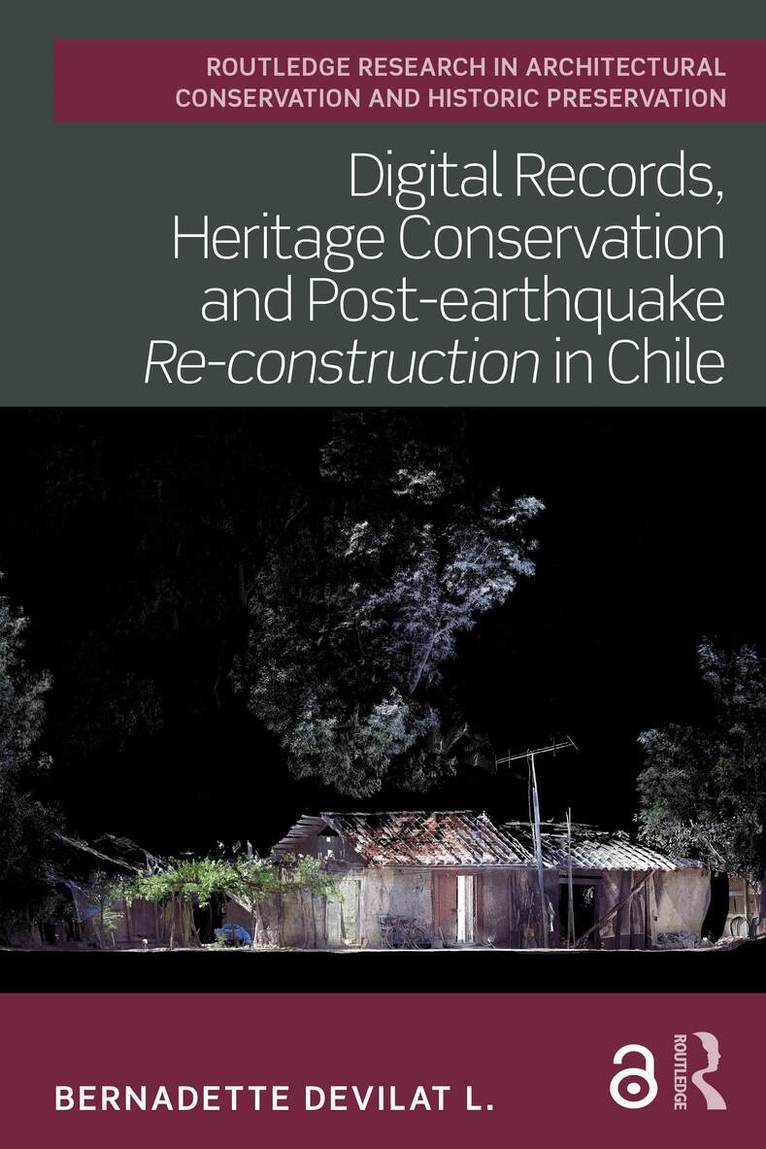
    Digital Records, Heritage Conservation and Post-earthquake Re-construction in Chile

    AvBernadette Devilat L.

    Inbunden, Engelska, 2025

    Del i serien Routledge Research in Architectural Conservation and Historic Preservation

    2 493 kr

    Beställningsvara. Skickas inom 10-15 vardagar. Fri frakt över 249 kr.

    Fler format och utgåvor

    Häftad

    701 kr

    E-bok

    794 kr

    E-bok

    794 kr

    Beskrivning

    The conservation of built heritage implies constant intervention. One form of intervention is reconstruction, which, in the context of disasters, usually tries to bring buildings and places back to their previous state and is contested in heritage discourses. This book challenges reconstruction as a replica to physically preserve damaged built heritage by critically examining a context of constant change resulting from earthquakes – Chile – advocating for the digital record to be an analytical basis for design, following the principles embedded in historical domestic architecture.Beyond monumental heritage, the focus is on the living heritage of the historical settlements of Tarapacá, Zúñiga, and Lolol, built with local resources and sustainable techniques. The book proposes re-construction as an alternative methodology, based on 3D-laser-scanning, photography, and questionnaires, to analyse the as-built condition of earthquake-affected buildings, consider risk mitigation, and recognise adaptation to earthquakes and subsequent reconstructions. This is relevant for seismic-prone areas and built heritage at risk in general.This book is aimed at researchers, academics, and practitioners in architectural conservation and is also a valuable resource for authorities and stakeholders involved in post-earthquake scenarios.The Open Access version of this book, available at http://www.taylorfrancis.com, has been made available under a Creative Commons Attribution-Non Commercial-No Derivatives (CC BY-NC-ND) 4.0 license.

    Produktinformation

    • Utgivningsdatum:2025-05-30
    • Mått:156 x 234 x 20 mm
    • Vikt:600 g
    • Format:Inbunden
    • Språk:Engelska
    • Serie:Routledge Research in Architectural Conservation and Historic Preservation
    • Antal sidor:268
    • Förlag:Taylor & Francis Ltd
    • ISBN:9780367776237

    Utforska kategorier

    • Arkitektur inom Kultur
    • Byggnadsteknik inom Naturvetenskap och teknik
    • Byggnadsvård inom Naturvetenskap och teknik

    Mer om författaren

    Bernadette Devilat L., also known as Bernardita, is an assistant professor at the Department of Architecture and Built Environment of the University of Nottingham, part of the Architecture, Culture and Tectonics Research Group, where she teaches and leads research projects as Principal Investigator. She graduated as an Architect in Chile with a Master’s in Architecture at the Pontificia Universidad Católica, followed by a PhD in Architectural Design from the Bartlett School of Architecture, University College London. Her research includes critical and novel uses of accurate recording technologies – mainly 3D-laser-scanning – to conserve built heritage at risk with case studies in Chile and India. She co-founded the Tarapacá Project, created after the 2005 earthquake in Chile; and DLA Scan Architectural Studio with built projects in Chile. She has research and teaching experience at all the universities listed, and Nottingham Trent University. She has published, given guest keynotes and lectures, exhibited and presented her work internationally, and received prestigious awards.

    Recensioner i media

    It is easy, in countries where buildings can be expected to last for thousands of years if they are very well built and maintained with care, to believe that restoration back to the original is the be all and end all of preservation. But buildings of this nature are rare, and historical continuity over long periods to support continuous maintenance is close to non-existent. In addition, buildings are continually repurposed, and this will inevitably have an impact on their fabric.Chile, with highly active earthquake zones and a rapidly developing culture and economy, is a petri dish in which concepts of conservation can be exposed to extreme challenges, and this book is a really welcome, erudite, and significant contribution to the subject. As society moves forward, it is plausible to believe that in many cases, a complete record of past buildings will become more significant than the retention of a few of the actual buildings.Professor Stephen Gage, The bartlett School of Architecture, UCLRelics, remnants, and records are something of the past that remains in the present, thresholds of knowledge that signify possibilities of the future. Bernadette Devilat’s book is bringing a novel and much needed discussion on the nature, form, and urgency of records, memory in the digital age as some form of contemporary Noah’s Arch to interpret the past to preserve some form of future of architecture and built environment in general. She is offering care and cautions, erudition and innovation with what she calls re-construction to a field of practice often left in a hurry to measure success, evidence, and novelty. Across disaster studies, architecture and digital design, Bernadette Devilat’s book is a needed reading for all interested in an architecture of hope.Professor Camillo Boano, Polytechnic of Turin, Italy; and Development Planning Unit, London

    Innehållsförteckning

    • List of figuresList of abbreviationsAcknowledgementsPrefaceIntroductionSituating the argumentEarthquakes in ChileRe-construction and recordStructure of the bookChapter 1: Built heritage conservation1.1. A brief history of conservation1.1.1. Initial attempts1.1.2. Rome and beyond1.1.3. Middle Ages1.1.4. From the Renaissance1.1.5. The becoming of heritage1.2 Why conserve?1.2.1. Living heritage: tangible and intangible1.2.2. Sustainability and economic value1.2.3. Tourism1.2.4. Memory and the construction of history1.3 How to conserve?1.3.1. Concepts of intervention in built heritage1.3.2. Reconstruction and re-construction1.3.3. Time in built heritage restoration1.3.4. Continuous conservation1.3.5. Two intervention extremes1.4. Concluding remarksChapter 2: Recording heritage buildings2.1. Architectural representation, building and measuring2.1.1 Building as recording2.1.2. Architectural treatises2.1.3. Other records2.2. Surveying buildings2.2.1. Hand-measuring method2.2.2. Photography2.2.3. 3D imaging2.2.4. 3D scanning using projected light2.2.5. 3D-laser-scanning2.3. The rise of digital recording technologies2.3.1. Products from the 3D record2.3.2. Designing from the 3D scan data2.3.3. The paradox of the complete record2.3.4. Record and archive2.3.5. Continuous modelling and design2.3.6. Visual replica2.4. Concluding remarksChapter 3: Record and reconstruction in the face of destruction 3.1. Potential destruction3.1.1. The record3.1.2. Rebuilding as replica3.1.3. The paradox of the original3.2 Recording for re-construction3.2.1 Documenting to manage risk3.2.2 Post-destruction assessment and documen3.3 Post-earthquake intervention of heritage areas3.3.1 Building techniques in reconstruction and re-construction3.4. Concluding remarksChapter 4: Reconstruction of heritage areas in Chile4.1. Built heritage in Chile4.1.1. Continuous destruction because of earthquakes4.1.2 Heritage stance4.1.3. Recording heritage buildings4.1.4 Mitigation of heritage damage4.2. Case studies4.2.1. Two earthquakes4.2.2 Chilean heritage areas4.2.3. Tarapacá4.2.4. Zúñiga4.2.5. Lolol4.3. Reconstruction after earthquakes in Chile4.3.1. Emergency period4.3.2. Permanent housing4.3.3. Post-earthquake surveys4.3.4. 2005 Earthquake4.3.5. 2010 Earthquake4.4. Persisting challenges4.4.1. Emergency period4.4.2 Reconstruction process4.5. Concluding remarksChapter 5: The record5.1. Data capture on-site5.1.1. Documenting the built environment5.1.2. Inhabitants' perception5.2. Visualisation5.3 Limitations5.4 The record for analysis5.4.1. Post-earthquake surveys5.4.2 Architectural design, heritage elements and the sustainability of the new “heritage” dwellings5.4.3. The paradox of authentic reproduction5.5. Concluding remarksChapter 6: Re-construction alternative6.1. Documenting to mitigate risk6.1.1. Mitigation retrofitting6.1.2. Integrating inhabitants6.2. Designing from the record6.2.1. Time6.2.2 Spatial use: the inhabited record6.2.3 Sustainability and materiality6.3.2. Spatial use: the inhabited record6.3 Re-construction6.3.1 Tarapacá – memory6.3.2 Zúñiga – use6.3.3. Lolol – in-between6.4. Concluding remarksConclusionsMethodologyAs a post-earthquake documenting toolAs a basis for analysis and designGoing beyond the buildingsImplicationsNew Buildings for oldMitigation as conservationContinuous transformationProjectionsReferencesIndex