• Fri frakt över 249 kr
  • •
  • Snabba leveranser
  • •
  • Billiga böcker
Kundservice

Du är på sajten för privatpersoner.

Företag, bibliotek eller offentlig verksamhet?

Du handlar på classic.bokus.com, där alla dina funktioner finns intakta.
Till classic.bokus.com
Bokus logotyp. Gå till startsidan.
  • Erbjudanden
  • Nyheter
  • Student
  • Topplistor
  • Barn & ungdom
  • Bokus Play
  • E-böcker
  • Pocketböcker
  • Spel & pussel

10% rabatt på allt med kod: NYSTART10 →

Sidfot

Mina sidor

    Hjälp

    • Kundservice
    • Vanliga frågor och svar
    • Frakt och leverans
    • Retur vid ångerrätt
    • Reklamera vara
    • Betalning
    • Köpvillkor
    • Allmänna villkor
    • Information om webbplatsens tillgänglighet

    Om Bokus

    • Om oss
    • Pressrum
    • För studenter
    • För företag
    • För bibliotek och offentlig verksamhet
    • För leverantörer
    • Hållbarhet

    Populärt

    • Aktuella erbjudanden
    • Presentkort
    • Studentlitteratur
    • Nya böcker
    • Topplistor
    • Signerade böcker
    • Engelska böcker

    Inspiration

    • Boktips
    • BookTok
    • Populära bokserier
    • Barnbokskaraktärer
    • Populära författare
    Logotyp för Bokus
    Följ oss på Facebook (extern länk)Följ oss på Instagram (extern länk)Följ oss på YouTube (extern länk)Följ oss på TikTok (extern länk)
    bokus @ CookiesAnpassa cookiesIntegritetspolicyKöpvillkor
    Till Citymail hemsida (extern länk)Till Budbee hemsida (extern länk)Till Postnord hemsida (extern länk)Till Schenker hemsida (extern länk)Till Early Bird hemsida (extern länk)Till Walleys hemsida (extern länk)
    1. Medicin
    2. Klinisk medicin och internmedicin
    3. Sjukdomar och rubbningar
    4. Onkologi

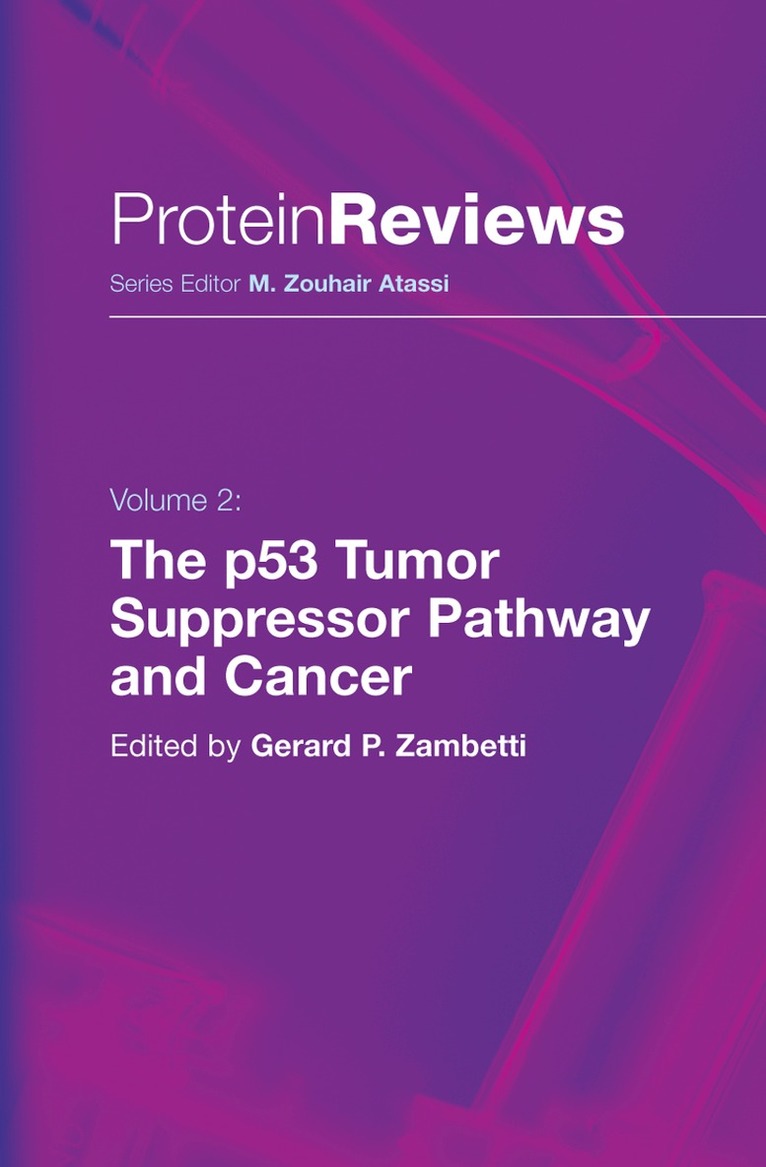
    p53 Tumor Suppressor Pathway and Cancer

    AvGerard P. Zambetti

    Inbunden, Engelska, 2006

    Del 2 i serien Protein Reviews

    1 674 kr

    Beställningsvara. Skickas inom 10-15 vardagar. Fri frakt över 249 kr.

    Beskrivning

    The current year (2004) marks the Silver Anniversary of the discovery of the p53 tumor suppressor. The emerging ?eld ?rst considered p53 as a viral antigen and then as an oncogene that cooperates with activated ras in transforming primary cells in culture. Fueling the concept of p53 acting as a transforming factor, p53 expression was markedly elevated in various transformed and tumorigenic cell lines when compared to normal cells. In a simple twist of fate, most of the studies conducted in those early years inadvertently relied on a point mutant of p53 that had been cloned from a normal mouse genomic library. A bona ?de wild-type p53 cDNA was subsequently isolated, ironically, from a mouse teratocarcinoma cell line. A decade after its discovery, p53 was shown to be a tumor suppressor that protects against cancer. It is now recognized that approximately half of all human tumors arise due to mutations within the p53 gene. As remarkable as this number may seem, it signi?cantly underrepresents how often the p53 pathway is targeted during tumorigenesis. It is my personal view, as well as many in the p53 ?eld, that the p53-signaling pathway is corrupted in nearly 100% of tumors. If you are interested in understanding cancer and how it develops, you must begin by studying p53 and its pathway. After demonstrating that p53 functions as a tumor suppressor the ?eld exploded and p53 became a major focus of scientists around the world.

    Produktinformation

    • Utgivningsdatum:2006-01-11
    • Mått:155 x 235 x 21 mm
    • Vikt:606 g
    • Format:Inbunden
    • Språk:Engelska
    • Serie:Protein Reviews
    • Antal sidor:246
    • Upplaga:2005
    • Förlag:Springer-Verlag New York Inc.
    • ISBN:9780387241357

    Utforska kategorier

    • Onkologi inom Medicin

    Mer om författaren

    Dr. Gerard Zambetti began working on p53 as a Damon-Runyon Postdoctoral Fellow in the laboratory of Arnie Levine at Princeton University in 1990. During his fellowship he developed the first mammalian promoter-reporter assay to monitor p53 transcriptional activity. A close colleague in the lab, Jamil Momand, identified Mdm2 as a 90 kD protein that binds wild-type p53. At the same time Donna George at Penn reported that Mdm2 promotes tumor growth. They rationalized that Mdm2 could be oncogenic by binding and inactivating p53. This hypothesis was borne out by Dr. Zambetti's demonstration that Mdm2 blocks the ability of p53 to transactivate a wild-type p53 responsive promoter-reporter. These findings established Mdm2 as a negative regulator of p53 and gave rise to the p53-Mdm2 field. Subsequent studies showed that Mdm2 inactivates p53 in human tumors. There is now a biannual international Mdm2 meeting and nearly 2000 published studies regarding Mdm2. Dr. Zambetti is presently an Associate Member at St. Jude Children's Research Hospital in Memphis, Tennessee. He has recently been involved in the identification and characterization of a novel germline p53 mutation that selectively predisposes carriers to pediatric adrenal cancer. His lab has also identified cytokine signaling pathways that repress the apoptotic function of p53. These findings could be exploited for the development of strategies to reduce the toxic side effects of radiation and chemotherapy. Dr. Zambetti also studies how p53 becomes activated during cell stress and how it kills tumor cells and his interests continue along these exciting, clinically important lines of research.

    Innehållsförteckning

    • The p53 Network.- The Three-Dimensional Structure of p53.- Transcriptional Activation by p53: Mechanisms and Targeted Genes.- Transcriptional Repression by the p53 Tumor Suppressor Protein.- Posttranslational Modifications of p53: Upstream Signaling Pathways.- p53 in Human Cancer — Somatic and Inherited Mutations and Mutation-independent Mechanisms.- MDM2 and MDMX Regulators of p53 Activity.- p53 Family Members: p63 and p73.- The Oncogenic Activity of p53 Mutants.- Therapeutic Strategies Based on Pharmacological Modulation of p53 Pathway.