• Fri frakt över 249 kr
  • •
  • Snabba leveranser
  • •
  • Billiga böcker
Kundservice

Du är på sajten för privatpersoner.

Företag, bibliotek eller offentlig verksamhet?

Du handlar på classic.bokus.com, där alla dina funktioner finns intakta.
Till classic.bokus.com
Bokus logotyp. Gå till startsidan.
  • Erbjudanden
  • Nyheter
  • Student
  • Topplistor
  • Barn & ungdom
  • Bokus Play
  • E-böcker
  • Pocketböcker
  • Spel & pussel

10% rabatt på allt med kod NYSTART10 →

Sidfot

Mina sidor

    Hjälp

    • Kundservice
    • Vanliga frågor och svar
    • Frakt och leverans
    • Retur vid ångerrätt
    • Reklamera vara
    • Betalning
    • Köpvillkor
    • Allmänna villkor
    • Information om webbplatsens tillgänglighet

    Om Bokus

    • Om oss
    • Pressrum
    • För studenter
    • För företag
    • För bibliotek och offentlig verksamhet
    • För leverantörer
    • Hållbarhet

    Populärt

    • Aktuella erbjudanden
    • Presentkort
    • Studentlitteratur
    • Nya böcker
    • Topplistor
    • Signerade böcker
    • Engelska böcker

    Inspiration

    • Boktips
    • BookTok
    • Populära bokserier
    • Barnbokskaraktärer
    • Populära författare
    Logotyp för Bokus
    Följ oss på Facebook (extern länk)Följ oss på Instagram (extern länk)Följ oss på YouTube (extern länk)Följ oss på TikTok (extern länk)
    bokus @ CookiesAnpassa cookiesIntegritetspolicyKöpvillkor
    Till Citymail hemsida (extern länk)Till Budbee hemsida (extern länk)Till Postnord hemsida (extern länk)Till Schenker hemsida (extern länk)Till Early Bird hemsida (extern länk)Till Walleys hemsida (extern länk)
    1. Djur och Natur
    2. Naturböcker
    3. Växtböcker

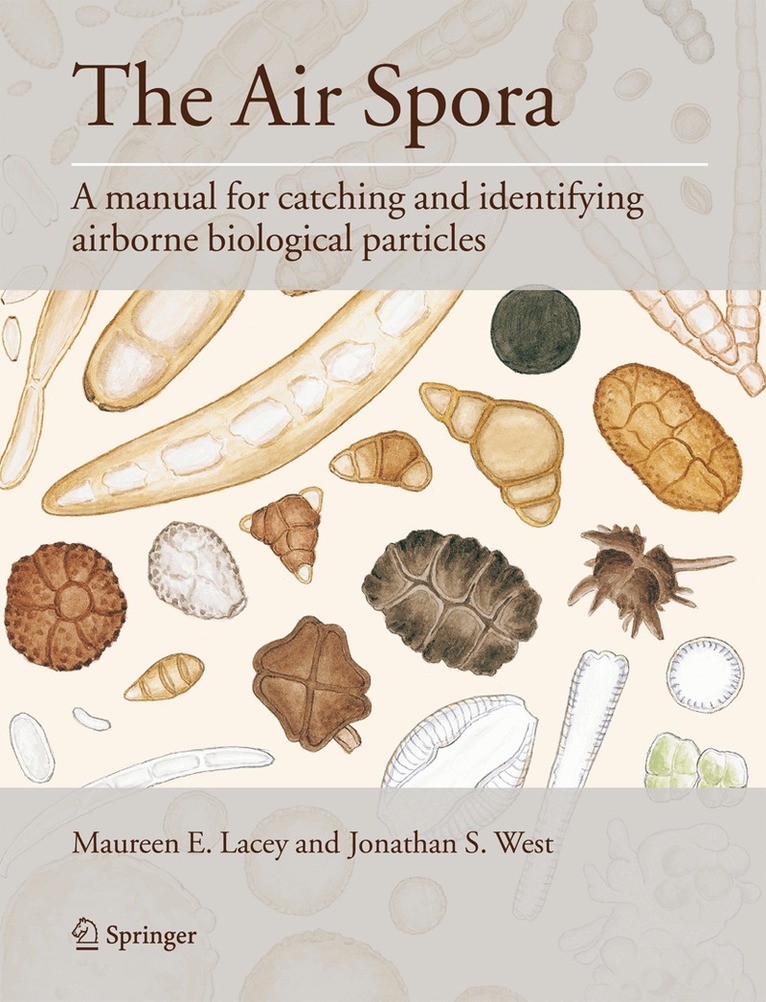
    Air Spora

    A manual for catching and identifying airborne biological particles

    AvMaureen E. Lacey,Jonathan S. West

    Häftad, Engelska, 2006

    2 559 kr

    Beställningsvara. Skickas inom 10-15 vardagar. Fri frakt över 249 kr.

    Beskrivning

    The Air Spora is an illustrated guide to trapping, identifying and quantifying airborne biological particles such as fungus and plant spores and pollen. This book will be of use to anyone interested in aerobiology or studying applied aspects such as dispersal and effect of allergens, or human, animal and plant pathogens. Including a comprehensive review of what is in the air and detailing the historical development of theories leading to modern aerobiology, the book explains the fundamental processes behind airborne dispersal and techniques used to sample, identify and quantify biological particles. Methods are explained in a step-by-step guide for the use of standard air sampling devices. Although formats applicable to modern molecular and immunological techniques are described, the emphasis of the book is on simple visual identification of particles in air samples using traditional microscopy. Consequently a chapter on setting-up and using a light microscope is included, although experienced researchers can skip to chapters showing photographs of examples of the Air Spora and nine colour plates of paintings of airborne particles at a magnification of x1000. "I recommend this book to those actively running or thinking of running a pollen and spore trapping program. It will also be of value to doctors, allergists, and those teaching the basics of palynology, wishing to include a lecture or two on air spora." David M. Jarzen, Florida Museum of Natural HistoryIn: The Newsletter of the American Association Of Stratigraphic Palynologists, 2007(40:2)

    Produktinformation

    • Utgivningsdatum:2006-10-19
    • Mått:193 x 260 x 12 mm
    • Vikt:426 g
    • Format:Häftad
    • Språk:Engelska
    • Antal sidor:156
    • Upplaga:2007
    • Förlag:Springer-Verlag New York Inc.
    • ISBN:9780387302522

    Utforska kategorier

    • Växtböcker inom Djur och Natur
    • Tillämpad fysik inom Naturvetenskap och teknik
    • Onkologi inom Medicin

    Recensioner i media

    From the reviews: 'A book on general aerobiology with an emphasis towards fungal spores and pollen that will interest both the specialist and the non-specialist. The illustrations are great' W.D. Griffiths, Airborne Matters, Dunstable, Beds, UK "The book adds a novel and important value to aerobiology. 'The Air Spora' is a well written step-by-step guide to key techniques for trapping, identifying and quantifying airborne biological particles. The book enables precise identification of particles largely by superb colour paintings. In my opinion the book will remain for decades a reference source for most institutions concerned with aerobiology. In conclusion, 'The Air Spora' is a high-quality book which could be recommended" (Jacek Dutkiewicz, Annals of Agricultural and Environmental Medicine, Issue 13, 2006) "This book draws together the different approaches and techniques, used in aerobiology in a very informative and useful way. The authors have produced a text which will become a standard reference in aerobiological teaching and research. The glossary contains many aerobiological terms which should be useful for the beginner. Given the subject areas covered and illustrations it is likely that this book will appeal to a wide range of nonspecialists readers as well as aerobiological connoisseurs." (Roy Kennedy, Plant Pathology, Issue 58, 2007) "I recommend this book to those actively running or thinking of running a pollen and spore trapping program. It will also be of value to doctors, allergists, and those teaching the basics of palynology, wishing to include a lecture or two on air spora." (David M. Jarzen, Florida Museum of Natural History In: The Newsletter of the American Association Of Stratigraphic Palynologists, 2007) "'The Air Spora' ... is an illustrated guide for trapping and quantifying airborne fungus spores, pollen and other bioparticles. ... The illustrations, microphotographs and colour paintings are very pleasing and are of high quality. The book is paper bound with an attractive laminated cover page containing paintings of biological particles which gives the book a most pleasing appearance. ... This is a well prepared manual and should be possessed by all aerobiologists. It is a 'must' for youngsters who choose to pursue research in aerobiology." (B. P. R. Vittal, Indian Journal of Aerobiology, Vol. 19 (2), 2006)

    Innehållsförteckning

    • Chapter 1 Introduction to Aerobiology 1. What is aerobiology 2. The Air Spora 3. What is in the air 4. Early history of aerobiology 5. Aerobiology as a discipline 6. Aerobiology in action Chapter 2 The Aerobiology Pathway 1. Introduction 2. Take-off (Release) 3. Dispersal 4. Deposition - sedimentation and impaction 5. Impact 6. Interpreting spore trap data 7. Dispersal by rain splash and aerosol Chapter 3 Air Sampling Techniques 1. Introduction 2. Passive traps 3. Cascade impactor 4. Andersen sampler 5. Whirling arm trap 6. Burkard trap 7. Cyclone and minature cyclone samplers 8. Virtual impactors and liquid impingers 9. Filters Chapter 4 Using a Burkard Trap 1. Introduction 2. Siting the trap 3. Running the trap Chapter 5 Using a microscope 1. Introduction 2. Microscope structures 3. Using a microscope 4. Measuring and calibration Chapter 6 Pollen and spore counts 1. Introduction 2. Counting pollens and spores from a Burkard trap 3. Counting pollen and spores from a whirling arm trap Chapter 7 Identification 1. Introduction 2. Particle types 3. Useful references 4. Paintings –x1000 Appendix Glossary References Index Chapter 1 Introduction to Aerobiology 1. What is aerobiology 2. The Air Spora 3. What is in the air 4. Early history of aerobiology 5. Aerobiology as a discipline 6. Aerobiology in action Chapter 2 The Aerobiology Pathway 1. Introduction 2. Take-off (Release) 3. Dispersal 4. Deposition - sedimentation and impaction 5. Impact 6. Interpreting spore trap data 7. Dispersal by rain splash and aerosol Chapter 3 Air Sampling Techniques 1. Introduction 2. Passive traps 3. Cascade impactor 4. Andersen sampler 5. Whirling arm trap 6. Burkard trap 7. Cyclone and minaturecyclone samplers 8. Virtual impactors and liquid impingers 9. Filters Chapter 4 Using a Burkard Trap 1. Introduction 2. Siting the trap 3. Running the trap Chapter 5 Using a microscope 1. Introduction 2. Microscope structures 3. Using a microscope 4. Measuring and calibration Chapter 6 Pollen and spore counts 1. Introduction 2. Counting pollens and spores from a Burkard trap 3. Counting pollen and spores from a whirling arm trap Chapter 7 Identification 1. Introduction 2. Particle types 3. Useful references 4. Paint