• Fri frakt över 249 kr
  • •
  • Snabba leveranser
  • •
  • Billiga böcker
Kundservice

Du är på sajten för privatpersoner.

Företag, bibliotek eller offentlig verksamhet?

Du handlar på classic.bokus.com, där alla dina funktioner finns intakta.
Till classic.bokus.com
Bokus logotyp. Gå till startsidan.
  • Erbjudanden
  • Student
  • Topplistor
  • Barn & ungdom
  • Bokus Play
  • E-böcker
  • Ljudböcker
  • Pocketböcker
  • Spel och pussel

Pocketfynda! Hundratals böcker för 49 kr/st →

Sidfot

Mina sidor

    Hjälp

    • Kundservice
    • Vanliga frågor och svar
    • Frakt och leverans
    • Retur vid ångerrätt
    • Reklamera vara
    • Betalning
    • Köpvillkor
    • Allmänna villkor
    • Information om webbplatsens tillgänglighet

    Om Bokus

    • Om oss
    • Pressrum
    • För studenter
    • För företag
    • För bibliotek och offentlig verksamhet
    • För leverantörer
    • Hållbarhet

    Populärt

    • Aktuella erbjudanden
    • Presentkort
    • Studentlitteratur
    • Nya böcker
    • Topplistor
    • Signerade böcker
    • Engelska böcker

    Inspiration

    • Boktips
    • BookTok
    • Barnbokskaraktärer
    • Populära författare
    Logotyp för Bokus
    Följ oss på Facebook (extern länk)Följ oss på Instagram (extern länk)Följ oss på YouTube (extern länk)Följ oss på TikTok (extern länk)
    bokus @ CookiesAnpassa cookiesIntegritetspolicyKöpvillkor
    Till Citymail hemsida (extern länk)Till Budbee hemsida (extern länk)Till Postnord hemsida (extern länk)Till Schenker hemsida (extern länk)Till Early Bird hemsida (extern länk)Till Walleys hemsida (extern länk)
    1. Skönlitteratur
    2. Litteraturvetenskap
    3. Litteraturvetenskap

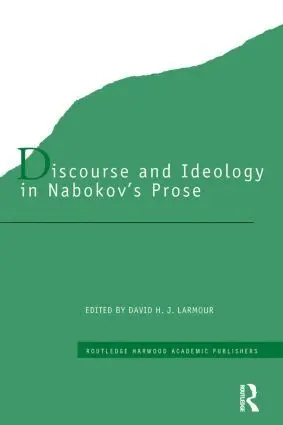
    Discourse and Ideology in Nabokov's Prose

    AvDavid H. J. Larmour

    Inbunden, Engelska, 2002

    Del i serien Routledge Harwood Studies in Russian and European Literature

    3 651 kr

    Beställningsvara. Skickas inom 5-8 vardagar. Fri frakt över 249 kr.

    Beskrivning

    The prose writings of Vladimir Nabokov form one of the most intriguing oeuvres of the twentieth century. His novels, which include Despair, Lolita and Pale Fire, have been celebrated for their stylistic artistry, their formal complexity, and their unique treatment of themes of memory, exile, loss, and desire.This collection of essays offers readings of several novels as well as discussions of Nabokov's exchange of views about literature with Edmund Wilson, and his place in the 1960s and contemporary popular culture.The volume brings together a diverse group of Nabokovian readers, of widely divergent scholarly backgrounds, interests, and approaches. Together they shift the focus from the manipulative games of author and text to the restless and sometimes resistant reader, and suggest new ways of enjoying these endlessly fascinating texts.

    Produktinformation

    • Utgivningsdatum:2002-05-30
    • Mått:156 x 234 x 13 mm
    • Vikt:520 g
    • Format:Inbunden
    • Språk:Engelska
    • Serie:Routledge Harwood Studies in Russian and European Literature
    • Antal sidor:192
    • Förlag:Taylor & Francis Ltd
    • ISBN:9780415286589

    Utforska kategorier

    • Litteraturvetenskap inom Skönlitteratur

    Mer om författaren

    David Larmour is Professor of Classics and Comparative Literature at Texas Tech University. He co-edited Russian Literature and the Classics (1996) and since 1997 has been one of the editors of the journal Intertexts.

    Recensioner i media

    'I would like to stress that the volume makes for fascinating reading.' - MLR 99.2, 2004

    Innehållsförteckning

    • Introduction: collusion and collision PART I The artist and ideology 1 The Nabokov–Wilson debate: art versus social and moral responsibility 2 Two organ-grinders: duality and discontent in Bend Sinister PART II Discourses of gender and sexuality 3 Okrylyonnyy Soglyadatay – The winged eavesdropper: Nabokov and Kuzmin 4 Getting one past the goalkeeper: sports and games in Glory 5 The crewcut as homoerotic discourse in Nabokov’s Pale Fire PART III Lolita 6 Seeing through Humbert: focussing on the feminist sympathy in Lolita 7 Discourse, ideology, and hegemony: the double dramas in and around Lolita PART IV Cultural contacts 8 Nabokov and the sixties 9 Vladimir Nabokov and popular culture