• Fri frakt över 249 kr
  • •
  • Snabba leveranser
  • •
  • Billiga böcker
Kundservice

Du är på sajten för privatpersoner.

Företag, bibliotek eller offentlig verksamhet?

Du handlar på classic.bokus.com, där alla dina funktioner finns intakta.
Till classic.bokus.com
Bokus logotyp. Gå till startsidan.
  • Erbjudanden
  • Nyheter
  • Student
  • Topplistor
  • Barn & ungdom
  • Bokus Play
  • E-böcker
  • Pocketböcker
  • Spel & pussel

10% rabatt på allt med kod: NYSTART10 →

Sidfot

Mina sidor

    Hjälp

    • Kundservice
    • Vanliga frågor och svar
    • Frakt och leverans
    • Retur vid ångerrätt
    • Reklamera vara
    • Betalning
    • Köpvillkor
    • Allmänna villkor
    • Information om webbplatsens tillgänglighet

    Om Bokus

    • Om oss
    • Pressrum
    • För studenter
    • För företag
    • För bibliotek och offentlig verksamhet
    • För leverantörer
    • Hållbarhet

    Populärt

    • Aktuella erbjudanden
    • Presentkort
    • Studentlitteratur
    • Nya böcker
    • Topplistor
    • Signerade böcker
    • Engelska böcker

    Inspiration

    • Boktips
    • BookTok
    • Populära bokserier
    • Barnbokskaraktärer
    • Populära författare
    Logotyp för Bokus
    Följ oss på Facebook (extern länk)Följ oss på Instagram (extern länk)Följ oss på YouTube (extern länk)Följ oss på TikTok (extern länk)
    bokus @ CookiesAnpassa cookiesIntegritetspolicyKöpvillkor
    Till Citymail hemsida (extern länk)Till Budbee hemsida (extern länk)Till Postnord hemsida (extern länk)Till Schenker hemsida (extern länk)Till Early Bird hemsida (extern länk)Till Walleys hemsida (extern länk)
    1. Ekonomi och Ledarskap
    2. Nationalekonomi

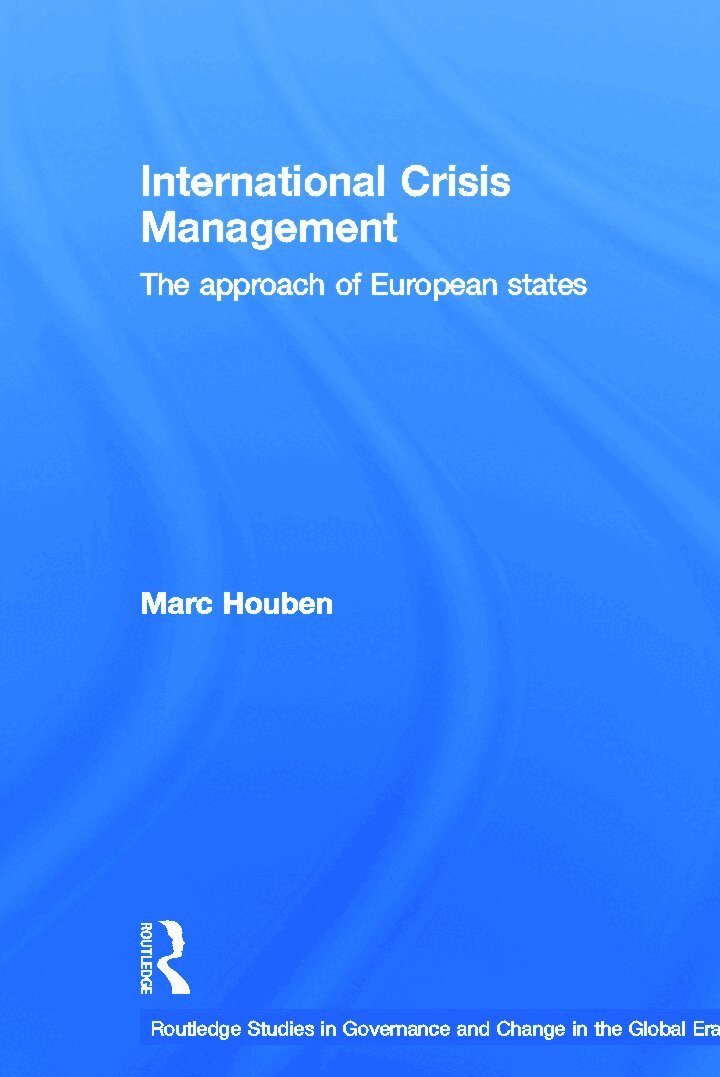
    International Crisis Management

    The Approach of European States

    AvMarc Houben

    Inbunden, Engelska, 2004

    Del i serien Routledge Studies in Governance and Change in the Global Era

    2 493 kr

    Beställningsvara. Skickas inom 10-15 vardagar. Fri frakt över 249 kr.

    Fler format och utgåvor

    Häftad

    744 kr

    E-bok

    858 kr

    E-bok

    855 kr

    Beskrivning

    Over the past fifty years, crisis management has become essential to achieving and maintaining national security. This book offers a comparative analysis of the preconditions and constraints nine European states place on their participation in international crisis management operations and the important consequences of such decisions, and provides a theoretical framework to help the reader understand this complex decision-making process.
    Produktinformation

    • Utgivningsdatum:2004-12-10
    • Mått:152 x 229 x 25 mm
    • Vikt:635 g
    • Format:Inbunden
    • Språk:Engelska
    • Serie:Routledge Studies in Governance and Change in the Global Era
    • Antal sidor:344
    • Förlag:Taylor & Francis Ltd
    • ISBN:9780415354554

    Utforska kategorier

    • Nationalekonomi inom Ekonomi och Ledarskap

    Mer om författaren

    Marc Houben holds master's degrees in philosophy and information management and a doctorate in social sciences. He has written about issues in philosophy, public policy, strategy and security and saw action in several crisis management operations as an officer in the Royal Netherlands Marine Corps.

    Innehållsförteckning

    • Part One: Problem definition and framework of analysis1. Introduction and plan of the book1.1 The double political problem of international crisis management1.2 Preconditions versus 'criteria for intervention'1.3 Research questions and methodology1.4 Defining the key terms: ambiguities and conundrums2. Elements of change2.1 The twin processes of normalisation and domestication2.2 Process and principles of self-organisation2.3 On the nature of the crisis3. Three propositions3.1 States are sovereign, only marginally free3.2 The imperative of cooperation3.3 All states are constrainedPart Two: The case studies: a comparative analysis4. Changing the rules:Belgium and the Netherlands4.1 Belgium4.2 The Netherlands4.3 Concluding remarks5. The imperative of consensus: Denmark and Norway5.1 Denmark5.2 Norway5.3 Concluding remarks6. The dominant government: the United Kingdom, France and Spain6.1 The United Kingdom6.2 France6.3 Spain6.4 Concluding remarks7. The dominant parliament: Germany and Italy7.1 Germany7.2 Italy7.3 Concluding remarksPart Three: Comparative analysis and conclusions8. National preconditions and multinational action8.1 Nature and charactersistics of the national decision-making process8.2 Do participation decisions fit a general pattern?8.3 How and why do governments precondition their participation?8.4 What are the consequences for multinational action?9. The relation between government and parliament9.1 Binding the government9.2 Obtaining and sustaining domestic support9.3 Does national decision-making improve if preconditions are formalised?9.4 Parliamentary scrutiny and evaluation9.5 Parliament as a democratic learning mechanismAnnex. The review framework of the Netherlands