• Fri frakt över 249 kr
  • •
  • Snabba leveranser
  • •
  • Billiga böcker
Kundservice

Du är på sajten för privatpersoner.

Företag, bibliotek eller offentlig verksamhet?

Du handlar på classic.bokus.com, där alla dina funktioner finns intakta.
Till classic.bokus.com
Bokus logotyp. Gå till startsidan.
  • Erbjudanden
  • Nyheter
  • Student
  • Topplistor
  • Barn & ungdom
  • Bokus Play
  • E-böcker
  • Pocketböcker
  • Spel & pussel

10% rabatt på allt med kod: NYSTART10 →

Sidfot

Mina sidor

    Hjälp

    • Kundservice
    • Vanliga frågor och svar
    • Frakt och leverans
    • Retur vid ångerrätt
    • Reklamera vara
    • Betalning
    • Köpvillkor
    • Allmänna villkor
    • Information om webbplatsens tillgänglighet

    Om Bokus

    • Om oss
    • Pressrum
    • För studenter
    • För företag
    • För bibliotek och offentlig verksamhet
    • För leverantörer
    • Hållbarhet

    Populärt

    • Aktuella erbjudanden
    • Presentkort
    • Studentlitteratur
    • Nya böcker
    • Topplistor
    • Signerade böcker
    • Engelska böcker

    Inspiration

    • Boktips
    • BookTok
    • Populära bokserier
    • Barnbokskaraktärer
    • Populära författare
    Logotyp för Bokus
    Följ oss på Facebook (extern länk)Följ oss på Instagram (extern länk)Följ oss på YouTube (extern länk)Följ oss på TikTok (extern länk)
    bokus @ CookiesAnpassa cookiesIntegritetspolicyKöpvillkor
    Till Citymail hemsida (extern länk)Till Budbee hemsida (extern länk)Till Postnord hemsida (extern länk)Till Schenker hemsida (extern länk)Till Early Bird hemsida (extern länk)Till Walleys hemsida (extern länk)
    1. Naturvetenskap och teknik
    2. Teknik och industri
    3. Byggnadsteknik

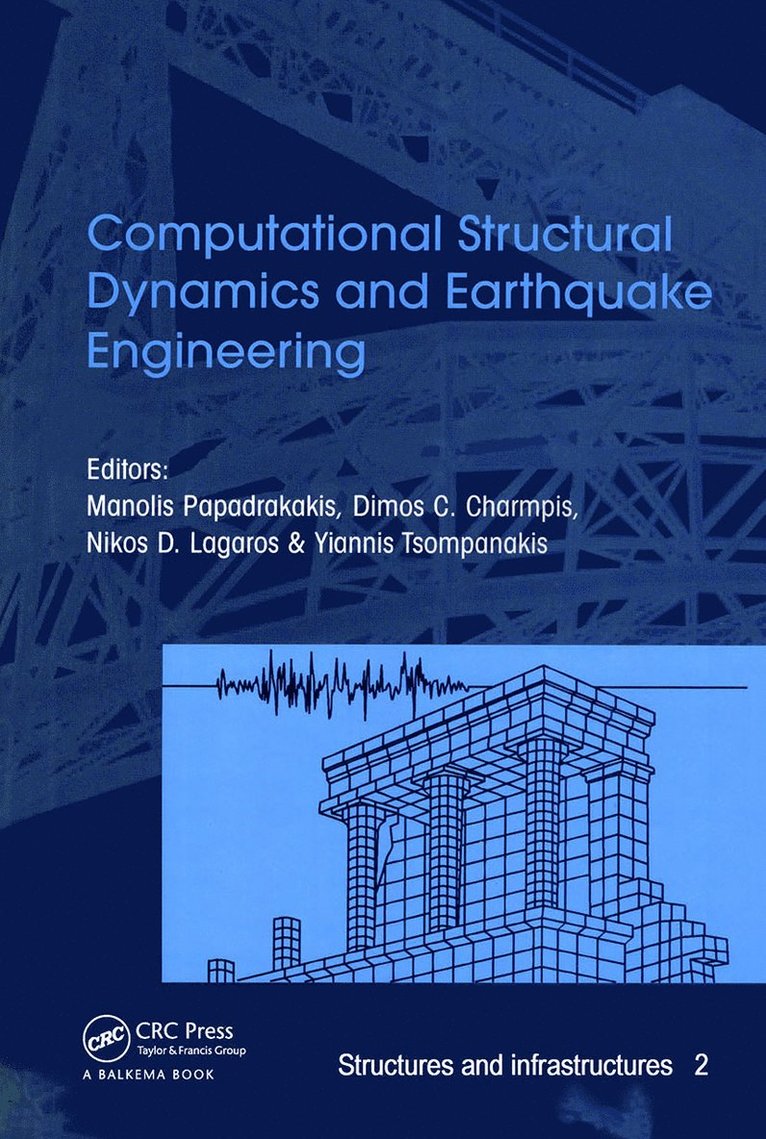
    Computational Structural Dynamics and Earthquake Engineering

    Structures and Infrastructures Book Series, Vol. 2

    AvManolis Papadrakakis,Dimos C. Charmpis

    Inbunden, Engelska, 2008

    Del i serien Structures and Infrastructures

    3 659 kr

    Beställningsvara. Skickas inom 5-8 vardagar. Fri frakt över 249 kr.

    Beskrivning

    The increasing necessity to solve complex problems in Structural Dynamics and Earthquake Engineering requires the development of new ideas, innovative methods and numerical tools for providing accurate numerical solutions in affordable computing times. This book presents the latest scientific developments in Computational Dynamics, Stochastic Dynamics, Structural Dynamics and Earthquake Engineering in thirty-five self-contained contributions. The selected state-of-the-art chapters are revised and extended versions of the papers which were presented as plenary, semi-plenary and keynote lectures at the thematic COMPDYN 2007 Conference.This volume will benefit researchers and engineering professionals working on structural dynamics, earthquake engineering and computational mechanics. Readers will get acquainted with advanced computational methods and software tools, which can assist them in tackling complex problems in dynamic/seismic analysis and design. Moreover, it will raise the awareness of important application areas and the social impact of the scientific and technical fields involved.

    Produktinformation

    • Utgivningsdatum:2008-12-04
    • Mått:174 x 246 x undefined mm
    • Vikt:1 316 g
    • Format:Inbunden
    • Språk:Engelska
    • Serie:Structures and Infrastructures
    • Antal sidor:670
    • Förlag:Taylor & Francis Ltd
    • ISBN:9780415452618

    Utforska kategorier

    • Byggnadsteknik inom Naturvetenskap och teknik

    Mer om författaren

    Manolis Papadrakakis is a Professor in Civil Engineering His research activities are focused on the development and the application of the latest computer methods and technology to structural engineering analysis and design. He has written and edited many publications, both in English and in Greek.Dimos Charmpis is a Lecturer at the Department of Civil and Environmental Engineering of the University of Cyprus. His research interests in Computational Mechanics aim for development and exploitation of innovative computational methodologies for the analysis and design of structures under static or dynamic/seismic loading. He has specialized in finite element methods, uncertainties in structural properties and loads, structural design optimization, soft computing applications, solution procedures for finite element equations and high performance computing. Yiannis Tsompanakis is an Assistant Professor of structural earthquake engineering. He has many research and practical projects in earthquake engineering and computational mechanics. His main interests include: computational dynamics, structural and geotechnical earthquake engineering, structural optimization, probabilistic mechanics, structural assessment, applications of artificial intelligence methods in engineering.Nikos D. Lagaros is an Assistant Professor of Civil Engineering. His main research interests include: *nonlinear dynamic analysis of concrete and steel structures under seismic loading, *performance-based earthquake engineering, *structural design optimization of real-world structures, *seismic risk and reliability analysis, * neural network in structural engineering, *fragility evaluation of reinforced concrete and steel structures, *inverse problems in structural dynamics, *parallel and distributed computing/Grid computing technologies, *evolutionary computations and *geotechnical earthquake engineering.

    Recensioner i media

    "This book presents the latest scientific developments in computational dynamics, stochastic dynamics, structural dynamics and earthquake engineering in 35 self-contained contributions. The selected state-of-the-art chapters are revised and extended versions of the papers which were presented as plenary, semi-plenary and keynote lectures at the thematic COMPDYN 2007 Conference. This volume will benefit researchers and engineering professionals working on structural dynamics, earthquake engineering a computational mechanics. Readers will get acquainted with advanced computational methods and software tools, which can assist them in tackling complex problems in dynamic/seismic analysis and design. It will also raise the awareness of important application areas and the social impact of the scientific and technical fields involved."—MCEER Information Service (IS), April 1, 2009

    Innehållsförteckning

    • PART 1Computational Structural Dynamics1 Computational stochastic dynamics – some lessons learned 2 Finite element response sensitivity, probabilistic response andreliability analyses 3 Energy-momentum algorithms for nonlinear solid dynamics and their assumed strain finite element formulation 4 Energy conservation and high-frequency damping in numericaltime integration 5 Computational elastoacoustics of uncertain complex systems andexperimental validation 6 Structural dynamics design validation and optimisation of structureswith imprecise parameters using the fuzzy finite element method 7 Morphological indicators and the prediction of the first natural frequency of a lightweight structure 8 Dynamic analysis of plates stiffened by parallel beams withdeformable connection 9 Impacts on beams: Uncertainty in experiments and numerical simulation 10 Rational derivation of conserving time integrationschemes: The moving-mass case 11 Classical and soft robust active control of smart beams 12 Rail vibrations caused by ground stiffness transitions 13 Development and applications of a staggered FEM-BEM methodology for ground vibrations due to moving train loads 14 Vibration monitoring as a diagnosis tool for structuralcondition assessment PART 11Computational Earthquake Engineering15 Multi-resolution distributed FEA simulation of a 54-story RC building 16 Simplified probabilistic seismic performance assessment of buildings17 Computational simulation of the seismic response of buildings withenergy dissipating devices 18 Structural health monitoring by Bayesian updating 19 A multiphase model with hypoplastic formulation of the solid phaseand its application to earthquake engineering problems20 Mixed Lagrangian formulation in analysis of collapse of structures 21 Nonlinear models and nonlinear procedures for seismic analysisof reinforced concrete frame structures 22 Modelling inelastic buckling of reinforcing bars under earthquake loading 23 Analyzing steel moment-resisting connections using finite elementmodeling 24 Earthquake damage scenario software for urban areas 25 Nonlinear performance assessment of bridges with Incremental Response Spectrum Analysis (IRSA) procedure 26 The equivalent modal damping concept and its use in seismic design of steel structures 27 Bayesian updating and model class selection of deteriorating hysteretic structural models using recorded seismic response 28 Parallel soil–foundation–structure interaction computations 29 Dynamic interaction of retaining walls and retained soil and structures 30 Earthquake response of liquid tanks installed in saturatedtransversely isotropic soil 31 Advances in design optimization of reinforced concrete structural systems 32 Robust stochastic optimal control of seismically excited buildings 33 A multi-objective robust criterion for tuned mass dampers optimal design 34 Performance-based seismic optimization implementing neural networks35 A very efficient computational procedure for the reliability-basedoptimization of uncertain stochastic linear dynamical systems