• Fri frakt över 249 kr
  • •
  • Snabba leveranser
  • •
  • Billiga böcker
Kundservice

Du är på sajten för privatpersoner.

Företag, bibliotek eller offentlig verksamhet?

Du handlar på classic.bokus.com, där alla dina funktioner finns intakta.
Till classic.bokus.com
Bokus logotyp. Gå till startsidan.
  • Erbjudanden
  • Student
  • Topplistor
  • Barn & ungdom
  • Bokus Play
  • E-böcker
  • Ljudböcker
  • Pocketböcker
  • Spel och pussel

5% studentrabatt – använd koden KURSBOK27 →

Sidfot

Mina sidor

    Hjälp

    • Kundservice
    • Vanliga frågor och svar
    • Frakt och leverans
    • Retur vid ångerrätt
    • Reklamera vara
    • Betalning
    • Köpvillkor
    • Allmänna villkor
    • Information om webbplatsens tillgänglighet

    Om Bokus

    • Om oss
    • Pressrum
    • För studenter
    • För företag
    • För bibliotek och offentlig verksamhet
    • För leverantörer
    • Hållbarhet

    Populärt

    • Aktuella erbjudanden
    • Presentkort
    • Studentlitteratur
    • Nya böcker
    • Topplistor
    • Signerade böcker
    • Engelska böcker

    Inspiration

    • Boktips
    • BookTok
    • Barnbokskaraktärer
    • Populära författare
    Logotyp för Bokus
    Följ oss på Facebook (extern länk)Följ oss på Instagram (extern länk)Följ oss på YouTube (extern länk)Följ oss på TikTok (extern länk)
    bokus @ CookiesAnpassa cookiesIntegritetspolicyKöpvillkor
    Till Citymail hemsida (extern länk)Till Budbee hemsida (extern länk)Till Postnord hemsida (extern länk)Till Schenker hemsida (extern länk)Till Early Bird hemsida (extern länk)Till Walleys hemsida (extern länk)
    1. Kultur
    2. Arkitektur

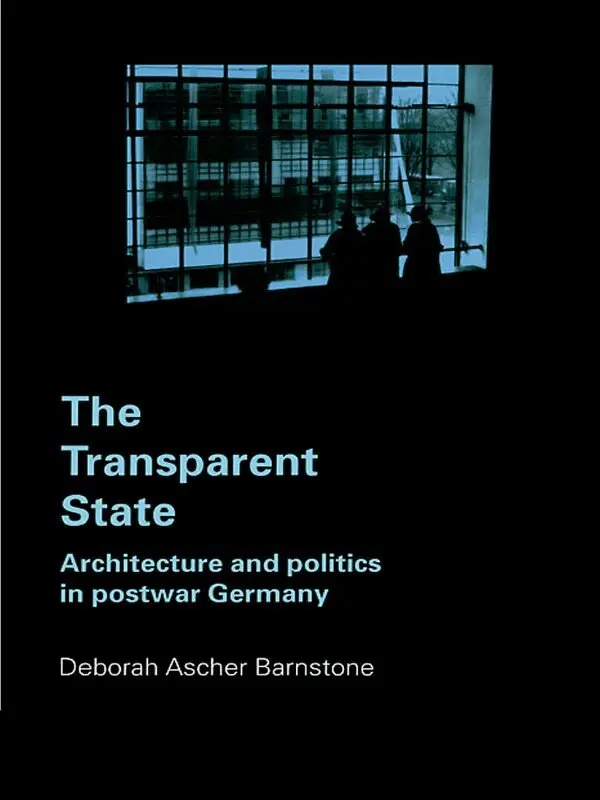
    Transparent State

    Architecture and Politics in Postwar Germany

    AvDeborah Ascher Barnstone

    Häftad, Engelska, 2005

    942 kr

    Beställningsvara. Skickas inom 10-15 vardagar. Fri frakt över 249 kr.

    Fler format och utgåvor

    Inbunden

    2 481 kr

    E-bok

    1 126 kr

    E-bok

    1 122 kr

    Beskrivning

    Examining the transformation of transparency as a metaphor in West German political thought to an analogy for democratic architecture, this bookquestions the prevailing assumption in German architectural circles that transparency in governmental buildings can be equated with openness, accessibility and greater democracy.The Transparent State traces the development of transparency in German political and architectural culture, tying this lineage to the relationship between culture and national identity, a connection that began before unification of the German state in the eighteenth century and continues today. The Weimar Republic and Third Reich periods are examined although the focus is on the postwar period, looking at the use of transparency in the three projects for a national parliament - the 1949 Bundestag project by Hans Schwippert, the 1992 Bundestag building by Gunter Behnisch and the 1999 Reichstag renovation by Norman Foster.Transparency is an important issue in contemporary architectural practice; this book will appeal to both the practising architect and the architectural historian.

    Produktinformation

    • Utgivningsdatum:2005-01-07
    • Mått:156 x 234 x 17 mm
    • Vikt:550 g
    • Format:Häftad
    • Språk:Engelska
    • Antal sidor:292
    • Förlag:Taylor & Francis Ltd
    • ISBN:9780415700191

    Utforska kategorier

    • Arkitektur inom Kultur

    Mer om författaren

    Deborah Ascher Barnstone is Associate Professor of Architectural Design at Washington State University, and also an architect and designer. Her work includes a special issue of the Journal of Architecture Education dedicated to transparency in Twentieth-Century architecture (with Anthony Vidler), and she has chaired sessions addressing transparency and approaches to architectural modernism at two annual meetings of the Association of Art Historians. Her design practice has explored both spatial and material transparency, and she has taught architectural design in Germany.

    Recensioner i media

    'Barnstone's aim is as ambitious as it is fascinating.' - Domus'[Barnstone] offers a stimulating argument which will engage readers interested in the debates about both German history and architecture in the twentieth century.' – The Art Book

    Innehållsförteckning

    • Acknowledgements  Introduction  1. Transparency Ideology  2. Transparency in German Architecture before and after the War  3. The Quest for an Open Society  4. Looking in the Mirror: Transparency after 1989  5. A Metaphor for the New Germany  6. House of Openness, Architecture of Encounter  7. Coming to Terms with the Past: Transparency in Norman Foster's Reichstag  8. Why Transparency?  Appendix 1: Biography of Hans Schwippert  Appendix 2: Biography of Günter Behnisch  Appendix 3: Biography of Sir Norman Foster  Appendix 4: Glück und Glas, Hans Schwippert  Bibliography