• Fri frakt över 249 kr
  • •
  • Snabba leveranser
  • •
  • Billiga böcker
Kundservice

Du är på sajten för privatpersoner.

Företag, bibliotek eller offentlig verksamhet?

Du handlar på classic.bokus.com, där alla dina funktioner finns intakta.
Till classic.bokus.com
Bokus logotyp. Gå till startsidan.
  • Erbjudanden
  • Nyheter
  • Student
  • Topplistor
  • Barn & ungdom
  • Bokus Play
  • E-böcker
  • Pocketböcker
  • Spel & pussel

10% studentrabatt med kod TERM26

Sidfot

Mina sidor

    Hjälp

    • Kundservice
    • Vanliga frågor och svar
    • Frakt och leverans
    • Retur vid ångerrätt
    • Reklamera vara
    • Betalning
    • Köpvillkor
    • Allmänna villkor
    • Information om webbplatsens tillgänglighet

    Om Bokus

    • Om oss
    • Pressrum
    • För studenter
    • För företag
    • För bibliotek och offentlig verksamhet
    • För leverantörer
    • Hållbarhet

    Populärt

    • Aktuella erbjudanden
    • Presentkort
    • Studentlitteratur
    • Nya böcker
    • Topplistor
    • Signerade böcker
    • Engelska böcker

    Inspiration

    • Boktips
    • BookTok
    • Populära bokserier
    • Barnbokskaraktärer
    • Populära författare
    Logotyp för Bokus
    Följ oss på Facebook (extern länk)Följ oss på Instagram (extern länk)Följ oss på YouTube (extern länk)Följ oss på TikTok (extern länk)
    bokus @ CookiesAnpassa cookiesIntegritetspolicyKöpvillkor
    Till Citymail hemsida (extern länk)Till Budbee hemsida (extern länk)Till Postnord hemsida (extern länk)Till Schenker hemsida (extern länk)Till Early Bird hemsida (extern länk)Till Walleys hemsida (extern länk)
    1. Historia och arkeologi
    2. Historia
    3. Europas historia

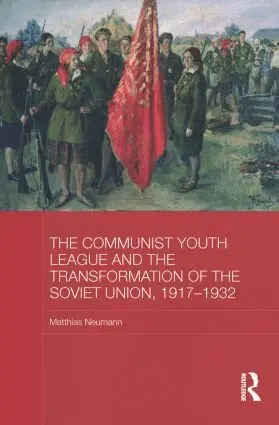
    Communist Youth League and the Transformation of the Soviet Union, 1917-1932

    AvMatthias Neumann

    Häftad, Engelska, 2013

    Del i serien BASEES/Routledge Series on Russian and East European Studies

    850 kr

    Beställningsvara. Skickas inom 10-15 vardagar. Fri frakt över 249 kr.

    Fler format och utgåvor

    Inbunden

    2 506 kr

    E-bok

    1 002 kr

    E-bok

    975 kr

    Beskrivning

    The study of Soviet youth has long lagged behind the comprehensive research conducted on Western European youth culture. In an era that saw the emergence of youth movements of all sorts across Europe, the Soviet Komsomol was the first state-sponsored youth organization, in the first communist country. Born out of an autonomous youth movement that emerged in 1917, the Komsomol eventually became the last link in a chain of Soviet socializing agencies which organized the young. Based on extensive archival research and building upon recent research on Soviet youth, this book broadens our understanding of the social and political dimension of Komsomol membership during the momentous period 1917–1932. It sheds light on the complicated interchange between ideology, policy and reality in the league's evolution, highlighting the important role ordinary members played. The transformation of the country shaped Komsomol members and their league's social identity, institutional structure and social psychology, and vice versa, the organization itself became a crucial force in the dramatic changes of that time. The book investigates the complex dialogue between the Communist Youth League and the regime, unravelling the intricate process that transformed the Komsomol into a mere institution for political socialization serving the regime's quest for social engineering and control.

    Produktinformation

    • Utgivningsdatum:2013-02-15
    • Mått:156 x 234 x 25 mm
    • Vikt:580 g
    • Format:Häftad
    • Språk:Engelska
    • Serie:BASEES/Routledge Series on Russian and East European Studies
    • Antal sidor:312
    • Förlag:Taylor & Francis Ltd
    • ISBN:9780415838368

    Utforska kategorier

    • Europas historia inom Historia och arkeologi

    Mer om författaren

    Matthias Neumann is Lecturer in Modern European History at the University of East Anglia, UK.

    Recensioner i media

    'The work is thorough and well researched. A reader seeking an introductory comprehensive overview to the Komsomol would do well to begin here.' – William B. Husband, Oregon State University; Slavic Review, vol. 72, no. 1 (Spring 2013).'Neumann has written a compelling work highlighting the agency of the Komsomol’s base in defeating the NEP. Paradoxically, this fine work suggests the need for greater detail in our understanding of the collapse of the NEP networks and the dynamics of the top and middle leadership. This will require scholars to go beyond the archives of the Komsomol Central Committee. For now, Matthias Neumann has written the new standard history of the early Komsomol.' – Isabel Tirado, William Paterson University; The Russian Review, vol. 72, no. 2, (April 2013), 336-337.'Matthias Neumann’s book offers a new and very detailed social history of the Soviet Communist League (Komsomol) since its beginnings in 1917 to its incorporation into the Soviet political machine in 1932. Based on serious study of archival documents, contemporary periodicals and memoirs, the book traces the transformation of the revolutionary group of rebellious youth into a bureaucratic organization of the Stalinist political regime under the total control of the Communist party apparatus. Neumann, who grew up in the 1980s in the city of Cottbus in Communist East Germany, brings a personal touch to his account, making it compelling and attractive even to ‘Cold War biased’ readers' – Sergei I. Zhuk, Department of History, Ball State University, USA; SEER, vol. 92, no.2, (April 2014).

    Innehållsförteckning

    • Part I - Revolution and Civil War 1. The Birth of the Russian Youth Movement 2. Revolution as Revelation: The First Red Dawn 3. Birth in the Civil War: The Struggle for an Identity Part II- The New Economic Policy 4. The Komsomol and the Policy of Class 5. Revolutionising Mind and Soul 6. A Living Organisation Part III - The Socialist Offensive 7. The Komsomol as an Object of Class War 8. The Komsomol as an Agent of Class War: The Second Red Dawn 9. Lost Identity – A Static Organisation Emerges Conclusions: Between Rebellion and Revolution – Youth as a Force of Change