• Fri frakt över 249 kr
  • •
  • Snabba leveranser
  • •
  • Billiga böcker
Kundservice

Du är på sajten för privatpersoner.

Företag, bibliotek eller offentlig verksamhet?

Du handlar på classic.bokus.com, där alla dina funktioner finns intakta.
Till classic.bokus.com
Bokus logotyp. Gå till startsidan.
  • Erbjudanden
  • Student
  • Topplistor
  • Barn & ungdom
  • Bokus Play
  • E-böcker
  • Ljudböcker
  • Pocketböcker
  • Spel och pussel

5% studentrabatt – använd koden KURSBOK27 →

Sidfot

Mina sidor

    Hjälp

    • Kundservice
    • Vanliga frågor och svar
    • Frakt och leverans
    • Retur vid ångerrätt
    • Reklamera vara
    • Betalning
    • Köpvillkor
    • Allmänna villkor
    • Information om webbplatsens tillgänglighet

    Om Bokus

    • Om oss
    • Pressrum
    • För studenter
    • För företag
    • För bibliotek och offentlig verksamhet
    • För leverantörer
    • Hållbarhet

    Populärt

    • Aktuella erbjudanden
    • Presentkort
    • Studentlitteratur
    • Nya böcker
    • Topplistor
    • Signerade böcker
    • Engelska böcker

    Inspiration

    • Boktips
    • BookTok
    • Barnbokskaraktärer
    • Populära författare
    Logotyp för Bokus
    Följ oss på Facebook (extern länk)Följ oss på Instagram (extern länk)Följ oss på YouTube (extern länk)Följ oss på TikTok (extern länk)
    bokus @ CookiesAnpassa cookiesIntegritetspolicyKöpvillkor
    Till Citymail hemsida (extern länk)Till Budbee hemsida (extern länk)Till Postnord hemsida (extern länk)Till Schenker hemsida (extern länk)Till Early Bird hemsida (extern länk)Till Walleys hemsida (extern länk)
    1. Historia och arkeologi
    2. Historia
    3. Europas historia

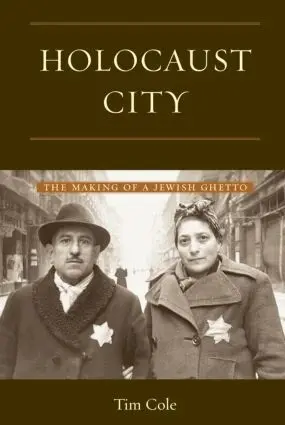
    Holocaust City

    The Making of a Jewish Ghetto

    AvTim Cole

    Häftad, Engelska, 2003

    683 kr

    Beställningsvara. Skickas inom 10-15 vardagar. Fri frakt över 249 kr.

    Fler format och utgåvor

    Inbunden

    2 712 kr

    E-bok

    812 kr

    E-bok

    812 kr

    Beskrivning

    Drawing from the ideas of critical geography and based on extensive archival research, Cole brilliantly reconstructs the formation of the Jewish ghetto during the Holocaust, focusing primarily on the ghetto in Budapest, Hungary--one of the largest created during the war, but rarely examined. Cole maps the city illustrating how spaces--cafes, theaters, bars, bathhouses--became divided in two. Throughout the book, Cole discusses how the creation of this Jewish ghetto, just like the others being built across occupied Europe, tells us a great deal about the nature of Nazism, what life was like under Nazi-occupation, and the role the ghetto actually played in the Final Solution.

    Produktinformation

    • Utgivningsdatum:2003-05-16
    • Mått:152 x 229 x 20 mm
    • Vikt:436 g
    • Format:Häftad
    • Språk:Engelska
    • Antal sidor:320
    • Förlag:Taylor & Francis Ltd
    • ISBN:9780415929691

    Utforska kategorier

    • Europas historia inom Historia och arkeologi
    • Förintelsen inom Historia och arkeologi
    • Modern militärhistoria inom Historia och arkeologi

    Mer om författaren

    Tim Cole, a respected historian on the Holocaust, is Lecturer of European Social History at the University of Bristol. Cole has written widely on the topic and his previous book, Selling the Holocaust: From Auschwitz toSchindler, How History is Bought, Packaged, and Sold (Routledge, 1999), received wide media attention and critical praise.

    Recensioner i media

    "A bold contribution to our understanding of the Shoah. Cole patiently unravels the layered complex of ideological motivations, economic ambitions, social realities and military contingencies that informed the decisions of politicians and officials who set out to separate Jews from gentiles in war-time Budapest. Holocaust City is an important book that, like Christopher Browning's Ordinary Men, will inspire a new genre of analysis of the Shoah as the greatest catastrophe western civilization both endured and permitted." -- Robert Jan van Pelt, co-author of Holocaust: A History"Tim Cole's new cultural history takes the study of space, cityscape, and the very role of the ghetto in the mass murder of Europe's Jews to revealing new levels. It will provoke and challenge readers to re-think and re-see the ghetto for what it was-an actual place and way station to death, and something that also had to be imagined conceptually and then graphically designed by the Nazis for their persecution of the Jews. This is a provocative and important book." -- James E. Young, author of TheTexture of Memory: Holocaust Memorials and Meaning"Cole's analysis of the subtle dynamics between state and local policy and the use of space goes a long way towards clarifying how ghettoization became an act of urban planning in Nazi-dominated Europe." -- Paul B. Jaskot, author of The Architecture of Oppression: The SS, ForcedLabor and the Nazi Monumental Building Economy"This a unique and interesting study of the phenomenology of the Jewish ghettos of the Nazi era." -- Jewish BookWorld"A bold contribution to our understanding of the Shoah. Cole patiently unravels the layered complex of ideological motivations, economic ambitions, social realities and military contingencies that informed the decisions of politicians and officials who set out to separate Jews from gentiles in war-time Budapest. Holocaust City is an important book that, like Christopher Browning's Ordinary Men, will inspire a new genre of analysis of the Shoah as the greatest catastrophe western civilization both endured and permitted." -- Robert Jan van Pelt, co-author of Holocaust: A History"Tim Cole's new cultural history takes the study of space, cityscape, and the very role of the ghetto in the mass murder of Europe's Jews to revealing new levels. It will provoke and challenge readers to re-think and re-see the ghetto for what it was-an actual place and way station to death, and something that also had to be imagined conceptually and then graphically designed by the Nazis for their persecution of the Jews. This is a provocative and important book." -- -James E. Young, author of TheTexture of Memory: Holocaust Memorials and Meaning"Cole's analysis of the subtle dynamics between state and local policy and the use of space goes a long way towards clarifying how ghettoization became an act of urban planning in Nazi-dominated Europe." -- -Paul B. Jaskot, author of The Architecture of Oppression: The SS, ForcedLabor and the Nazi Monumental Building Economy"Tim Cole's new cultural history takes the study of space, cityscape, and the very role of the ghetto in the mass murder of Europe's Jews to revealing new levels. It will provoke and challenge readers to re-think and re-see the ghetto for what it was--an actual place and way station to death, and something that also had to be imagined conceptually and then graphically designed by the Nazis for their persecution of the Jews. This is a provocative and important book." -- James E. Young, author of TheTexture of Memory: Holocaust Memorials and Meaning

    Innehållsförteckning

    • 1. Architectural Solutions, Spatial Solutions and Final Solutions  1.1 Architectural Solutions  1.2 Spatial Solutions  1.3 Pariah Landscapes, Landscapes of Exclusion and Spaces of Domination  2. Asking Spatial Questions of Holocaust Ghettoization  2.1 The Ghetto as "Jewish" Place  2.2 The Ghetto as Holocaust Place  2.3 Ghettoization and the Question Why  2.4 Ghettoization, the Question Why and the Question Where  2.5 Ghetto Space, and the Ghetto as Place: Ghettoization and "Jewish Presence" and"Jewish Absence"  2.6 Territoriality and the Exercise of Power through Ghetto Space  2.7 Ghetto Walls, Ghetto Boundaries  2.8 Postscript: Defining the "Jew"  3. Holocaust Ghettoization and the Specifics of Time and Place: Hungary, 1944  3.1 The German Occupation and the Hungarian Holocaust  3.2 Trianon, the Nazi Alliance and Antisemitic Measures  3.3 The "Hungarian-ness" of the Hungarian Holocaust  3.4 Politics at the Local Scale - Budapest, 1944  3.5 Holocaust Ghettoization in Hungary and the Question Why  3.6 Ghettoization Texts - 7 April and 28 April, Ghetto Orders  4. Planning and Implementing Ghettoization, April-May 1944  4.1 Mapping out the Ghettoization Plans of 9 May, 1944  4.2 Presences and Absences at the City Scale  4.3 Presences and Absences at the Ghetto Area Scale  4.4 The Changing Meanings of Ghettoization, Late May, 1944  4.5 Contested Timing  5. Implementing Ghettoization, June 1944  5.1 Comparing Ghettoization as Imagined (9 May) and Ghettoization as Implemented (16 June)  5.2 The Demographic Context to Ghettoization  5.3 A Brief History of the Discourse of "Jews," Allied Bombing and the Budapest Ghetto, 1944 to the Present  5.4 Experiencing Ghettoization: the XI District  6. Contesting Ghettoization, June 1944  6.1 Five Sites of Contestation between "Jews" and "non-Jews"  6.2 Two Sites of Contestation between "non-Jews"  6.3 Three Sites of Coalition between "Jews" and "non-Jews"  6.4 The Impact of Petitioning upon the Doctors of Space  6.5 The Definitive Mapping of the Ghetto, 22 June, 1944  6.6 Experiencing Ghettoization: the XI District  7. Putting the "Jews" in their Place, May-June 1944  7.1 Territorial Solutions, Temporal Solutions  7.2 Top-Down, Bottom-Up  7.3 Contesting the Division of the City  7.4 Contesting the Division of Cinema Space  8. Planning and Implementing Hyphenated Ghettoization, July 1944-January 1945  8.1 Plans to Separate "Christian Jews"  8.2 Plans to Separate "Protected Jews"  8.3 Implementing Hyphenated Ghettoization during the Nyilas Period  8.4 The Making of the International Ghetto  8.5 The Making of the Pest Ghetto  9. Uncovering the Traces of Ghettoization, 1945 to the Present  9.1 The Pest Ghetto as Site of History and Site of Memory  9.2 The International Ghetto as Site of History and Site of Memory  9.3 Other Sites of History and Memory  9.4 Two Museums, Two Memories