• Fri frakt över 249 kr
  • •
  • Snabba leveranser
  • •
  • Billiga böcker
Kundservice

Du är på sajten för privatpersoner.

Företag, bibliotek eller offentlig verksamhet?

Du handlar på classic.bokus.com, där alla dina funktioner finns intakta.
Till classic.bokus.com
Bokus logotyp. Gå till startsidan.
  • Erbjudanden
  • Nyheter
  • Student
  • Topplistor
  • Barn & ungdom
  • Bokus Play
  • E-böcker
  • Pocketböcker
  • Spel & pussel

10% rabatt på allt med kod: NYSTART10 →

Sidfot

Mina sidor

    Hjälp

    • Kundservice
    • Vanliga frågor och svar
    • Frakt och leverans
    • Retur vid ångerrätt
    • Reklamera vara
    • Betalning
    • Köpvillkor
    • Allmänna villkor
    • Information om webbplatsens tillgänglighet

    Om Bokus

    • Om oss
    • Pressrum
    • För studenter
    • För företag
    • För bibliotek och offentlig verksamhet
    • För leverantörer
    • Hållbarhet

    Populärt

    • Aktuella erbjudanden
    • Presentkort
    • Studentlitteratur
    • Nya böcker
    • Topplistor
    • Signerade böcker
    • Engelska böcker

    Inspiration

    • Boktips
    • BookTok
    • Populära bokserier
    • Barnbokskaraktärer
    • Populära författare
    Logotyp för Bokus
    Följ oss på Facebook (extern länk)Följ oss på Instagram (extern länk)Följ oss på YouTube (extern länk)Följ oss på TikTok (extern länk)
    bokus @ CookiesAnpassa cookiesIntegritetspolicyKöpvillkor
    Till Citymail hemsida (extern länk)Till Budbee hemsida (extern länk)Till Postnord hemsida (extern länk)Till Schenker hemsida (extern länk)Till Early Bird hemsida (extern länk)Till Walleys hemsida (extern länk)
    1. Samhälle och politik
    2. Politik och statsskick
    3. Statsvetenskap och politisk teori

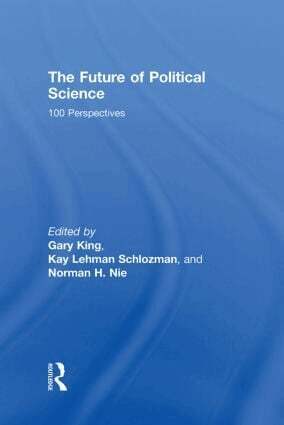
    Future of Political Science

    100 Perspectives

    AvGary King,Kay L. Schlozman

    Inbunden, Engelska, 2009

    2 954 kr

    Beställningsvara. Skickas inom 10-15 vardagar. Fri frakt över 249 kr.

    Beskrivning

    This book contains some of the newest, most exciting ideas now percolating among political scientists, from hallway conversations to conference room discussions. To spur future research, enrich classroom teaching, and direct non-specialist attention to cutting-edge ideas, a distinguished group of authors from various parts of this sprawling and pluralistic discipline has each contributed a brief essay about a single novel or insufficiently appreciated idea on some aspect of political science. The one hundred essays are concise, no more than a few pages apiece, and informal. While the contributions are highly diverse, readers can find unexpected connections across the volume, tracing echoes as well as diametrically opposed points of view. This book offers compelling points of departure for everyone who is concerned about political science -- whether as a scholar, teacher, student, or interested reader.

    Produktinformation

    • Utgivningsdatum:2009-03-23
    • Mått:152 x 229 x 21 mm
    • Vikt:720 g
    • Format:Inbunden
    • Språk:Engelska
    • Antal sidor:304
    • Förlag:Taylor & Francis Ltd
    • ISBN:9780415997003

    Utforska kategorier

    • Statsvetenskap och politisk teori inom Samhälle och politik

    Mer om författaren

    Gary King is David Florence Professor of Government at Harvard University.Kay Lehman Schlozman is J. Joseph Moakley Professor of Political Science at Boston College.Norman Nie is Research Professor of Political Science at Stanford University and Professor Emeritus at University of Chicago.

    Recensioner i media

    "In this one-of-a-kind collection, an eclectic set of contributors offer short but forceful forecasts about the future of the discipline. The resulting assortment is captivating, consistently thought-provoking, often intriguing, and sure to spur discussion and debate."—Wendy K. Tam Cho, University of Illinois at Urbana-Champaign"King, Schlozman, and Nie have created a visionary and stimulating volume. The organization of the essays strikes me as nothing less than brilliant: The book enacts the process that it seeks to engender, generating a spirit of serendipitous discovery and insight in the very process of reading a book devoted to encouraging new directions in research, scholarly exploration, and discovery. It is a volume that will be greatly welcomed in the discipline and could become a classic, creating a new genre and also providing students as well as scholars with a ready source of intellectual stimulation and research strategies. It is truly a joy to read."—Lawrence C. Dodd, Manning J. Dauer Eminent Scholar in Political Science, University of Florida"The list of authors in The Future of Political Science is a "who's who" of political science. As I was reading it, I came to think of it as a platter of tasty hors d'oeuvres. It hooked me thoroughly."—Peter Kingstone, University of Connecticut"This is a very high quality project, well-written and accessible. The book is truly unique and really has no competitor in the field. The Future of Political Science will clearly appeal to scholars and graduate students across all subfields within the discipline. It is a wonderful contribution."—Brian Schaffner, University of Massachusetts, Amherst

    Innehållsförteckning

    • Introduction 1. The United States: A Different Democracy, Arend Lijphart 2. Taking Portraits or Group Photos?, Russell Dalton 3. Why Political Theorists Should Think More Carefully About Leadership, Nannerl O. Keohane 4. The Leadership Gap, Mark A. Peterson 5. Instrumental Value of Elite Memories on Past Violence during the Emergence of a New State: Slovenian Experience, Anton Kramberger, Ana Barbic and Katja Boh 6. Politicians are People, too, Philip Edward Jones 7 . Elite Tough Talk and the Tides of History, Henry E. Brady 8. Representation as a Field of Study, Barry C. Burden 9. Political Science: What Should We Know?, David Butler 10. Dynamic Categories and the Context of Power, Jane Junn 11. Politics as Learning, Hugh Heclo 12. Rounding Up the Activists, Kent Jennings 13. The Troubling Persistence of Injustice, Michael L. Frazer 14. Making a Name for Oneself, Harvey Mansfield 15. Political Variation across Contexts, Michael Jones-Correa 16. Homo Politicus is Not an Island, Claudine Gay 17. The Sociological Bases of Political Preferences and Behavior, Casey A. Klofstad 18. Community Social Capital, Kristi Andersen 19. Tuned In, But Dropped Out, Carole Jean Uhlaner 20. Cognition, Emotion and Selectivity in Political Communication in a Multi-Facetted World, Rational Choice and Political Culture, Robert H. Bates 21. Who Wants War?, Ann Sartori 22. The Threat to Democracy, Lawrence R. Jacobs 23. Nationalist Missions and the Democratic Citizen, Katherine Tate 24. Something's Going On Here, but We Don't Know What It Is: Measuring Citizens' Exposure to Politically-Relevant Information in the New Media Environment, Michael X. Delli Carpini 25. What We Still Need to Know Why and How People Become Committed Democrats, Philip Oxhorn 26. When We Could Do So Much Better: Democratic Commitment and Empirical Political Psychology, by Virginia Sapiro 27. Political Science and the Future, James Q. Wilson 28. Family Matters, David E. Campbell 29. Where do the Premises of Political Choice Come From?, Daniel Carpenter 30. Immigration, Partisanship and Electoral Change, Norman H. Nie 31. Decisions People Make in Small Groups, John Aldrich 32. Why Do (Some) People Acquire Costly Political Knowledge?, Torben Iversen 33. A Political View of Political Ideology, John Zaller 34. Guess What? Voters are Smart, Gerald Pomper 35. Extra! Extra! Extra Info Needed with Survey Reporting, Andrea Louise Campbell 36. What Should Journalists and Politicians Know? Beyond the Margin of Error, Morris P. Fiorina 37. The Need for Survey Reporting Standards in Political Science, D. Sunshine Hillygus 38. The Changing Evidence Base of Political Science Research, Gary King 39. FMRI and Public Opinion Research, Ikua Kabashima 40. Special Interest Politics, Jeffry A. Frieden 41. An Ever Fainter Voice, Jeffrey M. Berry 42. Exploring Political Inequality, Benjamin I. Page 43. Voice, and Then What?, Larry M. Bartels 44. The Impact of Unequal Political Participation on Policy Outcome, Eric Schickler 45. Participation Matters, Jan Leighley 46. Participatory Distortion ($$) Takes Off!!, Philip Converse 47. The Rashomon World of Money and Politics, Thomas E. Mann 48. Does Rising Economic Inequality Matter, Christopher Jencks 49. Redistribution without Representation and Representation without Redistribution, James E. Alt 50. The Ideological Origins of Redistribution, Eric Nelson 51. Reuniting Interests and Values, David C. Leege 52. Using Research to Foster Democracy, Ken Stehlik-Berry 53. "Moral Convictions, Religion, and Diversity: Our Political Atmosphere, William C. McCready 54. Equality and Inclusiveness, Diversity and Conflict, John R. Petrocik 55. The End of 'the Protestant Nation', Byron Shafer 56. The Political Force of Group Consciousness, Bill Schneider 57. Going Global: New challenges and opportunities in research on democratic participation and the civic culture, Pippa Norris 58. The Effects of Immigration and Sending Countries Outreach on American Public Opinion and Political Behavior, Rodolfo O. de La Garza 59. Exorcising Huntingtonian Specters, Ary Zolberg 60. Adding-in Sex Discrimination to Legacies of Wrongdoing, Eileen McDonaugh 61. Gender Inequality, Nancy Burns 62. Gender Differences as the Basis for a Refoundation of the Social Sciences: The Political Integration of Women: Explaining Women’s Slow Advancement into Political Office, Michelle Swers 63. Is American Becoming a More Class-Based Society?, Robert Putnam 64. The NAACP Nobody Knows, Richard Vallelly 65. At the Intersection of Inequalities, Shauna L. Shames 66. The Professional Campaign, Ganesh Sitamaran 67. What Politicians Actually Can do: A Modest Proposal for Reporting on Campaigns, Daniel Schlozman 68. Elections: Five Rules for Commentators, John Mark Hansen 69. Negative Ads, Cynical Public?, Arthur Sanders 70. Independent Electoral Commissions, Nahomi Ichino 71. Watch Out! The Units You are Comparing May Not be What They Used to be!, Philippe C. Schmitter 72. Don't Stay Home: The Utility of Area Studies for Political Science Scholarship, by Jorge I. Dominguez 73. Can We Really be Happy with the Study of Comparative Government?, Hans Daalder 74. The Contingent Flaw of Majoritarian Systems, G. Bingham Powell, Jr. 75. Religion and Politics, Goldie Shabad 76. Study China!, Roderick MacFarquhar 77. Soft Power and the Future of Asia, by Lucian Pye 78. The Study of International Law, by Jens Meierhenrich 79. The Second Image Reversed Revisited, Robert Keohane 80. The Globalization Gap, James Rosenau 81. Congress and the Scope of Democracy, Ira Katznelson 82. 'Free Association': Traveling Ideas and the Study of Political Equality, Nancy Rosenblum 83. To Participate or Deliberate —is that the Question?, Dennis F. Thompson 84. Understanding Democracy as a Complex Adaptive System, Louise K.Comfort 85. The Public Roots of Private Action: A New Look at Voting Costs, Susan B. Hansen 86. On the Free Rider Problem, Jane Mansbridge 87. Time and Action in the 21st Century, Anya Bernstein 88. The Organizational 'Gap' in Political Science, Joseph LaPalombara 89. The Sudden Birth of Sticky Institutions, 1890-1915, Gerald Gamm 90. The Emerging Field of Education Policy, Paul Peterson 91. American Politics and the Not-So-Benign Neglect of Criminal Justice, Traci Burch 92. Law or Politics?, H. W. Perry, Jr. 93. What is Public Policy?, Catherine E. Rudder 94. Note to Politicians: Forget the Silver Bullet!, Kay Lehman Schlozman 95. Rediscovering Complexity and Synthesis, Bear F. Braumoeller 96. Why?, Kenneth A. Shepsle 97. Path Dependence, Peter A. Hall 98. Searching for a Politics of Space, Jennifer Hochschild 99. The Question of Relevance, Joseph S. Nye, Jr. 100. Can (Should) Political Science be a Policy Science?, Kenneth Prewitt