• Fri frakt över 249 kr
  • •
  • Snabba leveranser
  • •
  • Billiga böcker
Kundservice

Du är på sajten för privatpersoner.

Företag, bibliotek eller offentlig verksamhet?

Du handlar på classic.bokus.com, där alla dina funktioner finns intakta.
Till classic.bokus.com
Bokus logotyp. Gå till startsidan.
  • Erbjudanden
  • Nyheter
  • Student
  • Topplistor
  • Barn & ungdom
  • Bokus Play
  • E-böcker
  • Pocketböcker
  • Spel & pussel

10% rabatt på allt med kod: NYSTART10 →

Sidfot

Mina sidor

    Hjälp

    • Kundservice
    • Vanliga frågor och svar
    • Frakt och leverans
    • Retur vid ångerrätt
    • Reklamera vara
    • Betalning
    • Köpvillkor
    • Allmänna villkor
    • Information om webbplatsens tillgänglighet

    Om Bokus

    • Om oss
    • Pressrum
    • För studenter
    • För företag
    • För bibliotek och offentlig verksamhet
    • För leverantörer
    • Hållbarhet

    Populärt

    • Aktuella erbjudanden
    • Presentkort
    • Studentlitteratur
    • Nya böcker
    • Topplistor
    • Signerade böcker
    • Engelska böcker

    Inspiration

    • Boktips
    • BookTok
    • Populära bokserier
    • Barnbokskaraktärer
    • Populära författare
    Logotyp för Bokus
    Följ oss på Facebook (extern länk)Följ oss på Instagram (extern länk)Följ oss på YouTube (extern länk)Följ oss på TikTok (extern länk)
    bokus @ CookiesAnpassa cookiesIntegritetspolicyKöpvillkor
    Till Citymail hemsida (extern länk)Till Budbee hemsida (extern länk)Till Postnord hemsida (extern länk)Till Schenker hemsida (extern länk)Till Early Bird hemsida (extern länk)Till Walleys hemsida (extern länk)
    1. Filosofi och religion
    2. Filosofi
    3. Filosofiska discipliner

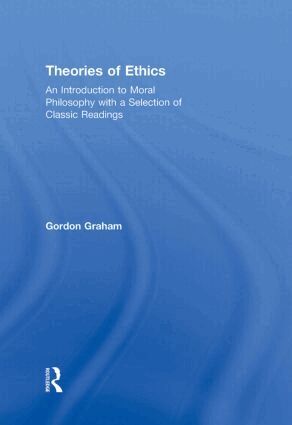
    Theories of Ethics

    An Introduction to Moral Philosophy with a Selection of Classic Readings

    AvGordon Graham

    Inbunden, Engelska, 2010

    2 423 kr

    Beställningsvara. Skickas inom 10-15 vardagar. Fri frakt över 249 kr.

    Fler format och utgåvor

    Häftad

    892 kr

    Beskrivning

    Theories of Ethics offers a comprehensive survey of the major schools and figures in moral philosophy, from Socrates to the present day. Written entirely in non-technical language, it aims to be introductory without being elementary, so that readers may quickly engage with selected readings from classic sources. The writings of major philosophers are explained in a structured exploration of recurrently important issues about right and wrong, good and evil, social relations and religious meaning. This book is a radical revision of Gordon Graham’s Eight Theories of Ethics (Routledge 2004). A hallmark of the new edition is the incorporation of primary readings into the text itself, making the book suitable as a stand-alone publication for any ethics course or for anyone wanting to know the history and arguments or moral philosophy. Primary sources include extracts from Aristotle, Camus, Hume, Kant, Locke, Mill, Nietzsche, Plato, Reid, and Sartre, as well as Aldo Leopold and James Lovelock. The new edition also offers extended treatment of the objective/subjective debate, social contract theory, Nietzsche on morality, recent interpretations of Kant, the relation between morality and the existence of God, and a full chapter on environmental ethics.

    Produktinformation

    • Utgivningsdatum:2010-12-20
    • Mått:178 x 254 x 26 mm
    • Vikt:900 g
    • Format:Inbunden
    • Språk:Engelska
    • Antal sidor:400
    • Förlag:Taylor & Francis Ltd
    • ISBN:9780415999465

    Utforska kategorier

    • Filosofiska discipliner inom Filosofi och religion

    Mer om författaren

    Gordon Graham is Henry Luce III Professor of Philosophy and the Arts at Princeton Theological Seminary.

    Innehållsförteckning

    • Chapter 1: Ethics, Truth and Reason 1.1 Right and Wrong 1.2 Relativism and Subjectivism 1.3 Proof and Probability 1.4 Moral Realism 1.5 Moral Rationalism 1.6 Objectivism Chapter 2: Contractualism 2.1 Justice and Beneficence 2.2 Promises and Contracts 2.3 John Locke and "tacit" consent. 2.4 John Rawls and "hypothetical" consent. 2.5 T.M. Scanlon and unreasonable rejection 2.6 Bernard Mandeville and The Fable of the Bees Chapter 3: Egoism 3.1 Egoism versus Altruism 3.2 Psychological Egoism 3.3 Rational Egoism 3.4 Nietzsche and the Genealogy of Morality 3.5 The Nietzschean ideal 3.6 Desires and interests Chapter 4: Hedonism 4.1 Egoism and Hedonism 4.2 The Cyrenaics 4.3 The Epicureans 4.4 John Stuart Mill on Higher and Lower Pleasures 4.5 Sadistic pleasures 4.6 Aristotle on Pleasure Chapter 5: Naturalism and Virtue 5.1 Eudaimonia and the Good 5.2 Human Nature as Rational Animal 5.3 Ethics, Ethology and Evolution 5.4 Virtue Theory 5.5 The Natural as a Norm 5.6 Is the "good for man" good? 5.7 Natural good and freedom Chapter 6: Existentialism 6.1 Kierkegaard and the origins of existentialism 6.2 Sartre and Radical Freedom 6.3 Anguish and Bad Faith 6.4 The Absurdity of Existence 6.5 Acting in Good Faith 6.6 The Creation of Value 6.7 Radical Freedom Chapter 7: Kantianism 7.1 Virtue and Happiness: "Faring Well" and "Doing Right" 7.2 Kant and the Good Will 7.3 David Hume and Practical Reason 7.5 Pure Practical Reason and the Moral Law 7.6 Universalizability Chapter 8: Utilitarianism 8.1 Utility and the Greatest Happiness Principle 8.2 Jeremy Bentham 8.3 Egotism, Altruism and Generalized Benevolence 8.4 Act and Rule Utilitarianism 8.5 Utilitarianism and Consequentialism 8.6 Ascertaining Consequences 8.7 Assessment and Prescription 8.8 Consequentialism and Spontaneity 8.9 Act and Rule 8.10 Summary - Does the End Justify the Means? 8.11 The Nature of Happiness 8.12 Measuring Happiness 8.13 Distributing happiness 8.13 Mill's "proof" and preference utilitarianism 8.14 Motivation and the limitless moral code Chapter 9: Ethics and Environment 9.1 Extending the Moral Sphere 9.2 Pollution, Sustainability and Climatic Change 9.3 The Land Ethic 9.4 Deep and Shallow Ecology 9.5 Wilderness 9.6 Nature and Gaia Chapter 10: Ethics, Religion and the Meaning of Life 10.1 Morality and Ordinary Life 10.2 God and Good: Plato’s Euthyphro 10.3 Kant and the Harmony of Happiness and Virtue 10.4 Moral Action and Religious Practice 10.5 The Myth of Sisyphus 10.6 Subjective Value and Objective Purpose 10.7 Life, Time and Eternity 10.8 Worship of the Sacred Readings for Chapter 1: Treatise of Human Nature (excerpt) by David Hume Essays on the Active Powers of Man (excerpt) by Thomas Reid Readings for Chapter 2: “The Second Treatise of Government” (excerpt) by John Locke “Of the Original Contract” by David Hume “Justice as Fairness” by John Rawls Readings for Chapter 3: The Republic (excerpt) by Plato Twilight of the Idols (excerpt) by Friedrich Nietzsche Readings for Chapter 4: “The Epicurean” by David Hume Nicomachean Ethics, Book X by Aristotle “The Letter to Menoeceus” by Epicurus Readings for Chapter 5: Nicomachean Ethics, Books I & II, Aristotle Readings for Chapter 6: Existentialism is a Humanism (excerpt), Jean-Paul Sartre Readings for Chapter 7: “Foundations of the Metaphysics of Morals” (excerpt) by Immanuel Kant Readings for Chapter 8: Utilitarianism (excerpt) by John Stuart Mill Readings for Chapter 9: “The Land Ethic” by Aldo Leopold “A Personal View of Environmentalism” by James Lovelock Readings for Chapter 10: Euthyphro by Plato Critique of Practical Reason (excerpt) by Immanuel Kant “The Myth of Sisyphus” (excerpt) by Albert Camus