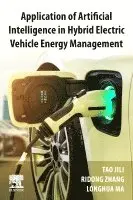
Häftad, Engelska, 2024
Application of Artificial Intelligence in Hybrid Electric Vehicle Energy Management
Av Tao Jili, Ridong Zhang, Longhua Ma
1727 kr
Beställningsvara. Skickas inom 10-15 vardagar. Fri frakt över 249 kr.
Beskrivning
Application of Artificial Intelligence in Hybrid Electric Vehicle Energy Management presents the state of the art in hybrid electric vehicle system modeling and management. With a focus on learning-based energy management strategies, this book provides detailed methods, mathematical models, and strategies designed to optimize the energy management of the energy supply module of a hybrid vehicle.
This book first addresses the underlying problems in Hybrid Electric Vehicle (HEV) modeling, and then introduces several artificial intelligence-based energy management strategies of HEV systems, including those based on fuzzy control with driving pattern recognition, multiobjective optimization, fuzzy Q-learning and Deep Deterministic Policy Gradient (DDPG) algorithms. To help readers apply these management strategies, this book also introduces State of Charge and State of Health prediction methods and real-time driving pattern recognition. For each application, the detailed experimental process, program code, experimental results, and algorithm performance evaluation are provided.
Application of Artificial Intelligence in Hybrid Electric Vehicle Energy Management is a valuable reference for anyone involved in the modeling and management of hybrid electric vehicles, and will be of interest to graduate students, researchers, and professionals working on HEVs in the fields of energy, electrical, and automotive engineering.
This book first addresses the underlying problems in Hybrid Electric Vehicle (HEV) modeling, and then introduces several artificial intelligence-based energy management strategies of HEV systems, including those based on fuzzy control with driving pattern recognition, multiobjective optimization, fuzzy Q-learning and Deep Deterministic Policy Gradient (DDPG) algorithms. To help readers apply these management strategies, this book also introduces State of Charge and State of Health prediction methods and real-time driving pattern recognition. For each application, the detailed experimental process, program code, experimental results, and algorithm performance evaluation are provided.
Application of Artificial Intelligence in Hybrid Electric Vehicle Energy Management is a valuable reference for anyone involved in the modeling and management of hybrid electric vehicles, and will be of interest to graduate students, researchers, and professionals working on HEVs in the fields of energy, electrical, and automotive engineering.
- Provides a guide to the modeling and simulation methods of hybrid electric vehicle energy systems, including fuel cell systems
- Describes the fundamental concepts and theory behind CNN, MPC, fuzzy control, multi objective optimization, fuzzy Q-learning and DDPG
- Explains how to use energy management methods such as parameter estimation, Q-learning, and pattern recognition, including battery State of Health and State of Charge prediction, and vehicle operating conditions
Produktinformation
- Utgivningsdatum: 2024-05-03
- Mått: 152 x 229 x 20 mm
- Vikt: 550 g
- Format: Häftad
- Språk: Engelska
- Antal sidor: 346
- Förlag: Elsevier Science
- ISBN: 9780443131899
Utforska kategorier
Betyg & recensioner
0 recensioner
Inga recensioner tillgängliga.