• Fri frakt över 249 kr
  • •
  • Snabba leveranser
  • •
  • Billiga böcker
Kundservice

Du är på sajten för privatpersoner.

Företag, bibliotek eller offentlig verksamhet?

Du handlar på classic.bokus.com, där alla dina funktioner finns intakta.
Till classic.bokus.com
Bokus logotyp. Gå till startsidan.
  • Erbjudanden
  • Nyheter
  • Student
  • Topplistor
  • Barn & ungdom
  • Bokus Play
  • E-böcker
  • Pocketböcker
  • Spel & pussel

10% rabatt på allt med kod: NYSTART10 →

Sidfot

Mina sidor

    Hjälp

    • Kundservice
    • Vanliga frågor och svar
    • Frakt och leverans
    • Retur vid ångerrätt
    • Reklamera vara
    • Betalning
    • Köpvillkor
    • Allmänna villkor
    • Information om webbplatsens tillgänglighet

    Om Bokus

    • Om oss
    • Pressrum
    • För studenter
    • För företag
    • För bibliotek och offentlig verksamhet
    • För leverantörer
    • Hållbarhet

    Populärt

    • Aktuella erbjudanden
    • Presentkort
    • Studentlitteratur
    • Nya böcker
    • Topplistor
    • Signerade böcker
    • Engelska böcker

    Inspiration

    • Boktips
    • BookTok
    • Populära bokserier
    • Barnbokskaraktärer
    • Populära författare
    Logotyp för Bokus
    Följ oss på Facebook (extern länk)Följ oss på Instagram (extern länk)Följ oss på YouTube (extern länk)Följ oss på TikTok (extern länk)
    bokus @ CookiesAnpassa cookiesIntegritetspolicyKöpvillkor
    Till Citymail hemsida (extern länk)Till Budbee hemsida (extern länk)Till Postnord hemsida (extern länk)Till Schenker hemsida (extern länk)Till Early Bird hemsida (extern länk)Till Walleys hemsida (extern länk)
    1. Medicin
    2. Andra medicinska specialiteter
    3. Farmakologi

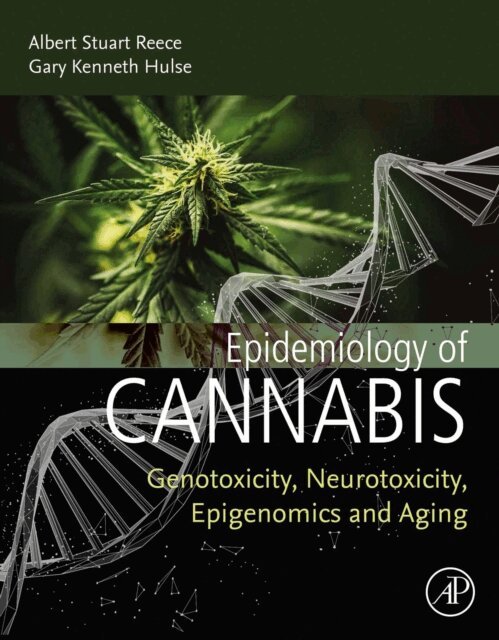
    Epidemiology of Cannabis

    Genotoxicity, Neurotoxicity, Epigenomics and Aging

    AvAlbert Stuart Reece,Gary Kenneth Hulse

    Häftad, Engelska, 2025

    4 164 kr

    Beställningsvara. Skickas inom 10-15 vardagar. Fri frakt över 249 kr.

    Fler format och utgåvor

    Övrigt

    Kommande

    Beskrivning

    Epidemiology of Cannabis: Genotoxicity, Neurotoxicity, Epigenomics and Aging provides a novel and comprehensive exploration of five areas that have previously been associated with cannabis use, namely mental health in adults and young adults, pediatric autism, congenital anomalies, cancers, and aging. The book also explores the possibility of how these associations might be reflected in overall disease trends at the population health level. This book surveys these five areas in detail and applies cutting-edge analytical software and geospatial space-time analytical techniques to these questions.

    With all this information gathered into one book in an easily readable form, this book is a reference for clinicians, health science and allied health practitioners, public health and basic science researchers and drug and health regulators interested in these topics. It is also suitable for inclusion in course work and study preparation courses at both the undergraduate and postgraduate levels.

    • Examines adult and pediatric neurotoxicity and genotoxicity from cannabis use, along with health impacts
    • Analyzes epigenetics and the observed pattern of teratological, cancerogenic, and age-accelerated disease
    • Utilizes advanced statistical and geotemporalspatial analysis to investigate cannabis exposure and health

    Produktinformation

    • Utgivningsdatum:2025-05-22
    • Mått:216 x 276 x 52 mm
    • Vikt:2 790 g
    • Format:Häftad
    • Språk:Engelska
    • Antal sidor:1 026
    • Förlag:Elsevier Science
    • ISBN:9780443134920

    Utforska kategorier

    • Farmakologi inom Medicin

    Mer om författaren

    Dr. Stuart Reece has been a registered medical practitioner in Australia since 1982. He has worked with a special interest in addiction medicine since 1997 when he was introduced to naltrexone medicine in Perth. He has worked in a variety of hospital and community-based environments in Australia, UK, France, and Papua New Guinea. In addition to his basic medical qualification, Dr Reece holds surgical fellowships from the Royal College of Surgeons of Edinburgh and the Royal College of Physicians and Surgeons of Glasgow, a Fellowship of the Royal Australian College of General Practitioners, and a Doctorate of Medicine in liver transplantation. Dr Reece was appointed as Associate Professor of Medicine at the University of Western Australia in 2010, and an adjunct Professor of Medicine at both the University of Western Australia and the Edith Cowan University in 2018. Professor Gary Hulse has worked in the area of problem alcohol and drug use for the past 30 years, For the past fourteen years he has held an academic appointment as ‘Coordinator of Alcohol and Drug Education and Training’ within the Faculty of Medicine, University of Western Australia, based at Sir Charles Gairdner Hospital Perth. Research and clinical activities have been primarily directed at developing evidence- based information which will enhance clinical practice. Between 1992-2009, Professor Hulse chaired the Committee on Alcohol and Drug Education in Medical Schools on behalf of the Committee of Deans Australian and New Zealand Medical Schools. Professor Hulse has published in excess of 150 peer review publications. He is Chief Editor of two evidence based clinical alcohol and drug texts published by Oxford University Press which have been adopted as the standard text for medical training by the Australian Medical Schools [Committee of Deans].

    Innehållsförteckning

    • Section A Mental illness1 Close parallels between cannabis use and deteriorating US Mental Health at four levels supports and extends the epidemiological salience of demonstrated causal mental health relationships: A geospatiotemporal studyIntroductionMethods- Analysis plan- Statistical considerations- Data availability- Assessing causalityResults- National level- Regional level- State level- Substate level- Considerations of causality- Koch’s postulates- Hills’ causal algorithm- Brain disease pathways and mechanisms- Cannabis and mass violenceBrain- Endocannabinoid system in the brain- Dopamine- Other- Mitochondriology- Immunome- Genomic studies- Cannabinoid-opioid interactionsConclusionSection B Autistic spectrum disorder2 Linked rise of cannabis use and autism incidence demonstrated by close three-level geospatiotemporal relationships, USA, 1990–2011IntroductionMethodological comment- Assessing causality- Data availabilityResults- National level data- Regional level- State level data- Impact of cannabis legal status on autism rates- Causal inferenceDiscussion- Mechanistic considerations- European neuroteratology studies- Morphogen gradients guide brain development- Retinoic acid- Slit-Robo- Neurexin-neuroligin- DSCAM and DLGAP2- Oligodendrocytes and myelination- Genomic studies- Epigenomic studies- Pediatric poisoningsConclusionGeneral questionsCase studies- Case 1- Case 2- Case 3Section C Congenital anomalies3 Geospatiotemporal and causal inferential analysis of United States congenital anomalies as a function of multiple cannabinoidand substance-exposures: Phenocopying thalidomide and hundred megabase-scale genotoxicityExecutive summary- Introduction- Methods- Ethics- Results- Cannabis-related defects- Upper quintile threshold discontinuityConclusionCannabis-related congenital anomalies- Cannabis-related anomalies by geotemporospatial criteria, N=38- Cannabis-related anomalies by prevalence ratio criteria, N=44- Cannabis-related anomalies by prevalence ratio criteria, N=42Introduction- Methodology- Data sources- Cannabis consumption quintiles- Data analysis- Statistics- Broom-Purrr multimodel assessments- Matrix multiplication- Geospatial modeling- Two phases of data analysis- Spatial error structures- Spatial model specification- Corrections for multiple testing- Assessing causality- Data availability- EthicsResults- Section one: Drug use by ethnicity and age- Section two: Drugs and congenital anomalies overview- Section three: Chromosomal defects- Section four: Gastroschisis and body wall- Section five: Atrial septal defect (secundum type)- Section six: Cardiovascular defects of interest- Section seven: Hawaiian—American reviewDiscussion- General considerations- Bivariate analysisSummary observations- Data summary- Forest plot- Canada- Australia- Mechanistic summary- Multivariable analysis- Multivariable causal analysis- Multivariable causal analysis- Effect of cannabis legalization- Considerations of causality- Geotemporal trimodality- Causality and the hill criteria- Causal inference- Causal assignment- CommonalityPathways and mechanisms- Genotoxic mechanisms- Morphogen gradients control body formation and patterning- Cannabinoid modulation of other morphogenetic pathwaysSpecific organ systems- Heart- Respiratory defects- Face- Gastrointestinal tract- Urinary tract- Body wall anomalies- Limbs- Chromosomal defectsInteractions of other major morphogen systems with cannabinoids- Cannabinoid teratology- Chromosomal mechanics and dynamics- Sperm and cannabinoids- Oocytes and cannabinoids- Embryonic developmentConclusion- Directions for future researchCongenital anomalies general questions and case studies- General questions- Case studies-- Case 1: Jodie-- Case 2: JenniferSection D Cancer and Heritable Cancer4 Geospatiotemporal and causal inferential epidemiological survey and exploration of cannabinoidand substance-related carcinogenesis in the United States from 2003 to 2017 (Online chapter)Section E Epigenetics and aging5 Multivalent cannabinoid epigenotoxicities and multigenerational agingIntroductionDefinitionsEpigenetic layersHallmarks of agingMethodology- Data- Computations- Ethical permissionResults and discussion- Historical studies- Mitochondrial inhibition- Important earlier epigenomic studies- Longitudinal human sperm study- Detailed analysis of longitudinal sperm study results- Perturbation of fundamental epigenomic machinery- Stem cell genes- Age-related immunometabolic genes- Chromosomes, centrosomes, and kinetochores- DNA repair- EpigenomicsEpigenomics of cannabinoid teratology- Brain- Cannabinoid neurotoxicity- Cannabinoid epigenomic neurotoxicity- Summary of cannabinoid neurotoxicity- Cardiovascular system- Other organs and systems- Chromosomal anomalies- Uronephrology- Body wall- Teratological summaryEpigenomics of cannabinoid-related cancersEpigenomics of aging- Overview of conceptual aging paradigm- Aging is driven by a loss of epigenetic information- Epigenomics- Overall pattern of cannabis toxicity- Hallmarks of cannabinoid accelerated agingEpigenomic—genomic overlap in aging syndromes- Heterochronic parabiosis- Haemopoietic stem cells- Heterochronic CSF circulation- Movement in fibroblasts- Ovarian aging- Mouse agingEpigenomics and pathobiology of aging- Inflammation and stem cells- Cardiovascular disease- Hematopoietic stem cells- Skeletal muscle- Summary genomic-epigenomic tables- Summary of cannabinoid aging accelerationOverall summary of multivalent cannabinoid epigenotoxicitiesCase studies—Epigenetics and aging- Leonard - Case description- Case questions- Q multiple choice6 Conclusion