• Fri frakt över 249 kr
  • •
  • Snabba leveranser
  • •
  • Billiga böcker
Kundservice

Du är på sajten för privatpersoner.

Företag, bibliotek eller offentlig verksamhet?

Du handlar på classic.bokus.com, där alla dina funktioner finns intakta.
Till classic.bokus.com
Bokus logotyp. Gå till startsidan.
  • Erbjudanden
  • Nyheter
  • Student
  • Topplistor
  • Barn & ungdom
  • Bokus Play
  • E-böcker
  • Pocketböcker
  • Spel & pussel

Må bättre, för mindre! Upp till 50% rabatt på hälsoböcker

Sidfot

Mina sidor

    Hjälp

    • Kundservice
    • Vanliga frågor och svar
    • Frakt och leverans
    • Retur vid ångerrätt
    • Reklamera vara
    • Betalning
    • Köpvillkor
    • Allmänna villkor
    • Information om webbplatsens tillgänglighet

    Om Bokus

    • Om oss
    • Pressrum
    • För studenter
    • För företag
    • För bibliotek och offentlig verksamhet
    • För leverantörer
    • Hållbarhet

    Populärt

    • Aktuella erbjudanden
    • Presentkort
    • Studentlitteratur
    • Nya böcker
    • Topplistor
    • Signerade böcker
    • Engelska böcker

    Inspiration

    • Boktips
    • BookTok
    • Populära bokserier
    • Barnbokskaraktärer
    • Populära författare
    Logotyp för Bokus
    Följ oss på Facebook (extern länk)Följ oss på Instagram (extern länk)Följ oss på YouTube (extern länk)Följ oss på TikTok (extern länk)
    bokus @ CookiesAnpassa cookiesIntegritetspolicyKöpvillkor
    Till Citymail hemsida (extern länk)Till Budbee hemsida (extern länk)Till Postnord hemsida (extern länk)Till Schenker hemsida (extern länk)Till Early Bird hemsida (extern länk)Till Walleys hemsida (extern länk)
    1. Naturvetenskap och teknik
    2. Teknik och industri
    3. Energiteknik

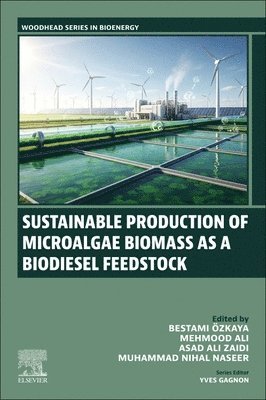
    Sustainable Production of Microalgae Biomass as a Biodiesel Feedstock

    AvBestami �zkaya,Mehmood Ali

    Häftad, Engelska, 2026

    Del i serien Woodhead Series in Bioenergy

    2 741 kr

    Beställningsvara. Skickas inom 10-15 vardagar. Fri frakt över 249 kr.

    Beskrivning

    Sustainable Production of Microalgae Biomass as a Biodiesel Feedstock brings together the latest methods in the production and utilization of microalgae as biodiesel, offering new insights into how this can be environmentally-friendly, renewable-integrated, energy efficient, and in a way that supports the mitigation of the effects of climate change. The book begins by introducing the different feedstock options for biodiesel production and their selection, the various biodiesel production processes, and the role of microalgae biodiesel as an alternative fuel for diesel engines. Strategies for reducing energy consumption during production, and the connections between microalgae cultivation and CO2 capture are also examined.

    Other sections focus on renewable energy integration with specific case studies. This is followed by a section that addresses sustainability and related impacts, including techno-economic analysis that compares conventional and renewable energy sources, and life cycle assessment. Finally, emerging technologies and future research opportunities are discussed. This new volume in the Woodhead Series in Bioenergy is valuable to all those with an interest in biodiesel production from microalgae, bioenergy, biotechnology, and clean energy, including graduate students, researchers, faculty, engineers, R&D, industry professionals, and policy makers.

    • Covers cultivation techniques, strain selection, harvesting, extraction methods, lipid profiling, and conversion processes
    • Explains integration with renewable energy, including solar, wind, biomass gasification, and geothermal
    • Addresses energy balance, environmental sustainability, lifecycle, and techno-economic analysis
    • Provides insights on future opportunities and research directions in microalgae and biodiesel

    Produktinformation

    • Utgivningsdatum:2026-05-22
    • Mått:152 x 229 x 32 mm
    • Vikt:1 000 g
    • Format:Häftad
    • Språk:Engelska
    • Serie:Woodhead Series in Bioenergy
    • Antal sidor:676
    • Förlag:Elsevier Science
    • ISBN:9780443292699

    Utforska kategorier

    • Energiteknik inom Naturvetenskap och teknik

    Mer om författaren

    Prof. Bestami Özkaya is a Professor at İstinye University, Turkey. After completing his undergraduate studies at Fırat University, he received his master's and doctoral degrees from Yıldız Technical University (YTÜ). He conducted his postdoctoral research at Tampere Technical University (TUT) in Finland in the fields of environmental engineering, circular economy, and biotechnology. Throughout his academic career, he has proven his international academic competence by obtaining the title of Associate Professor both in Türkiye (YTÜ) and Finland (TUT), and served as an Adjunct Professor at Tampere Technical University from 2010 to 2015. From 2013 to 2025, he served as a professor at Yıldız Technical University. He currently serves as the Vice Rector responsible for Research, Innovation, and Commercialization at İstinye University. Dr. Özkaya’s expertise includes areas of environmental engineering, environmental biotechnology, biofuels (biodiesel/bioethanol/biogas), bioenergy, municipal waste management, biohydrogen (acidogenic fermentation), bioelectricity (microbial fuel cell (MFC)), and biodiesel production from waste matrix. He has published over 200 articles in peer reviewed journals and has been involved in more than 50 projects funded by national and international institutes.Dr. Mehmood Ali is an Associate Professor in the Department of Environmental Engineering at NED University of Engineering and Technology in Karachi, Pakistan. He completed his doctorate in Mechanical Engineering (with specialization in biofuels) at the University of Glasgow, Scotland, UK. With over 17 years of academic and research experience in the area of biofuels, Dr. Ali’s research interests include a wide range of fundamental science and engineering technologies to produce biodiesel alternative fuel. He has experience in producing biodiesel from sustainable feedstocks such as vegetable oil seeds, microalgae, and lignocellulosic biomass, and specializes in biomass thermochemical treatments, biodiesel combustion in engines and emission characteristics. He has presented his research work at national and international conferences, and has published 25 research articles in reputable international journals.Dr. Asad Ali Zaidi is an Associate Professor at the Department of Mechanical Engineering, Faculty of Engineering Sciences and Technology, Hamdard University, Pakistan. With extensive experience as head of an undergraduate program, Assistant Professor of thermal sciences, and research supervisor at the National University of Sciences and Technology-Pakistan, Dr. Zaidi’s research interests lie in the field of bioenergy, with expertise in materials, renewable energy, and low-cost biowaste utilization technologies. Dr. Zaidi earned his Ph.D. in Power and Energy Engineering from Harbin Engineering University in China, with a focus on bioenergy production. He has authored or co-authored over 80 papers in international refereed journals and conferences, and delivered numerous invited/plenary talks at international conferences.Muhammad Nihal Naseer is a Mechanical Engineering graduate from the National University of Sciences and Technology (NUST), Pakistan. He started his research career in 2018 at the Laboratory of Applied Sciences at NUST-Pakistan. His field of research is thermodynamic modelling of energy conversion and storage systems. In 2019, he was a scientific assistant at the NANOCAT research center at the University of Malaya, Malaysia. He has published over 20 research articles in peer-reviewed journals and conferences, and has served as an editor of two books.

    Innehållsförteckning

    • Section 1: Introduction1. Importance and benefits of biodiesel as a renewable fuel2. Different feedstock options for biodiesel production and their selection3. Biodiesel production processes (Transesterification, Microemulsion Technology, Supercritical Fluid Technology, etc.)4. Microalgae biodiesel - an alternative fuel for diesel engines5. Recent advances in plant-based biodiesel integrated with microalgal biodiesel production6. Microalgal cultivation systems for wastewater treatment and carbon sequestration7. Microalgae capture of CO2 as a mitigating source to reduce climate change and global warmingSection 2: Renewable Energy Integration8. Energy demand for cultivating microalgae with both traditional and renewable energy sources in wastewater9. Solar de-watering of microalgae biomass for biodiesel production10. Solar photovoltaics for powering microalgae cultivation systems (power generation, heat generation, light optimization for photobioreactors)11. Wind energy integration in microalgae cultivation for biodiesel production12. Biomass gasification for microalgae cultivation and energy generation13. Geothermal power generation for sustainable microalgae biomass-based biodiesel14. Harvesting and dewatering techniques for microalgae biomass15. Case studies on microalgae biofuels production using renewable energySection 3: Sustainability and Impacts16. Techno-economic analysis of microalgal biodiesel produced by conventional and renewable energy sources17. Sustainability and impacts of different renewable energy-based systems on microalgal biodiesel production18. Life Cycle assessment (LCA) of microalgal biodiesel production19. Sustainable microalgae cultivation using wastewater or saline water in marginal landSection 4: Future Perspectives and Research Directions20. Automation and monitoring systems for improved microalgae productivity for biodiesel21. Genetic engineering and biotechnological approaches for enhanced biodiesel yield22. Integration of other renewable energy resources in microalgae cultivation and biodiesel production23. Emerging technologies and innovations in microalgae cultivation and biodiesel synthesis24. Future prospects of producing microalgae-based biodiesel from renewable sources25. Global perspective of biofuel production from microalgae26. Prospects and challenges of microalgae biorefinery