• Fri frakt över 249 kr
  • •
  • Snabba leveranser
  • •
  • Billiga böcker
Kundservice

Du är på sajten för privatpersoner.

Företag, bibliotek eller offentlig verksamhet?

Du handlar på classic.bokus.com, där alla dina funktioner finns intakta.
Till classic.bokus.com
Bokus logotyp. Gå till startsidan.
  • Erbjudanden
  • Nyheter
  • Student
  • Topplistor
  • Barn & ungdom
  • Bokus Play
  • E-böcker
  • Pocketböcker
  • Spel & pussel

10% rabatt på allt med kod NYSTART10 →

Sidfot

Mina sidor

    Hjälp

    • Kundservice
    • Vanliga frågor och svar
    • Frakt och leverans
    • Retur vid ångerrätt
    • Reklamera vara
    • Betalning
    • Köpvillkor
    • Allmänna villkor
    • Information om webbplatsens tillgänglighet

    Om Bokus

    • Om oss
    • Pressrum
    • För studenter
    • För företag
    • För bibliotek och offentlig verksamhet
    • För leverantörer
    • Hållbarhet

    Populärt

    • Aktuella erbjudanden
    • Presentkort
    • Studentlitteratur
    • Nya böcker
    • Topplistor
    • Signerade böcker
    • Engelska böcker

    Inspiration

    • Boktips
    • BookTok
    • Populära bokserier
    • Barnbokskaraktärer
    • Populära författare
    Logotyp för Bokus
    Följ oss på Facebook (extern länk)Följ oss på Instagram (extern länk)Följ oss på YouTube (extern länk)Följ oss på TikTok (extern länk)
    bokus @ CookiesAnpassa cookiesIntegritetspolicyKöpvillkor
    Till Citymail hemsida (extern länk)Till Budbee hemsida (extern länk)Till Postnord hemsida (extern länk)Till Schenker hemsida (extern länk)Till Early Bird hemsida (extern länk)Till Walleys hemsida (extern länk)
    1. Data och IT
    2. Programmeringsböcker

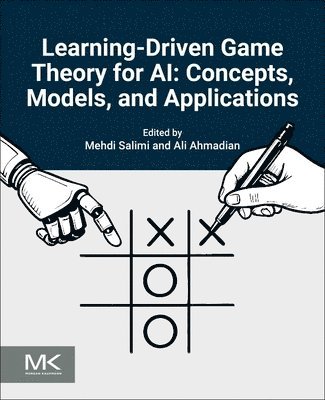
    Learning-Driven Game Theory for AI

    Concepts, Models, and Applications

    AvMehdi Salimi,Ali Ahmadian

    Häftad, Engelska, 2026

    1 829 kr

    Beställningsvara. Skickas inom 10-15 vardagar. Fri frakt över 249 kr.

    Beskrivning

    Learning-Driven Game Theory for AI: Concepts, Models, and Applications offers in-depth coverage of recent methodological and conceptual advancements in various disciplines of Dynamic Games, namely differential and discrete-time dynamic games, evolutionary games, repeated and stochastic games, and their applications in a variety of fields, such as computer science, biology, economics, and management science. In this book, the authors bridge the gap between traditional game theory and its modern applications in artificial intelligence (AI) and related technological fields. The dynamic nature of contemporary problems in robotics, cybersecurity, machine learning, and multi-agent systems requires game-theoretic solutions that go beyond classical methods. The book delves into the rapidly growing intersection of pursuit differential games and AI, focusing on how these advanced game-theoretic models can be applied to modern AI systems, making it an indispensable resource for both academics and professionals. The book also provides a variety of applications demonstrating the practical integration of AI and game theory across various disciplines, such as autonomous systems, federated learning, and distributed decision-making frameworks. The book also explores the use of game theory in reinforcement learning, swarm intelligence, multi-agent coordination, and cybersecurity. These are critical areas where AI and dynamic games converge. Each chapter covers a different facet of dynamic games, offering readers a comprehensive yet focused exploration of topics such as differential and discrete-time games, evolutionary dynamics, and repeated and stochastic games. The absence of static games ensures a concentrated focus on the dynamic, evolving problems that are most relevant today.

    • Offers comprehensive coverage of advanced games while focusing on cutting-edge AI applications
    • Includes case studies that illustrate the application of game theory in AI-driven fields like reinforcement learning, swarm intelligence, and cybersecurity
    • Provides readers with a practical focus, combined with the inclusion of emerging methodologies like learning-based approaches to pursuit-evasion games
    • Equips readers with tools and frameworks to tackle the complex, dynamic challenges in their fields

    Produktinformation

    • Utgivningsdatum:2026-01-15
    • Mått:216 x 276 x undefined mm
    • Vikt:450 g
    • Format:Häftad
    • Språk:Engelska
    • Antal sidor:268
    • Förlag:Elsevier Science
    • ISBN:9780443438523

    Utforska kategorier

    • Programmeringsböcker inom Data och IT
    • Artificiell intelligens inom Data och IT
    • Systemvetenskap och AI inom Data och IT

    Mer om författaren

    Dr. Mehdi Salimi is an accomplished faculty member with a diverse academic background, having held positions at several Canadian universities, including KPU, StFX, and McMaster University. He earned his Ph.D. in applied mathematics from UPM in 2011 and previously obtained a master's degree in pure mathematics from Tehran, Iran, in 2006. Dr. Salimi has served as a visiting professor at UniRC and a research fellow at the MEDAlics Research Centre at the University "Dante Alighieri" in Italy. He completed a postdoctoral fellowship at the Center for Dynamics (CfD) at Dresden University of Technology, Germany, in January 2015 and is now a senior member of the faculty there. Additionally, he is part of the Decisions Lab at DiGiES, University of Reggio Calabria, Italy. Dr. Salimi has published around 80 articles, showcasing his expertise in Game Theory, Dynamical Systems, and Data Science. His contributions extend to editorial roles in several prestigious journals, reflecting his commitment to advancing scientific knowledge and fostering academic dialogue in his fields of interest. Moreover, Dr. Salimi has made valuable contributions as an editorial member of esteemed journals, including Mathematical Methods of Operations Research, Journal of Optimization Theory and Applications, Annals of Operations Research, Soft Computing, Dynamic Games and Applications, Results in Control and Optimization, Engineering Science and Technology an International Journal, Mathematics, and Sustainable Computing: Informatics and Systems. Dr. Ali Ahmadian is a senior research scientist the Mediterranea University of Reggio Calabria, Italy and an Associate Fellow Researcher at the Institute of IR 4.0, The National University of Malaysia. As an active researcher, he is dedicated to research in applied mathematics. He received his Ph.D. in early of 2014 as the best postgraduate student from Universiti Putra Malaysia (UPM). After his Ph.D. He took a postdoctoral fellowship at same university as part of the numerical analysis research group and at the same time joint to the University of Malaya as an Associate Researcher. He was promoted as a Fellow Researcher on December 2017 in UPM. In 2019, he joined the National University of Malaysia as a senior lecturer where he currently works in the Institute of IR 4.0. In general, his primary mathematical focus is the development of computational methods and models for problems arising in computer science, biology, physics, and engineering under fuzzy and fractional calculus (FC); in this context, he has worked on projects related to nano-communication networks, drug delivery systems, acid hydrolysis in palm oil frond, and carbon nanotubes dynamics, nanofluids, viscosity, AI and etc. He is a member of editorial board in Sustainable Computing: Informatics and Systems, Soft Computing, Journal of control and Decision, Progress in Fractional Differentiation and Applications (Natural Sciences Publishing) and Mathematical Problems in Engineering (Hindawi) and lead guest editor of special issues in more than 50 international journals from Elsevier, Springer, Wiley and so on. He is an author of more than 350 research papers published in as Nature, IEEE, Elsevier, Springer, Wiley and etc. He is an author and editor of four books published and in process in CRC Press and Elsevier, respectively. He also presented his research works in 38 international conferences held in Canada, Serbia, China, Turkey, Malaysia and UAE. He also received Premio Anassilaos Giovani Award for his achievement in art, culture, economics and science from Italy in November 2021.

    Innehållsförteckning

    • Foundations and Applications of Game Theory1. Applications of Game Theory in Artificial Intelligence: A Review2. Applications of Game Theory in Climate Change Studies: A Review3. A Review on the Applications of Game Theory in Environmental Health4. Applications of game theory in renewable energy studies: A review5. Tourist-resident interactions in evolutionary games: tourism and sustainability6. Exploring the Evolution and Impact of Learning-Driven Game Theory for AI: A Bibliometric AnalysisGame Theory in Learning and AI Systems7. Evolutionary Game Dynamics of Learning in Neural Networks Through Replicator Equations8. Game-Based Ensemble Learning for Classifying Multi-Class Problems9. Fair Incentive Allocation in Vertical Federated Learning Using NucleolusGame Theory and Explainability in AI10. Several Perspectives on Explainable AI in Medicine: Game Theory Integrated Learning11. Inverse Game Theory for Preference Learning in Generative AI Systems: A Computational Complexity Framework12. MYerson Additive Explanations on Graphs (MYER): Advancement of Explainable Artificial Intelligence Using a Graphical ApproachMathematical Models and Adaptive Algorithms13. Integrating Game-Theoretic Learning with AI for Lung Cancer Diagnosis and Risk Prediction14. Truth as Geometry: A Topological Approach to Logic, Uncertainty, and AI Reasoning15. Pursuit–Evasion Differential Games with Gronwall-Type Constraints: A Theoretical Study16. Optimal pursuit time in a linear differential game with a Gronwall-type constraint17. Pursuit-Evasion Game under Lawden-Type Constraints18. Guaranteed Pursuit Time of a Linear Pursuit Differential Game with a Mixed Constraints on Players’ Control Functions19. Adaptive Control of Opinion Dynamics on a Social Network with a Principal20. An Enhanced K-Means Clustering Approach: NBK-means Algorithm